Fission, Fusion & Binding Energy
One graph explains why splitting uranium releases energy, why fusing hydrogen releases energy, and why you can't get useful energy from splitting iron or fusing lead. It's a single curve — binding energy per nucleon against nucleon number — and this lesson builds from reading it correctly.
Mass defect and binding energy
The mass of a nucleus is always slightly less than the sum of the masses of its individual, separated protons and neutrons. This missing mass is the mass defect, $\Delta m$:
where $Z$ is the number of protons (each of mass $m_p$), $N$ is the number of neutrons (each of mass $m_n$), and $m_{\text{nucleus}}$ is the actual measured mass of the nucleus. By mass–energy equivalence, this missing mass corresponds to an energy, $\Delta E = \Delta m \, c^2$, called the binding energy of the nucleus: the energy needed to completely separate it into individual, widely-spaced protons and neutrons, or equivalently, the energy released when separate nucleons come together to form it.
It can feel backwards that a nucleus with less mass than its parts is more stable — but this follows from energy conservation. Bringing nucleons together and binding them releases energy (the strong nuclear force does work pulling them in), and by $E=mc^2$ that energy comes from a reduction in the system's total rest mass. A larger mass defect means more energy was released forming the nucleus, so it's more tightly bound and more stable.
Worked example: binding energy from mass defect
Binding energy per nucleon
Total binding energy isn't a fair way to compare nuclear stability, since a nucleus with more nucleons naturally has a larger total, just from having more parts. The fair comparison is binding energy per nucleon, $\dfrac{\Delta E}{A}$ — the average binding energy per nucleon. A higher value means each nucleon is more tightly bound, and the nucleus more stable.
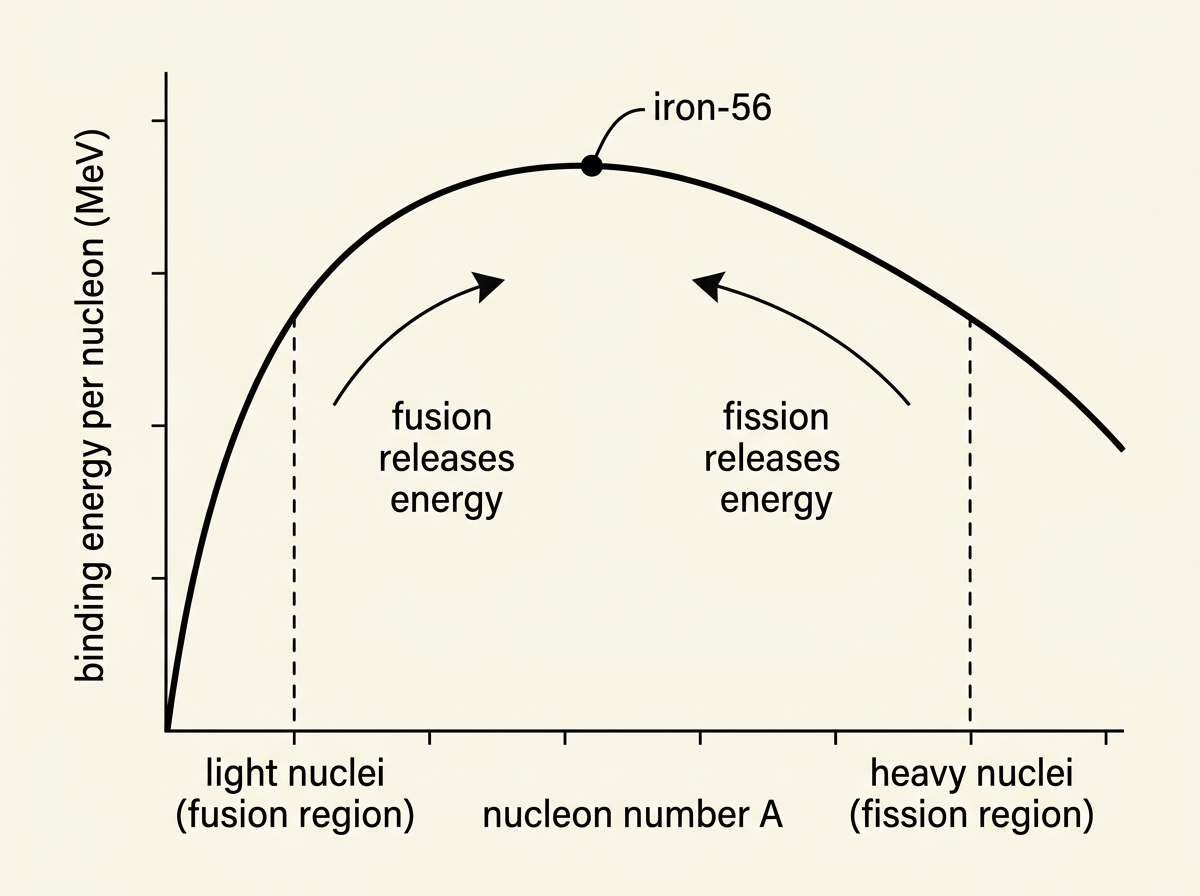
The curve rises steeply for the lightest nuclei, reaches a broad maximum around iron-56 ($A\approx56$, binding energy per nucleon of about $8.8\,\text{MeV}$ — the most tightly-bound, most stable nuclide), then falls away slowly for heavier nuclei. This shape explains both fission and fusion releasing energy.
Whether a nuclear process releases energy depends on one thing: does it move the nucleons to a higher position on this curve? Fusion combines two light nuclei (from the steep, low-$A$ end) into one heavier nucleus, moving up the steep slope toward the peak — a large increase in binding energy per nucleon, and a large release of energy. Fission splits one heavy nucleus (from the high-$A$ end) into two lighter fragments, each sitting further up the gently falling slope — again an increase, though smaller per nucleon, and again a release of energy. Both work because they move nucleons toward iron-56 — which is why you can't release energy fusing nuclei already heavier than iron, or splitting nuclei already lighter than iron: either would move nucleons "downhill," requiring energy input rather than releasing it.
Fission and chain reactions
Nuclear fission is the splitting of a heavy nucleus (such as uranium-235) into two lighter daughter nuclei, usually triggered by absorbing a slow-moving ("thermal") neutron, and typically releasing two or three additional free neutrons plus a large amount of energy:
where $X$ and $Y$ are the fission fragments and $k$ (typically 2 or 3) is the number of neutrons released. Since each fission event releases more neutrons than it absorbs, those neutrons can trigger fission in further uranium-235 nuclei, each releasing further neutrons in turn — a chain reaction.
Whether a chain reaction sustains itself, dies out, or grows uncontrollably depends on criticality: how many neutrons from one fission event, on average, cause a further fission. Exactly one neutron per fission causing one further fission is critical — self-sustaining at a constant rate, the controlled condition inside a nuclear reactor. Fewer than one (too many neutrons escape or are absorbed without causing fission) is sub-critical and dies out. More than one is super-critical, and the fission rate grows rapidly — the uncontrolled condition behind a fission weapon's explosive release.
Fusion and the conditions needed to sustain it
Nuclear fusion combines two light nuclei into a single heavier nucleus, releasing energy because the product sits higher on the binding-energy-per-nucleon curve. The Sun, and stars generally, are powered by fusing hydrogen into helium.
Fusion is difficult to achieve and sustain, anywhere, because two positively-charged nuclei repel each other electrostatically as they approach, and this repulsion must be overcome before the short-range strong nuclear force can bind them together. Overcoming it requires the nuclei to collide at extremely high speed, meaning the fuel must be raised to an extremely high temperature (of order $10^7$–$10^8\,\text{K}$) so a usable fraction of collisions get close enough to fuse. High pressure (or density) is also needed so collisions happen often enough to sustain a useful reaction rate.
Sustaining these conditions — millions of degrees, at high density, for long enough to release net energy — is an extraordinarily difficult engineering challenge: no solid container can withstand contact with fuel this hot, so the superheated plasma must be confined without touching a physical wall, typically using strong magnetic fields. This is why controlled, net-energy-positive fusion, unlike fission, hasn't yet been achieved as a viable commercial power source, even though the underlying physics is just as well understood.
Key takeaways
- Mass defect $\Delta m$ (separated nucleon mass minus actual nuclear mass) converts to binding energy via $\Delta E = \Delta m\,c^2$ — the energy needed to fully separate a nucleus into individual nucleons.
- Binding energy per nucleon, not total binding energy, measures nuclear stability fairly; plotted against nucleon number it peaks at iron-56 (~8.8 MeV per nucleon), the most stable nuclide.
- Both fusion (light nuclei combining) and fission (heavy nuclei splitting) release energy because both move nucleons to a higher position on the binding-energy curve, closer to iron-56.
- A fission chain reaction is sustained when released neutrons trigger further fission; criticality (exactly one neutron per fission causing a further fission, on average) gives a controlled, constant-rate reaction, as used in a power-station reactor.
- Fusion requires extremely high temperature and pressure/density to overcome electrostatic repulsion between nuclei and sustain a useful reaction rate — conditions that make controlled fusion power very difficult to achieve on Earth, unlike fission.