Charged Particles in Magnetic Fields
A current is just a stream of moving charge, so the same force that pushes a current-carrying wire sideways pushes a single moving charged particle too — but a free particle isn't clamped in place. Left free to move, that sideways force bends it into a circle, and this lesson is about that circle: how fast it turns, how big it is, and how it's used to pick out particles of a chosen speed.
Force on a moving charge
A current is a flow of charge, so it's no surprise that the motor-effect force on a current-carrying wire, $F=BIL\sin\theta$, has an equivalent for a single moving charge. A charge $Q$ moving at speed $v$ takes time $t=L/v$ to cross a length $L$, carrying an equivalent current $I=Q/t=Qv/L$. Substituting into $F=BIL\sin\theta$:
where $v$ is the particle's speed and $\theta$ is the angle between its velocity and the field. As before, the force is maximum when velocity and field are perpendicular ($F=BQv$) and zero when they're parallel.
Direction still comes from Fleming's left-hand rule, with velocity taking the place of current — First finger = Field, seCond finger = velocity (conventional current direction), thuMb = Force. For a negative charge, the force is reversed, since its motion corresponds to a conventional current in the opposite direction.
Circular motion in a magnetic field
This force has a property that makes it very different from the force on a wire clamped in place: it always acts perpendicular to the particle's velocity, whatever direction that velocity happens to be pointing. A force perpendicular to velocity does no work — it can't speed the particle up or slow it down — but it does change the direction of motion. That's exactly what a centripetal force does, and a magnetic force perpendicular to $v$ is precisely that: the particle moves at constant speed on a circular path, with the magnetic force supplying the centripetal force.
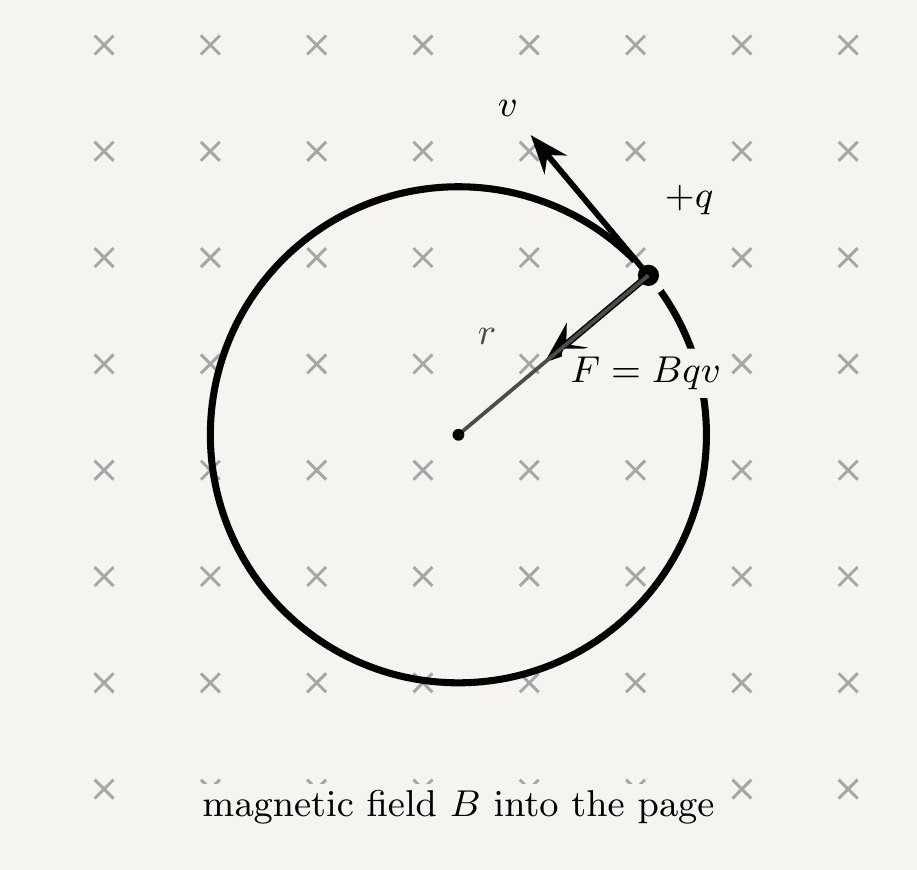
Faster particles, or more massive ones, sweep out larger circles; a stronger field or a larger charge pulls the circle tighter. This is the working principle behind bending and focusing charged-particle beams in accelerators and detectors — the radius of curvature in a known field reveals the particle's momentum.
Period and frequency of the circular motion
The time for one full revolution is the circumference divided by the speed, $T=\dfrac{2\pi r}{v}$. Substituting $r=mv/(BQ)$:
Notice $v$ cancels out of $T$ entirely — every particle of the same charge-to-mass ratio takes the same time to complete a full circle, however fast it's moving. Faster particles just trace bigger circles in that same time. This is the principle behind the cyclotron: a particle accelerator that can use a fixed-frequency alternating field to keep accelerating a particle, since the particle's orbital frequency stays constant even as its speed (and orbit radius) grows.
Velocity selector: crossed electric and magnetic fields
A charged particle moving through both an electric field and a magnetic field, arranged perpendicular to each other and to its velocity, feels two forces at once: an electric force $QE$ and a magnetic force $BQv$. If these two forces are arranged to point in opposite directions, they cancel exactly for one particular speed, letting that speed pass through undeflected while all others are deflected away:
A narrow slit placed after the fields then only lets through particles travelling at $v=E/B$, whatever their mass or charge — this velocity selector is a standard way of producing a beam of particles with a single, known speed, for use in further experiments.
Key takeaways
- Force on a moving charge: $F=BQv\sin\theta$, derived from $F=BIL\sin\theta$ by treating the moving charge as an equivalent current; direction from Fleming's left-hand rule (velocity in place of current), reversed for negative charges.
- Since this force is always perpendicular to velocity, it does no work and acts as a centripetal force, giving circular motion at constant speed.
- Radius of the circular path: $r=\dfrac{mv}{BQ}$ — larger for faster or more massive particles, smaller for a stronger field or larger charge.
- Period and frequency: $T=\dfrac{2\pi m}{BQ}$, $f=\dfrac{BQ}{2\pi m}$ — independent of speed, the principle behind the fixed-frequency cyclotron.
- A velocity selector uses balanced electric and magnetic forces ($QE=BQv$) to let through only particles travelling at $v=E/B$, whatever their mass or charge.