Gravitational Potential
Why does every formula for gravitational energy in this topic come out negative? It isn't a sign error — it's a deliberate convention that turns out to be the cleanest way to describe an attractive force that never quite lets go. Once you see why zero is placed at infinity, escape velocity drops out in three lines of algebra.
Defining gravitational potential
The gravitational potential $V$ at a point in a gravitational field is the work done per unit mass to bring a small test mass from infinity to that point. If a mass $M$ sets up the field, the potential at a distance $r$ from its centre is:
where $G = 6.67\times10^{-11}\,\text{N m}^2\text{kg}^{-2}$ is the gravitational constant, $M$ the mass creating the field, and $r$ the distance from its centre. Potential is measured in joules per kilogram (J kg−1), and — like field strength — it's a property of the field itself at that point, not of whatever test mass is brought into it. Put a test mass $m$ at a point where the potential is $V$, and its gravitational potential energy is:
Notice both quantities are negative for every finite value of $r$. This follows directly from how the zero point of potential is defined.
Gravitational potential is defined to be zero at infinity, by convention — infinity is chosen because that's where the gravitational influence of $M$ becomes negligible. Since gravity is attractive, moving a test mass from infinity to any finite distance $r$ means letting it fall inward: the field does positive work on the mass as it approaches, or equivalently the mass loses potential energy getting closer. This is the opposite of climbing a hill away from Earth's surface, which requires positive work in.
Now run the argument the other way. Escaping from a finite $r$ out to infinity requires energy input — positive work against gravity the whole way out. If reaching infinity from any closer point always costs energy, and infinity is the zero of potential, every closer point must sit at a lower potential than that zero — negative. The negative sign isn't a problem; it's telling you this location is a well you'd have to climb out of to reach the zero level at infinity.
How potential varies with distance
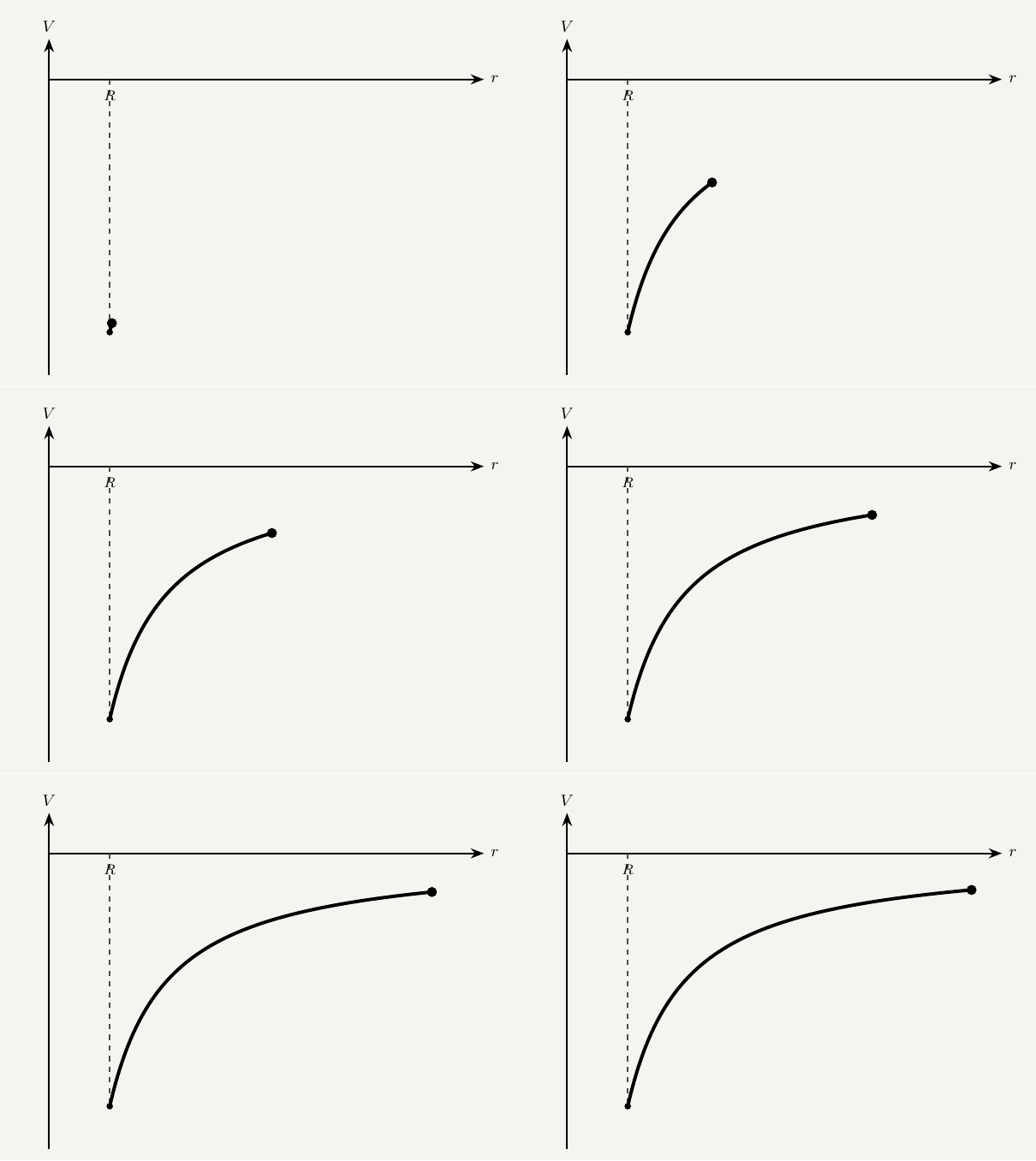
Because $V = -GM/r$, potential increases (becomes less negative) as $r$ increases — climbing out of the well, getting closer to the zero level at infinity — and decreases (more negative) as $r$ decreases. As $r\to\infty$, $V\to 0$ from below, but $V$ never reaches zero at any finite distance and never becomes positive: zero only in the limit of infinite separation, negative everywhere else.
Plotting $V$ against $r$ gives a curve that starts very negative and steep close to the mass, rises quickly at first, then flattens and creeps asymptotically toward zero at large $r$, always staying at or below the zero line. This shape is called a potential well, the same basic shape met again for the electric potential around a point charge — though there it can also sit above zero for a negative charge.
Finding ΔV graphically: area under a g–r graph
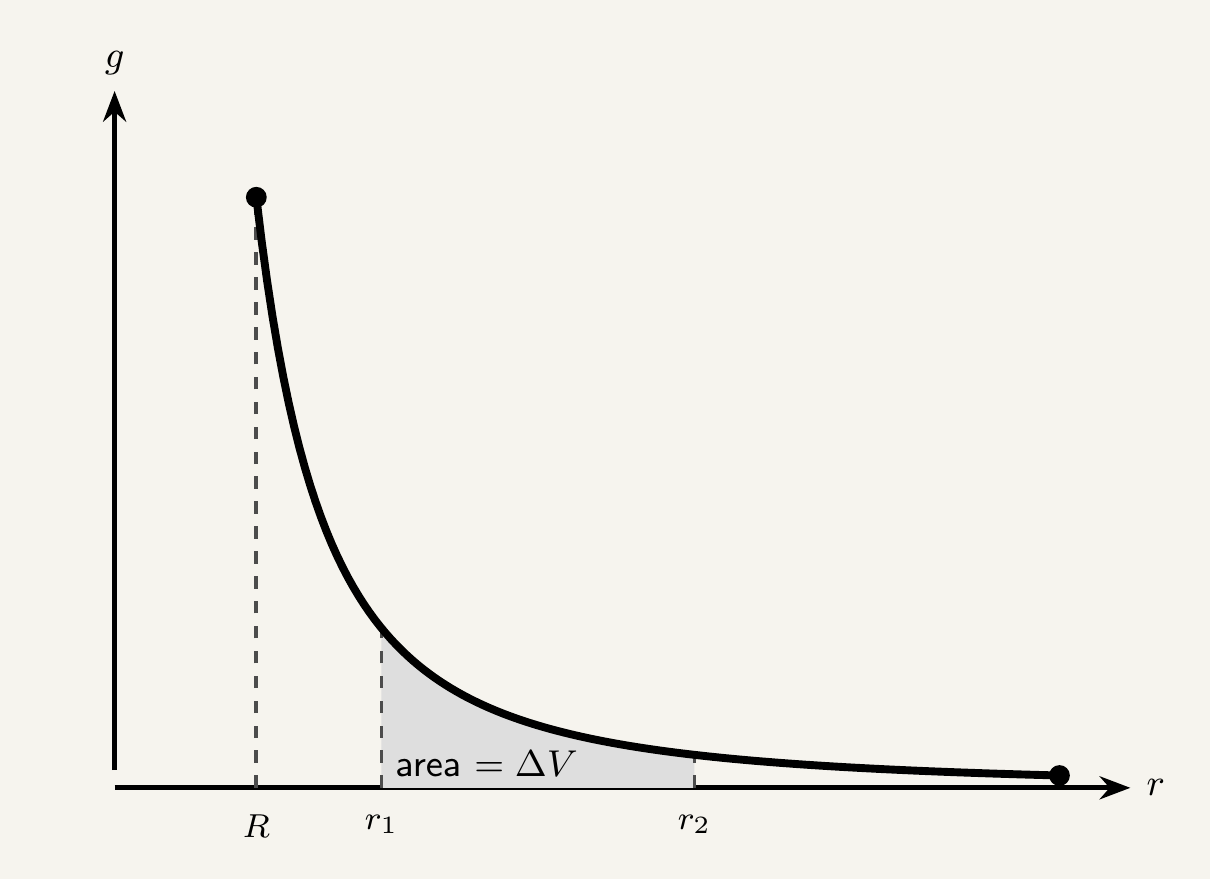
Field strength and potential are linked by more than a shared source: since $V=-GM/r$, differentiating with respect to $r$ gives $\dfrac{dV}{dr}=\dfrac{GM}{r^2}=g$ — field strength is simply the rate at which potential changes with distance. Rearranging and integrating both sides between two radii $r_1$ and $r_2$ turns this into a statement about area:
The integral on the left is exactly the area under a graph of $g$ against $r$, between $r_1$ and $r_2$. So the shaded area under a $g$–$r$ graph, between any two values of $r$, gives the change in potential between those points — directly analogous to how the area under a force–extension graph gives work done, or the area under a velocity–time graph gives displacement.
Lines of equipotential
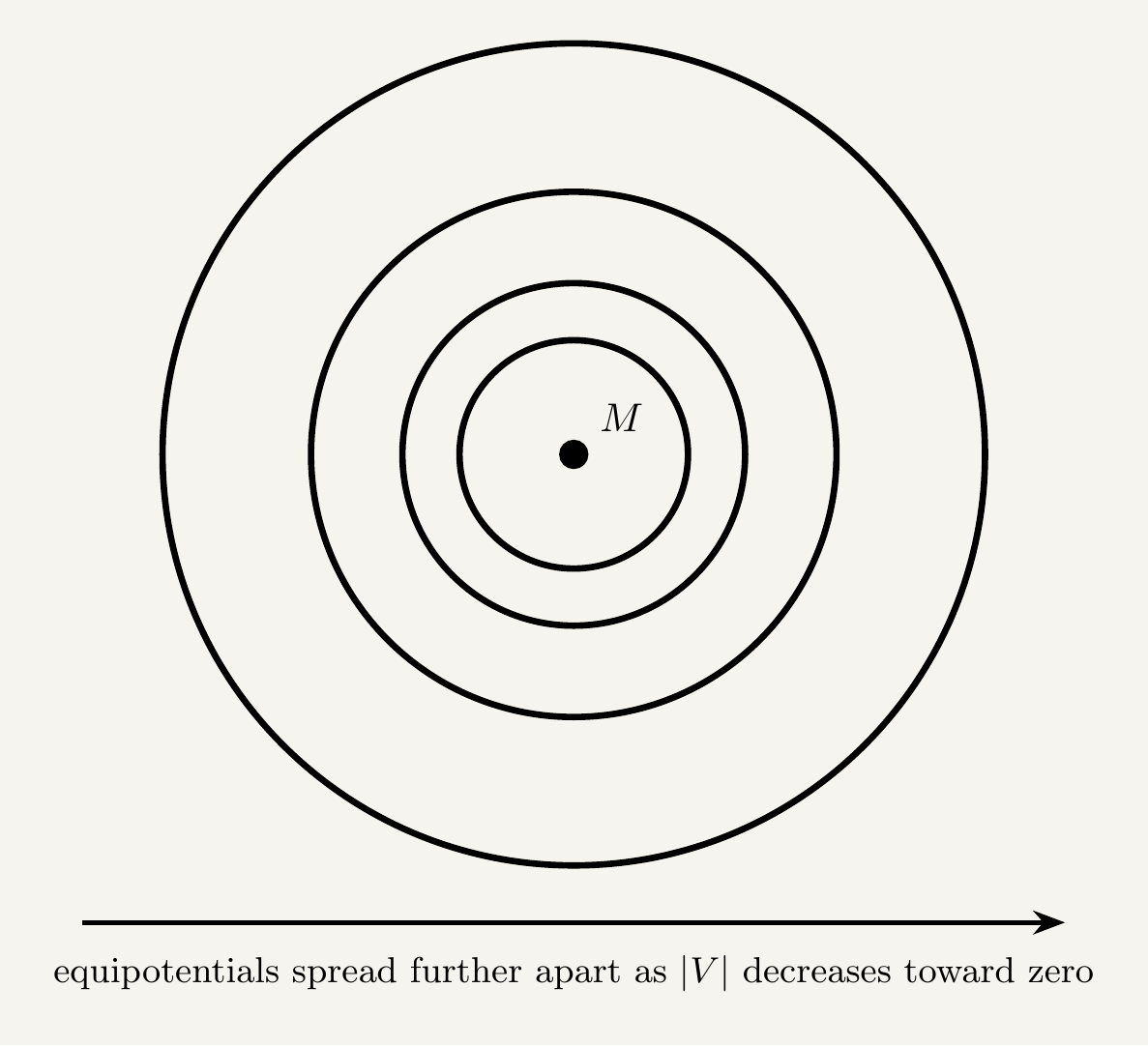
Because $V$ depends only on distance $r$ from the mass, every point at a given radius shares the same potential — join all such points together and you get a gravitational equipotential: a surface (a sphere, for a point or spherical mass; a circle in cross-section, as drawn below) joining every location at equal potential. No work is done moving a test mass along an equipotential, since $V$ — and so the energy per unit mass — doesn't change along it; all the "climbing" happens when moving between equipotentials, not along one.
Because $V=-GM/r$ flattens out at large $r$, equal steps in potential correspond to equipotentials that are bunched close together near the mass and spread progressively further apart with increasing distance — the same steepen-near, flatten-far shape seen in the $V$–$r$ graph above, now viewed as a set of contour-like surfaces rather than a single curve. A contour map is a useful physical analogy: each contour line joins points of equal height, hence equal gravitational potential, and the closely-packed contours of a steep hillside correspond to the closely-packed equipotentials near a mass.
It's tempting to think a "bigger" potential means a stronger pull, but potential and field strength answer different questions. Field strength $g = -GM/r^2$ is the force per unit mass — how hard something is pulled at that point. Potential $V = -GM/r$ is the energy per unit mass needed to have got there from infinity. Both are negative here for the same underlying reason (gravity is attractive, zero set at infinity), but they scale differently with $r$ — field strength falls off as $1/r^2$, potential only as $1/r$.
Escape velocity
One of the most useful applications of gravitational potential is finding the minimum speed an object needs to escape a planet's gravity entirely, without further propulsion once launched. The key idea is energy conservation: an object has just barely escaped if it reaches infinity with exactly zero kinetic energy left, having used up all its initial kinetic energy climbing out of the potential well, with nothing left over and nothing missing.
This is the minimum speed needed, launched from radius $r$ (typically the surface of the body), to escape that body's gravity completely and never fall back — ignoring atmospheric drag and further thrust after launch. Launch slower than $v_{\text{esc}}$ and the object eventually falls back (assuming no orbit); launch at or above $v_{\text{esc}}$ and it keeps moving outward forever, arriving at infinity with zero speed (exactly $v_{\text{esc}}$) or some leftover speed (faster).
Worked example: escape velocity from Earth's surface
Take Earth's mass as $M = 5.97\times10^{24}\,\text{kg}$ and radius as $r = 6.37\times10^6\,\text{m}$. Substituting into $v_{\text{esc}} = \sqrt{2GM/r}$:
That's about $11.2\,\text{km s}^{-1}$ — roughly 40,000 km/h. This is why leaving Earth's gravity for good is such a demanding engineering problem: a rocket has to reach over eleven kilometres every second before coasting away without further thrust, which is why real spacecraft rely on multiple stages and careful trajectory design rather than a single burn from the surface.
Key takeaways
- Gravitational potential $V = -\dfrac{GM}{r}$ is the work done per unit mass to bring a test mass from infinity to a point, measured in J kg−1.
- Potential is defined to be zero at infinity by convention; because gravity is attractive, every finite point has lower (negative) potential than infinity.
- $V$ increases (becomes less negative) as $r$ increases, and decreases (more negative) as $r$ decreases, approaching zero asymptotically as $r\to\infty$ — the "potential well" shape.
- Gravitational potential energy of a mass $m$ at that point is $E_p = mV = -\dfrac{GMm}{r}$, negative for the same reason as $V$.
- Escape velocity $v_{\text{esc}} = \sqrt{\dfrac{2GM}{r}}$ comes from setting total mechanical energy to zero — the borderline condition for reaching infinity with zero speed left over. It's independent of the escaping object's own mass.
- Earth's escape velocity works out to roughly $11.2\,\text{km s}^{-1}$, using $M = 5.97\times10^{24}\,\text{kg}$ and $r = 6.37\times10^6\,\text{m}$.