Gravitational Field Strength
You already know "g" is roughly 9.81 in your falling-object equations — but what is it actually a measurement of, and why does it take a slightly different value on a mountain top than at sea level? Gravitational field strength turns "how strong gravity is here" into a precise, defined quantity, and reveals the constant $g$ from AS level was really just a local approximation all along.
Defining field strength
Gravitational field strength, $g$, at a point in space is defined as the gravitational force exerted per unit mass on a small test mass placed at that point:
where $F$ is the gravitational force acting on a test mass $m$ placed at that point. Field strength is measured in newtons per kilogram (N kg−1), which — since $F=ma$ rearranges to the same combination of units — is exactly equivalent to metres per second squared (m s−2), the units $g$ was quoted in from AS mechanics.
Gravitational field strength is a vector quantity: it has both magnitude and direction, the direction a small test mass would accelerate if released — always toward whatever is creating the field, since gravity is attractive. "9.81 N kg−1 downward" carries genuinely more information than just "9.81 N kg−1".
The test mass $m$ in $g=F/m$ is imagined small enough that it doesn't disturb the field it's measuring (small enough that its own gravitational pull on the source mass is negligible). Its job is purely to reveal what the field is doing at that point; the value of $g$ calculated must not depend on which test mass was used.
Field strength around a point (or spherical) mass
For a point mass $M$ — or, using the point-mass approximation for spheres from the previous lesson, any uniform spherical mass $M$ at a point outside its surface — the field strength at distance $r$ from its centre follows from combining Newton's law of gravitation with the definition of $g$ above.
This is a genuinely important structural point: $g=GM/r^2$ describes the field created by $M$, existing at every point in space around it, whether or not a test mass happens to be sitting there. The field is a property of the source; a test mass placed within it simply reveals, and never alters, the value of $g$ already present.
The shape of the field: radial field lines
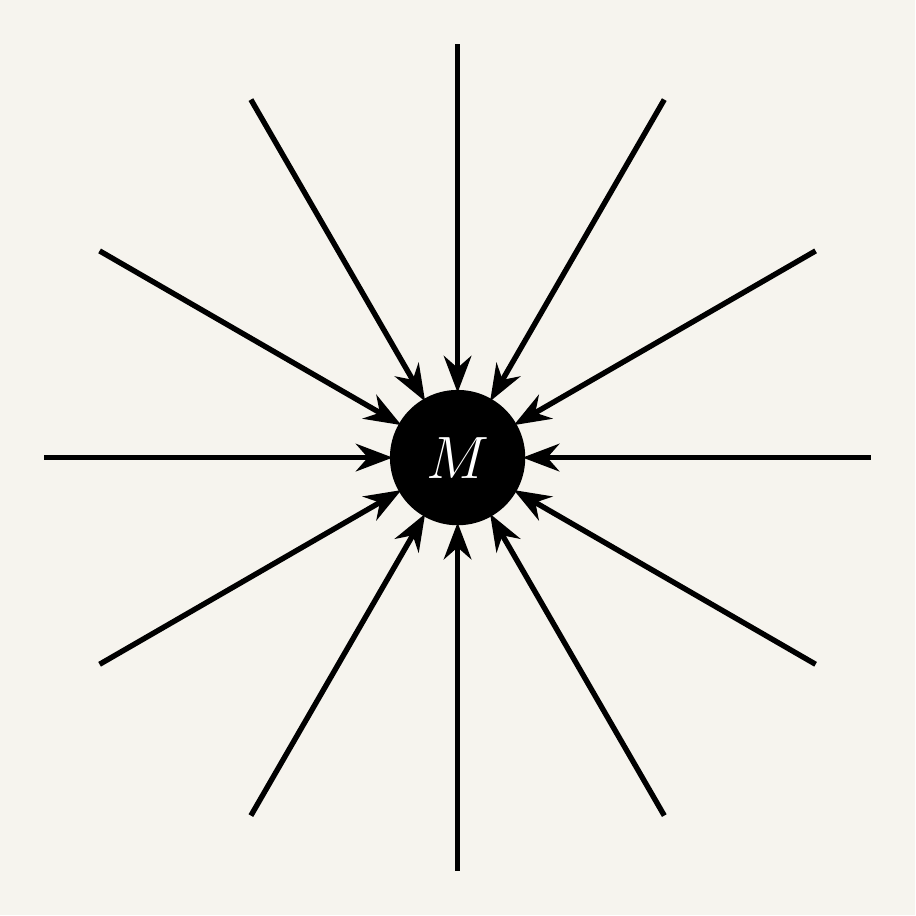
Around a point mass (or a spherical mass, viewed from outside), the gravitational field is radial: field lines run in straight lines directly toward the centre of the mass from every direction. Because gravity is always attractive, every field line points inward, never outward — there's no source of gravitational field lines the way a positive charge sources outward electric field lines, only "sinks".
The spacing of the field lines carries information about strength: closer together near the mass, where $g$ is large, and further apart at greater distances, where $g$ is smaller — directly reflecting the inverse-square fall-off of $g=GM/r^2$.
The uniform-field approximation near Earth's surface
Strictly, the Earth's gravitational field is radial, like any spherical mass's — field lines converge on the Earth's centre, and $g$ technically varies very slightly with height. But over the height ranges met in a school lab, or even everyday life — a few hundred metres at most, compared with the Earth's radius of about 6,400 km — the curvature of those field lines is utterly imperceptible. Over such a small patch of a truly enormous sphere, the field lines are, to an excellent approximation, straight, parallel and evenly spaced, pointing straight down.
This is the uniform field approximation, implicitly used throughout AS mechanics whenever $g$ was treated as a constant 9.81 N kg−1 (or m s−2) — a single fixed value at every height, with a single fixed "downward" direction. That assumption isn't wrong; it's a local approximation to the true radial field, valid only because the distances involved are small compared with the Earth's radius, so $r$ in $g=GM/r^2$ barely changes.
Zoom in close enough to any part of a radial field and it looks locally uniform — the same idea as a small enough patch of the (spherical) Earth's surface looking locally flat. Use the uniform-field, constant-$g$ model for problems confined near the Earth's surface (projectile motion, free fall in a lab). Switch to the full radial-field model $g=GM/r^2$ as soon as a problem involves a significant change in distance from the Earth's centre — satellites, orbits, or a genuinely different altitude.
Why g decreases with height
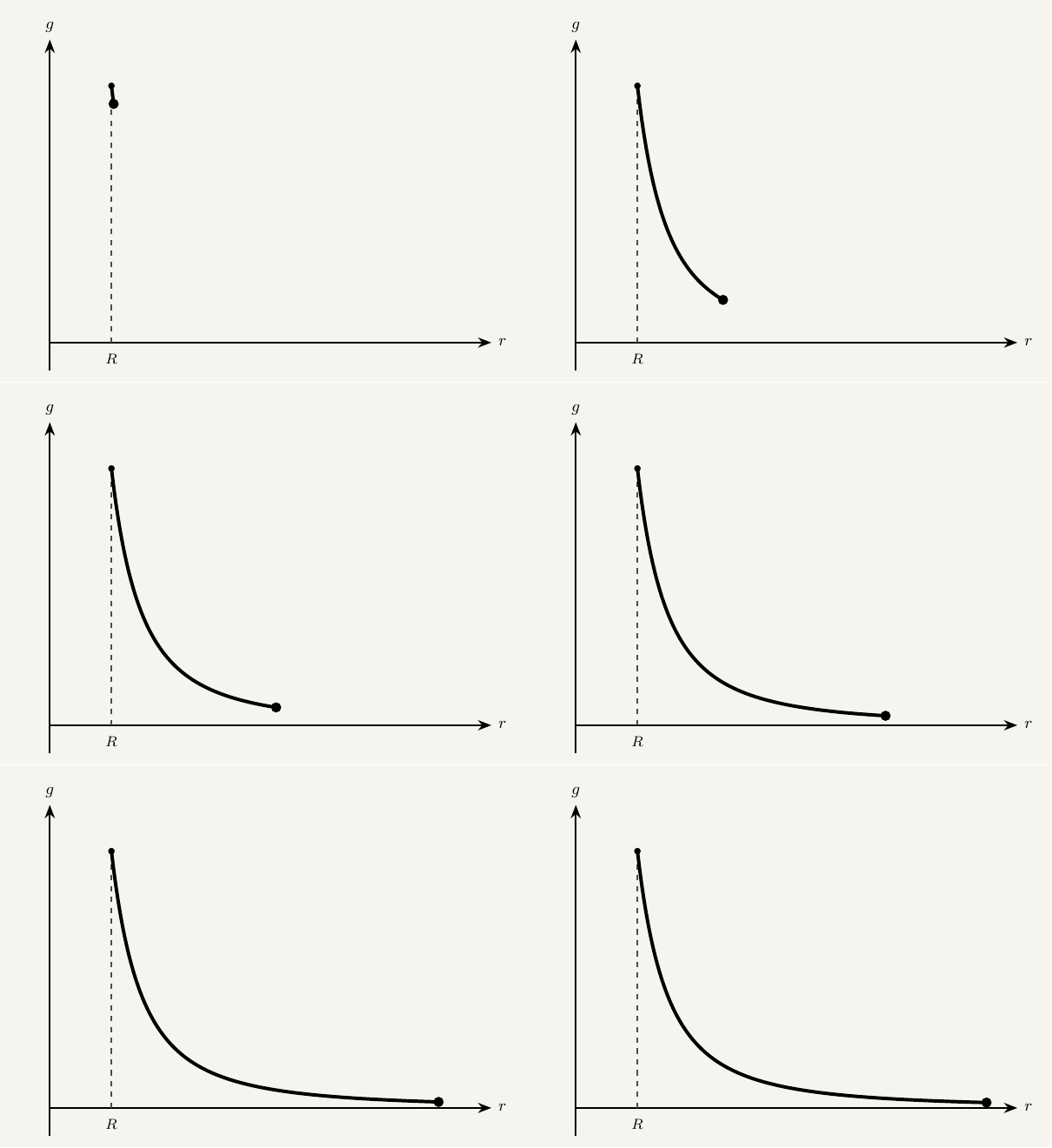
Because $g=\dfrac{GM}{r^2}$, and $r$ is measured from the centre of the Earth, climbing to greater height increases $r$, and an increased $r$ means a decreased $g$, following the same inverse-square reasoning met with force in the previous lesson. Fly high enough — to the altitude of the ISS, for instance — and the change in $r$ is no longer negligible compared with the Earth's radius, so $g$ drops by an amount that matters, even though it never reaches zero at any finite height.
The same logic explains a smaller, subtler effect: $g$ at sea level also varies slightly with latitude, mostly because the Earth isn't a perfect sphere — it bulges slightly at the equator and is flattened at the poles, so the equator sits marginally further from the Earth's centre, giving a marginally smaller $g$ there. This is a minor effect, but a nice illustration that $g=GM/r^2$ genuinely tracks distance from the centre, not just "height above ground."
Worked example: g at Earth's surface, and at the ISS
Given the mass of the Earth, $M = 5.97\times10^{24}\,\text{kg}$, and its mean radius, $R = 6.37\times10^{6}\,\text{m}$, find $g$ at the Earth's surface, and again at the altitude of the International Space Station, roughly 400 km above the surface.
Key takeaways
- Gravitational field strength $g = F/m$ is the force per unit mass on a small test mass at a point (N kg−1, equivalent to m s−2) — a vector, pointing in the direction a test mass would accelerate.
- For a point mass or a uniform sphere (viewed from outside), $g = \dfrac{GM}{r^2}$ — derived by dividing Newton's law of gravitation $F=GMm/r^2$ by the test mass $m$, which then cancels out.
- Because $m$ cancels, $g$ is a property of the source mass $M$ and distance $r$ alone — it doesn't depend on whatever test mass is used to measure it.
- Field lines around a point or spherical mass are radial, always pointing inward, and denser close to the mass where the field is stronger.
- Near the Earth's surface, over small height ranges, the field is very nearly uniform and $g\approx9.81\,\text{N kg}^{-1}$ — the constant-$g$ assumption from AS level is a local approximation to the true radial field.
- $g$ decreases with distance from Earth's centre following the inverse-square law — about 11% lower at ISS altitude (~400 km up) than at the surface — and varies very slightly with latitude due to the Earth's non-spherical shape.