Electric Potential
Moving a charge through an electric field generally takes work. This lesson introduces electric potential — the quantity that measures how much work is needed to bring a charge to a point — along with the equipotential surfaces that map out where a charge can move freely, without any work being done at all.
Electric potential and potential energy
Moving a charge through an electric field generally takes work — pushing a positive charge closer to another positive charge, against the repulsive force, requires energy input. This is captured by electric potential energy; the quantity used to measure it per unit charge is electric potential, $V$, defined at a point as the work done per unit positive charge bringing a test charge from infinity (zero potential) to that point.
Potential is a scalar (unlike field strength), measured in volts (V), where $1\,\text{V} = 1\,\text{J C}^{-1}$. The work done moving a charge $Q$ between two points at different potentials follows directly:
where $\Delta V$ is the potential difference between start and end points — the same equation used to define the volt at AS for circuits, now applied to motion through a field.
Field strength $E$ is force per unit charge — how hard the field pushes. Potential $V$ is potential energy per unit charge — how much work is needed to bring a charge there from infinity. They're connected (field strength is the rate at which potential changes with distance) but answer different questions, with different units (N C⁻¹, equivalently V m⁻¹, for $E$; volts for $V$). A region can have large potential but zero field strength, or vice versa.
How potential varies with distance
Around an isolated point charge $Q$, the potential at a distance $r$ from it is:
where $\varepsilon_0$ is the permittivity of free space. For a positive charge, $V$ is positive everywhere and falls away with distance: greatest right next to the charge, dropping quickly at first, then more gradually, creeping toward zero as $r\to\infty$ but never quite reaching it at any finite distance. For a negative charge, the same shape appears reflected below zero, since $Q$ is negative.
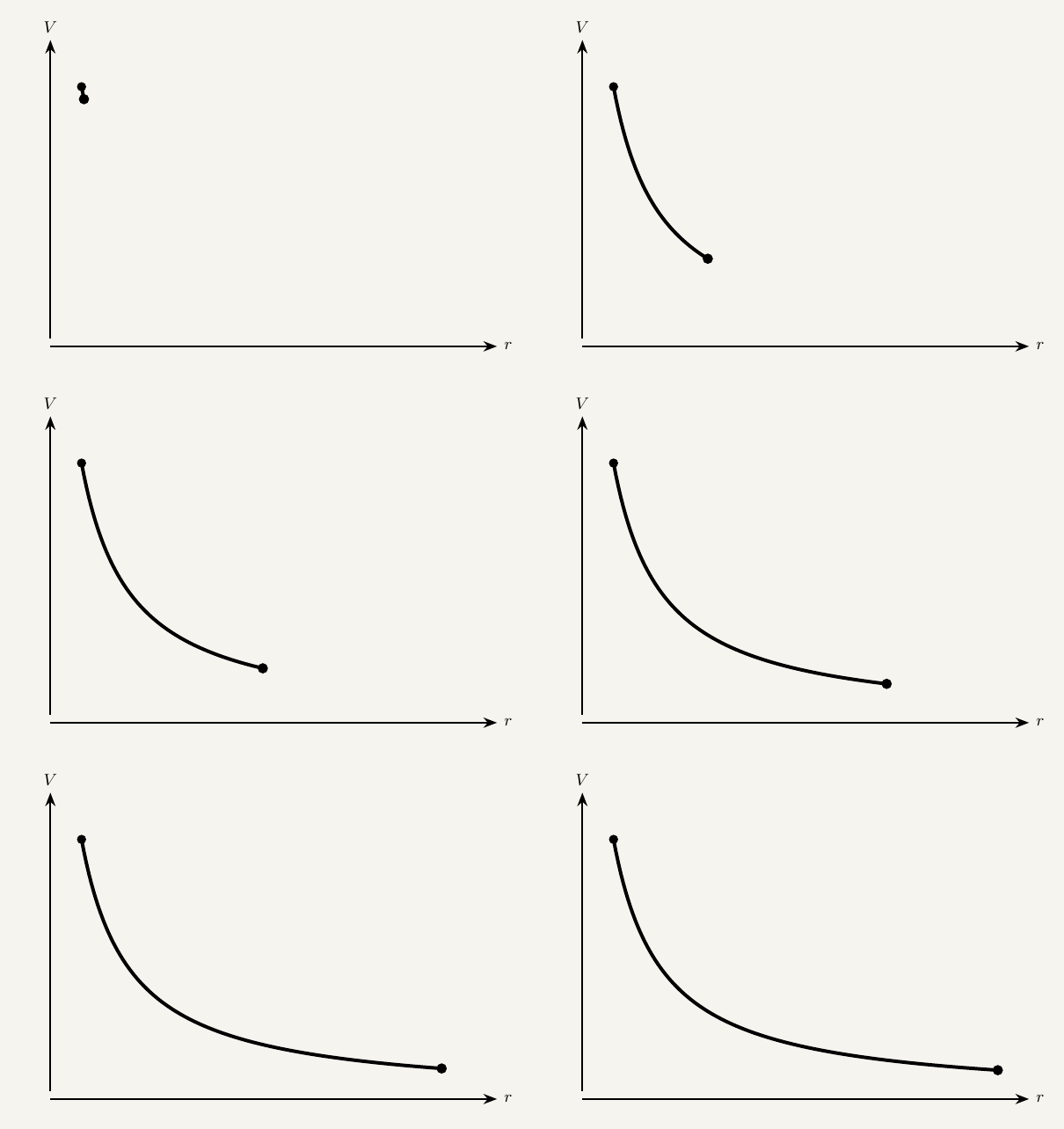
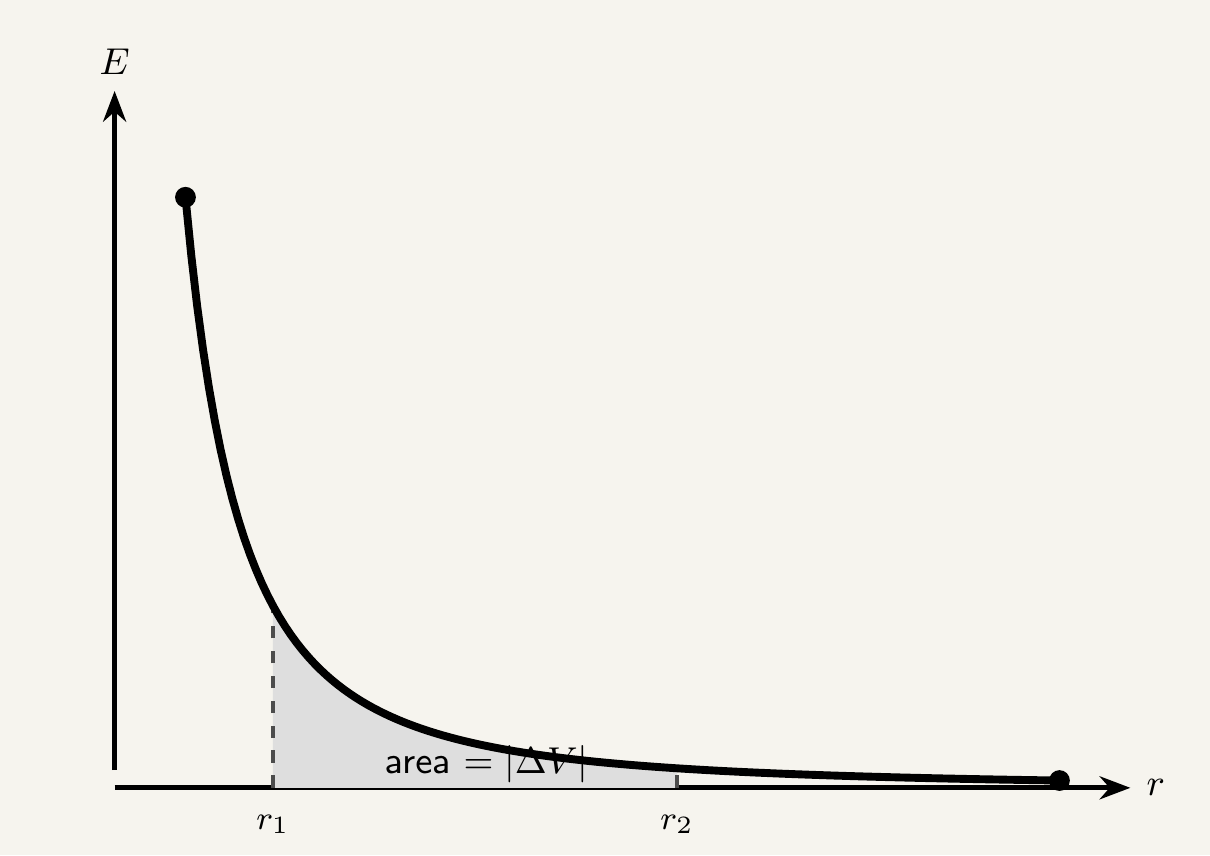
Finding $|\Delta V|$ graphically: area under an E–r graph
Field strength and potential are linked by more than a shared source charge: since $V=\dfrac{Q}{4\pi\varepsilon_0 r}$ decreases as $r$ increases, its rate of change is negative, and it's this rate of change (with a sign flip) that gives the field strength: $E=-\dfrac{dV}{dr}$. Rearranging and integrating both sides between two radii $r_1$ and $r_2$ turns this into a statement about area:
The integral on the left is exactly the area under a graph of $E$ against $r$, between $r_1$ and $r_2$. So the shaded area under an $E$–$r$ graph, between any two values of $r$, gives the size of the change in potential between those points, $|\Delta V|$ — directly analogous to how the area under a force–extension graph gives work done, or the area under a velocity–time graph gives displacement. The magnitude sign matters here: unlike the gravitational case, $E$ (always plotted as a positive quantity) and the sign of $\Delta V$ point the same way in size but not necessarily in sign, so the area gives $|\Delta V|$ rather than a signed $\Delta V$.
Equipotentials
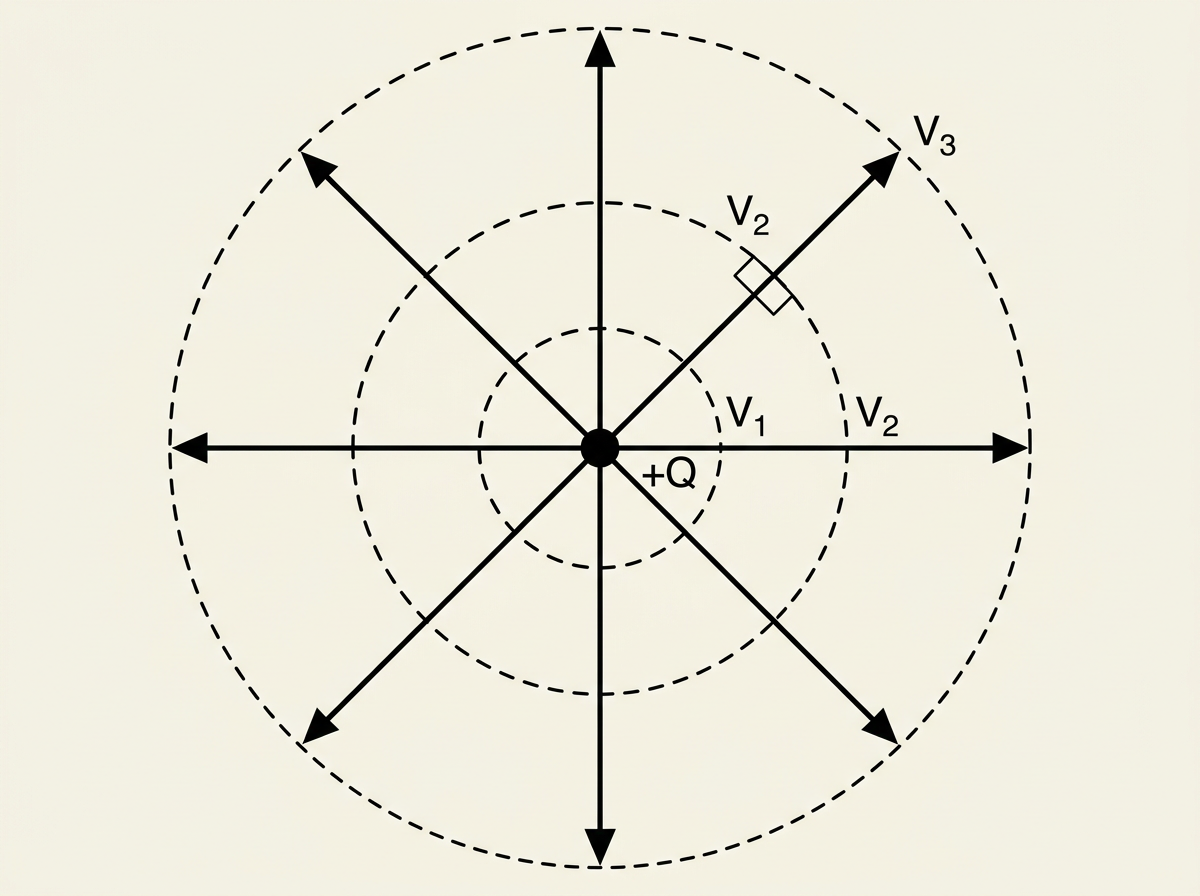
An equipotential surface (or line, in 2D) joins points in a field sharing the same potential. Around an isolated point charge, equipotentials are concentric spheres (circles in cross-section) centred on the charge, since every point at radius $r$ has the same potential. Between parallel plates, equipotentials are flat planes running parallel to the plates.
Two properties of equipotentials are common exam points:
- No work is done moving a charge along an equipotential. Every point on the surface is at the same potential, so $\Delta V=0$ and $W=Q\Delta V=0$ regardless of path. Work is only done moving between different equipotentials — i.e. in the direction of the field.
- Field lines always cross equipotentials at right angles. If a field line had any component along an equipotential, moving a charge along it would do work with no change in potential — a contradiction. So field lines and equipotentials are always mutually perpendicular, just as contour lines on a map are perpendicular to the direction of steepest slope.
Key takeaways
- Electric potential $V$ is the work done per unit charge bringing a test charge from infinity to a point; work done moving a charge $Q$ through a potential difference $\Delta V$ is $W=Q\Delta V$.
- Around a point charge, $V=\dfrac{Q}{4\pi\varepsilon_0 r}$ — positive and falling toward zero with distance for a positive charge, negative and rising toward zero for a negative charge.
- Field strength and potential are related but distinct: one measures force per unit charge, the other measures energy per unit charge.
- Equipotentials join points of equal potential (concentric spheres for a point charge, parallel planes between plates); no work is done moving along one, and field lines always cross them at right angles.