Electric Field Strength
Every charged object is surrounded by a region of influence that can push or pull on any other charge that strays into it, without touching it. That region is an electric field, and this lesson gives you the first of two quantities used to describe it precisely: field strength — how hard the field pushes at a given point, whether around a point charge or between parallel plates.
Electric field strength
An electric field exists in any region of space where a charged object experiences a force. The strength of that field at a point is defined as the force per unit positive charge that would be experienced by a small "test charge" placed there:
where $F$ is the force on the test charge $Q$. Electric field strength is a vector, with units of newtons per coulomb (N C⁻¹) — equivalently volts per metre (V m⁻¹). Its direction is the direction of the force on a small positive test charge placed there — a convention that fixes which way field-line arrows point.
Field lines
Field lines visualise an electric field: the direction of the line shows the field's direction, and how closely spaced the lines are shows relative strength — densely packed means strong, widely spaced means weak.
The radial field of a point charge
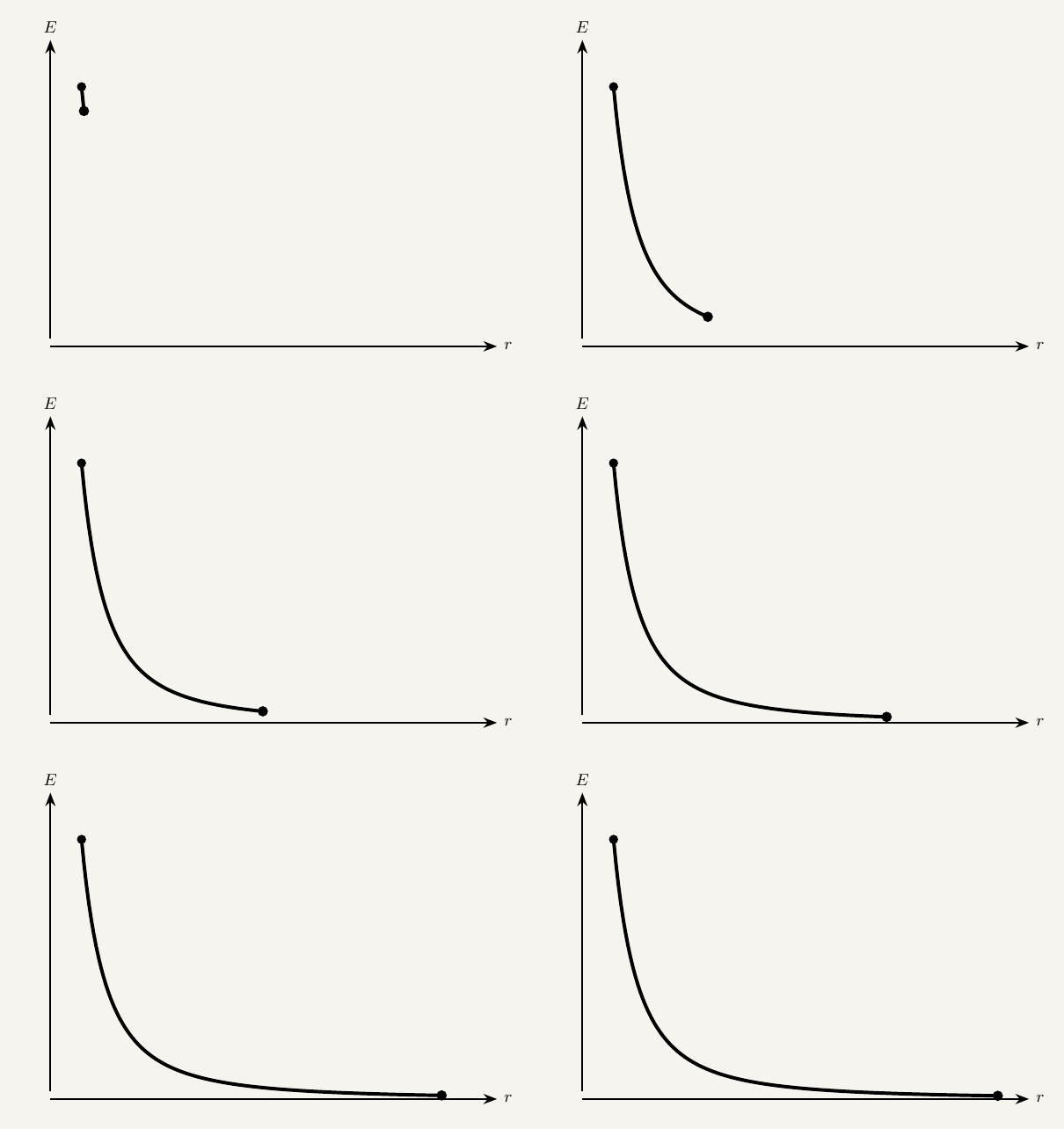
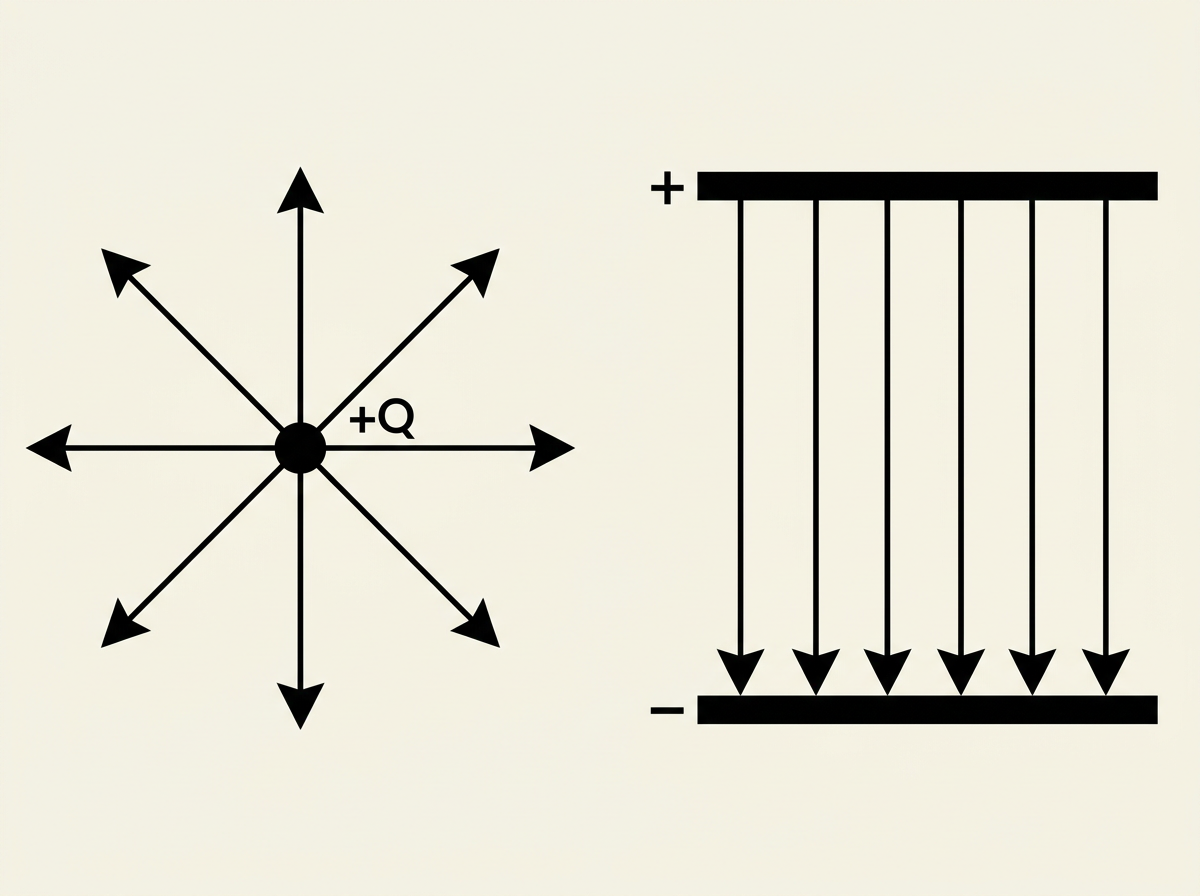
Around an isolated point charge, field lines radiate straight outward (positive) or inward (negative), evenly in all directions. Since the same total number of lines passes through an ever-larger sphere with distance, the lines become progressively less densely packed — the field weakens with distance, following an inverse-square law:
where $Q$ is the charge creating the field, $r$ is the distance from it, and $\varepsilon_0$ is the permittivity of free space. This is derived properly from Coulomb's law in the next lesson — for now, notice the shape it produces: $E$ falls away sharply close to the charge and flattens out at larger $r$, exactly the inverse-square pattern traced below.
The uniform field between parallel plates
Between two flat, oppositely charged parallel plates a fixed distance apart, field lines run straight from positive to negative, parallel and evenly spaced — except near the edges, where the field "fringes". Since the lines are evenly spaced in the central region, field strength there is the same everywhere: a uniform field. This is the standard practical arrangement (a capacitor, or a cathode-ray tube) for a field of known, constant strength.
For the uniform field between parallel plates, the field strength has a particularly simple formula in terms of the potential difference between the plates and their separation:
where $V$ is the potential difference between the plates and $d$ is their separation. This only holds for a uniform field — not for the radial field around a point charge, where $E$ varies with distance.
$E=F/Q$ is the universal definition of electric field strength — it works everywhere, for any field shape. $E=V/d$ is a special-case formula that only holds for a uniform field, such as between parallel plates. Using $E=V/d$ for a radial point-charge field, or forgetting that $E=F/Q$ always applies regardless of geometry, is one of the most common exam slips in this topic.
Key takeaways
- Electric field strength is defined as $E=F/Q$, a vector with units N C⁻¹ (equivalently V m⁻¹), pointing in the direction of the force on a positive test charge.
- Around a point charge, the field is radial and $E=\dfrac{Q}{4\pi\varepsilon_0 r^2}$ — an inverse-square fall-off, greatest close to the charge and approaching but never reaching zero at large $r$.
- Field lines show direction (arrow) and relative strength (spacing) — radial and thinning with distance for a point charge, straight and evenly spaced for the uniform field between parallel plates.
- For a uniform field only, $E=\dfrac{V}{d}$, linking field strength to potential difference and plate separation — this does not apply to the radial field around a point charge.