Charging Capacitors
Charging a capacitor through a resistor is the mirror image of discharging: instead of dying away, charge, potential difference and current all creep toward a final value, fastest at the start and ever more slowly thereafter, without quite reaching it. The same time constant that governed discharge governs charging too.
Charging through a resistor
Connect an uncharged capacitor in series with a resistor and a fixed-voltage supply, and charge begins to build on the plates. As charge $Q$ builds up, the potential difference $V=Q/C$ across the capacitor rises toward the supply e.m.f. $\varepsilon$, which shrinks the potential difference driving current round the resistor and so reduces the charging current — so, just as in discharge, the rate of charging continuously slows. This produces a rising exponential: charge and potential difference climb quickly at first, then level off, approaching their final values ever more slowly but never quite reaching them.
The time constant $\tau=RC$ sets the timescale of charging exactly as it does discharging. Substituting $t=\tau$ into $V=V_0(1-e^{-t/RC})$ gives $V=V_0(1-e^{-1})\approx0.63V_0$ — after one time constant, the capacitor has charged to about 63% of its final value. A capacitor is usually considered practically fully charged after about five time constants, by which point it's within 1% of $V_0$.
Charge and potential difference rise as identically-shaped curves, just rescaled, while current still decays — each graph below is marked at one time constant $\tau=RC$.
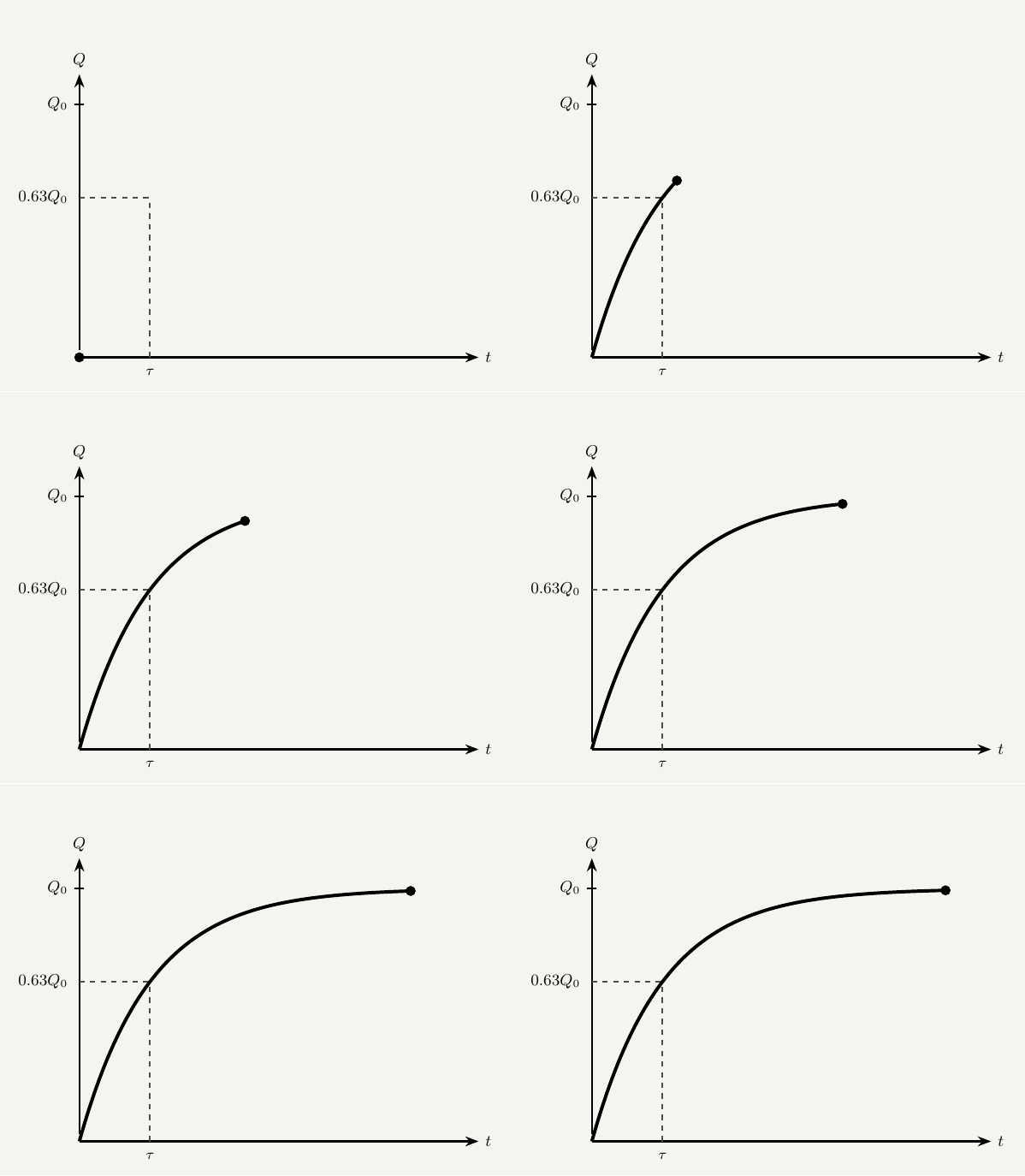
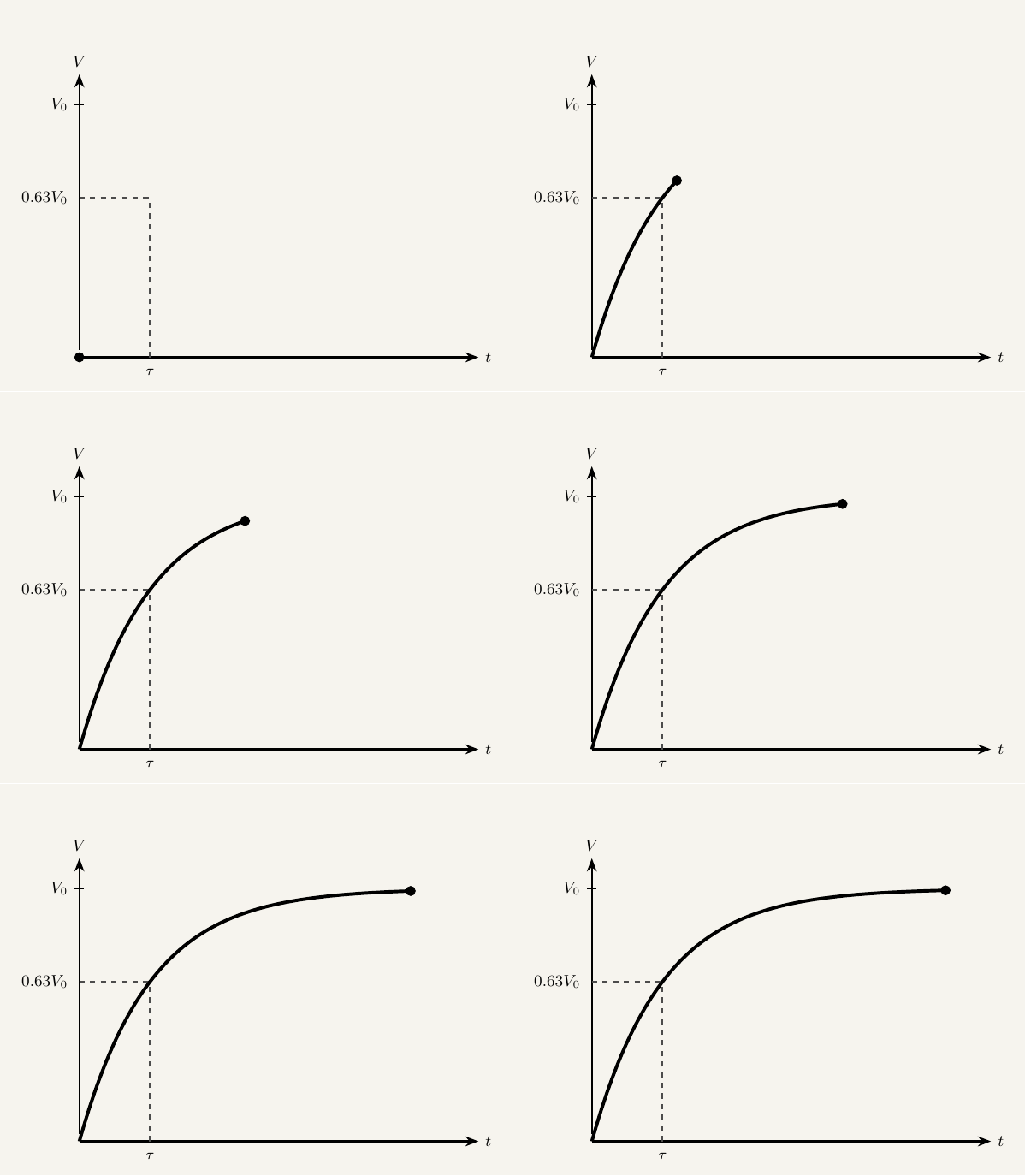
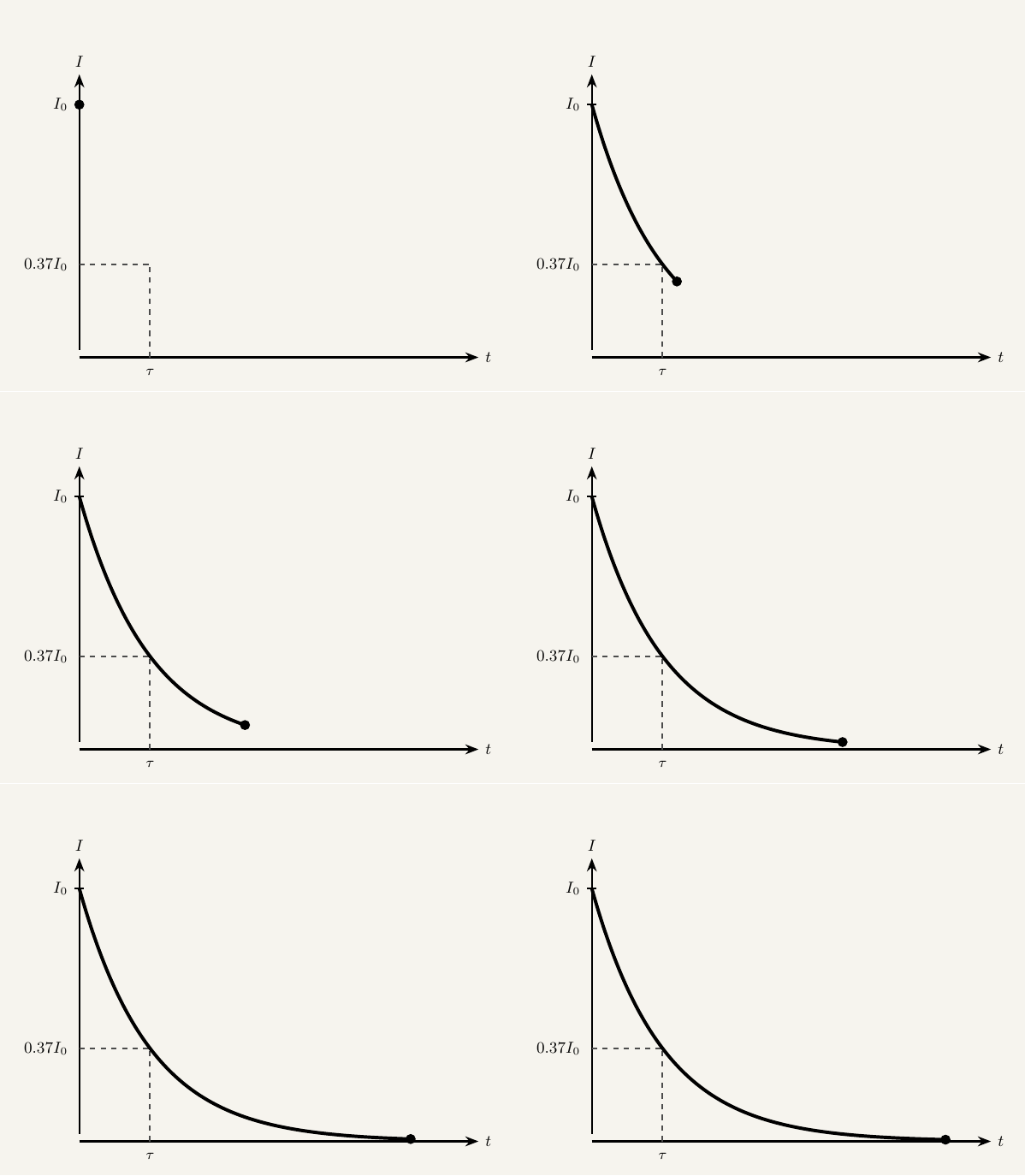
It's easy to assume everything behaves the same way during charging, but the charging current $I=I_0e^{-t/RC}$ is a decaying exponential, identical in shape to discharge current — only $Q$ and $V$ show the rising form. The current is largest at the instant charging begins (when the capacitor has zero opposing p.d.) and falls steadily to zero as the capacitor approaches full charge.
Key takeaways
- Charging: $Q=Q_0(1-e^{-t/RC})$ and $V=V_0(1-e^{-t/RC})$ rise as "rising exponentials", approaching their final values asymptotically but never quite reaching them.
- The charging current still decays exponentially, $I=I_0e^{-t/RC}$ — identical in shape to the discharge current, even though $Q$ and $V$ behave oppositely to discharge.
- The time constant $\tau=RC$ has the same meaning as in discharge: after one time constant, the charging quantity has risen to about 63% of its final value; a capacitor is practically fully charged after about five time constants.
- $Q_0=C\varepsilon$ and $V_0=\varepsilon$, where $\varepsilon$ is the e.m.f. of the supply charging the capacitor.