Wien's Displacement Law
A star's surface temperature is not something you can walk up to and measure with a thermometer — it has to be read off its light. Wien's displacement law is the tool that does exactly this: it turns the single number "where does the spectrum peak?" directly into a temperature in kelvin.
Stating the law
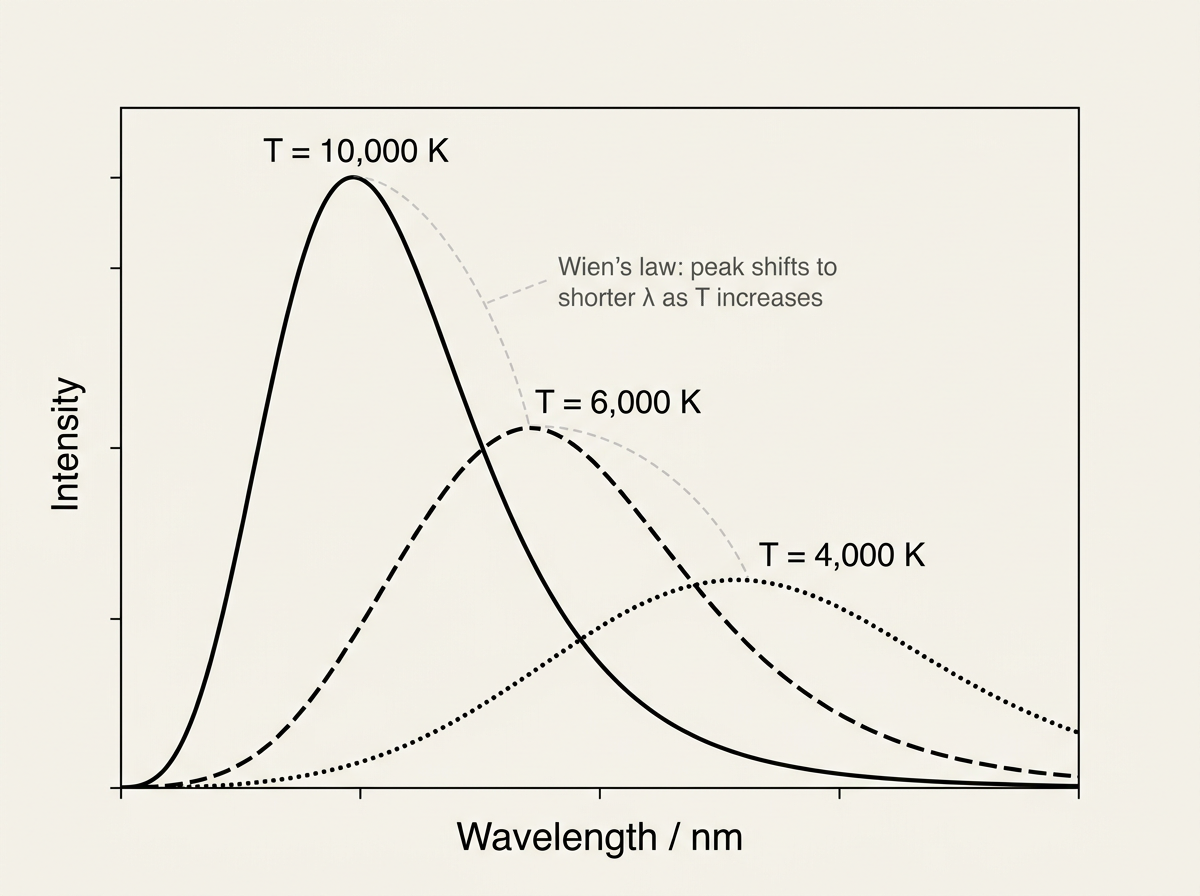
Recall from the previous lesson that a black body's emission curve — intensity plotted against wavelength — has a single peak, and that this peak shifts to shorter wavelengths as temperature increases. Wien's displacement law makes this relationship exact:
Here $\lambda_{max}$ is the wavelength (in metres) at which the black body's emission curve reaches its peak intensity, and $T$ is the black body's surface temperature in kelvin. The product of these two quantities is always the same fixed number, roughly $2.9\times10^{-3}\ \text{m K}$, for any black body radiator, whatever its size or composition.
What "displacement" means here
The law is called a displacement law because it describes how the peak of the curve is displaced (shifted) along the wavelength axis as temperature changes. Since the product $\lambda_{max}T$ is constant, $\lambda_{max}$ and $T$ must be inversely proportional to one another — as one goes up, the other must come down to keep their product fixed.
- A very hot star, with a surface temperature of tens of thousands of kelvin, has its emission peak shifted to short wavelengths — often into the blue or ultraviolet part of the spectrum, giving the star a blue-white appearance.
- A cooler star, with a surface temperature of only a few thousand kelvin, has its emission peak at much longer wavelengths — typically in the red or near-infrared, giving the star a noticeably red or orange appearance.
This is why star colour is such a direct, visual clue to surface temperature: what the eye perceives as "redder" or "bluer" starlight is really a rough read-out of where that star's black-body curve happens to peak.
Using the law to find a temperature
In practice, Wien's law is used the other way round from how it's often first introduced: astronomers record a star's spectrum, identify the wavelength at which its intensity is greatest, and substitute that peak wavelength into the law to calculate the star's surface temperature — all without ever needing to visit the star or measure its temperature directly.
Wien's law lets you determine a star's surface temperature from a single feature of its spectrum — the peak wavelength — without needing to know anything else about the star, such as its distance, size or luminosity. That independence from distance is what makes it such a powerful and widely used tool in stellar classification.
Key takeaways
- Wien's displacement law states $\lambda_{max}T = \text{constant} = 2.9\times10^{-3}\ \text{m K}$, linking a black body's peak emission wavelength to its temperature.
- $\lambda_{max}$ and $T$ are inversely proportional: hotter black bodies peak at shorter wavelengths, cooler ones at longer wavelengths.
- A hot, blue-white star has its emission peak in the blue or ultraviolet; a cool, red star has its peak in the red or infrared.
- In practice, the law is used to find a star's surface temperature from the measured peak wavelength of its spectrum.
- The relationship can be rearranged either way: to find $T$ from a known $\lambda_{max}$, or to predict $\lambda_{max}$ (and hence the star's apparent colour) from a known $T$.
- Determining temperature this way needs no knowledge of the star's distance, size, or total luminosity — only the shape of its spectrum.