Instantaneous rest, greatest velocity, greatest speed — all three are questions about turning points, and calculus finds them the same way it finds any other maximum or minimum.
12 min read3 worked examples
Three different questions, one method
Calculus answers several distinct-sounding questions about motion using the same turning-point technique:
Instantaneous rest: solve $v(t)=0$.
Maximum or minimum displacement: solve $\dfrac{ds}{dt}=v(t)=0$, then classify using $\dfrac{d^2s}{dt^2}$.
Maximum or minimum velocity: solve $\dfrac{dv}{dt}=a(t)=0$, then classify using $\dfrac{d^2v}{dt^2}$.
Classifying a turning point
At a stationary value, a negative second derivative means a maximum and a positive second derivative means a minimum — exactly the same test used for stationary points of any curve.
Worked example 1
Maximum height, with a justified restriction
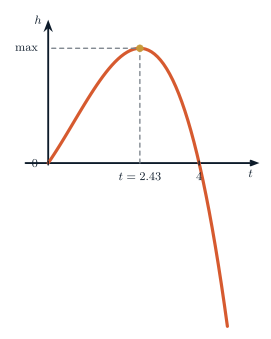
A toy drone rises from the ground and later lands again. Its height above the ground, $h$ metres, at time $t$ seconds is modelled by $h = 2.4t + 0.6t^2 - 0.3t^3$ for $0 \le t \le 4$. a Justify the restriction $0 \le t \le 4$. b Find the maximum height reached, correct to 3 s.f.
MethodFactorise to justify the domain, then differentiate to maximise
a
$h = 0.3t(8+2t-t^2) = 0.3t(4-t)(2+t)$.
Factorise the cubic.
For $00$, $(4-t)>0$ and $(2+t)>0$, so $h>0$ throughout — the drone stays above the ground. At $t=4$, $h=0$: the drone has landed, so the model should not continue past this point.
h must be non-negative, and motion starts at t=0.
b
$\dfrac{dh}{dt} = 2.4+1.2t-0.9t^2$. Setting this to zero: $0.9t^2-1.2t-2.4=0 \Rightarrow 3t^2-4t-8=0$.
Divide through by 0.3, then rearrange to standard form.
$t = \dfrac{4\pm\sqrt{16+96}}{6} = \dfrac{4\pm\sqrt{112}}{6}$. Taking the positive root: $t = 2.4305\ldots$ s.
Quadratic formula; reject the negative root.
$\dfrac{d^2h}{dt^2}=1.2-1.8t$, which is negative at $t=2.4305$, confirming a maximum.
The maximum height occurs at the single turning point inside the valid domain, between $t=0$ and the drone's landing at $t=4$.
Worked example 2
Rest points and maximum velocity
A particle's velocity at time $t$ seconds ($0 \le t \le 8$) is $v = 18t - 3t^2\ \text{m s}^{-1}$. Find the times at which the particle is instantaneously at rest, and its maximum velocity in this interval.
MethodSolve v = 0 for rest, dv/dt = 0 for the turning point of v
1
Instantaneous rest: $18t-3t^2=0 \Rightarrow 3t(6-t)=0$, so $t=0$ or $t=6$.
Factorise and solve.
2
$\dfrac{dv}{dt}=18-6t$. Setting this to zero: $t=3$.
A turning point of v occurs where a = 0.
3
$\dfrac{d^2v}{dt^2}=-6<0$, so $t=3$ gives a maximum.
Second derivative test.
4
$v(3) = 18(3)-3(9) = 54-27=27\ \text{m s}^{-1}$.
Substitute t = 3.
▪ solved
Worked example 3
Greatest speed — don't forget the endpointsChallenge
A particle's velocity at time $t$ seconds ($0 \le t \le 7$) is $v = t^2 - 8t + 12\ \text{m s}^{-1}$. Find the greatest speed of the particle in this interval.
MethodFind the interior turning point, then check both endpoints too
1
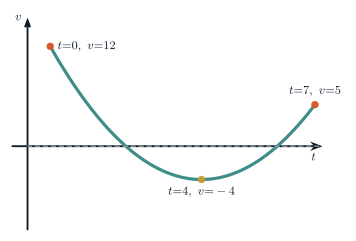
$\dfrac{dv}{dt}=2t-8=0 \Rightarrow t=4$. Since $\dfrac{d^2v}{dt^2}=2>0$, this is a minimum of $v$: $v(4)=16-32+12=-4\ \text{m s}^{-1}$.
The only interior turning point.
2
Check the endpoints too: $v(0)=12\ \text{m s}^{-1}$ and $v(7)=49-56+12=5\ \text{m s}^{-1}$.
The greatest speed can occur at either end of a closed interval.
3
Speeds at the three candidate points: $|12|=12$, $|-4|=4$, $|5|=5$. The greatest is $12\ \text{m s}^{-1}$, occurring at $t=0$.
Compare magnitudes, not signed velocities.
▪ solved
The interior turning point is not always the answer
The minimum of $v$ occurs at $t=4$, but that is a minimum of velocity, not the greatest speed. The greatest speed here actually occurs at the very start of the interval, $t=0$ — always check both endpoints of a closed interval, not just the interior stationary point.
The interior turning point at $t=4$ gives the smallest velocity, but the largest speed in the interval is actually at the endpoint $t=0$.
Common mistake
Reporting the interior stationary value of $v$ as the "greatest speed" without checking the endpoints of the given interval. On a closed interval $[0,T]$, the greatest speed can occur at $t=0$, at $t=T$, or at an interior point where $v=0$ or $a=0$ — all candidates must be compared. Confusing "greatest velocity" (a signed quantity, can be negative) with "greatest speed" (always non-negative, $|v|$) is the other frequent error.
Check yourself
A particle's velocity at time $t$ seconds ($0 \le t \le 6$) is $v = 10t - 2t^2\ \text{m s}^{-1}$. Find the times at which the particle is instantaneously at rest, and its maximum velocity in this interval, justifying that it is a maximum. (Hint: solve v = 0, then dv/dt = 0, and classify with the second derivative.)
$10t-2t^2=0 \Rightarrow 2t(5-t)=0$, so the particle is at rest at $t=0$ and $t=5$.
$\dfrac{dv}{dt}=10-4t=0$ at $t=2.5$, and $\dfrac{d^2v}{dt^2}=-4<0$, confirming a maximum. $v(2.5)=25-12.5=12.5\ \text{m s}^{-1}$.