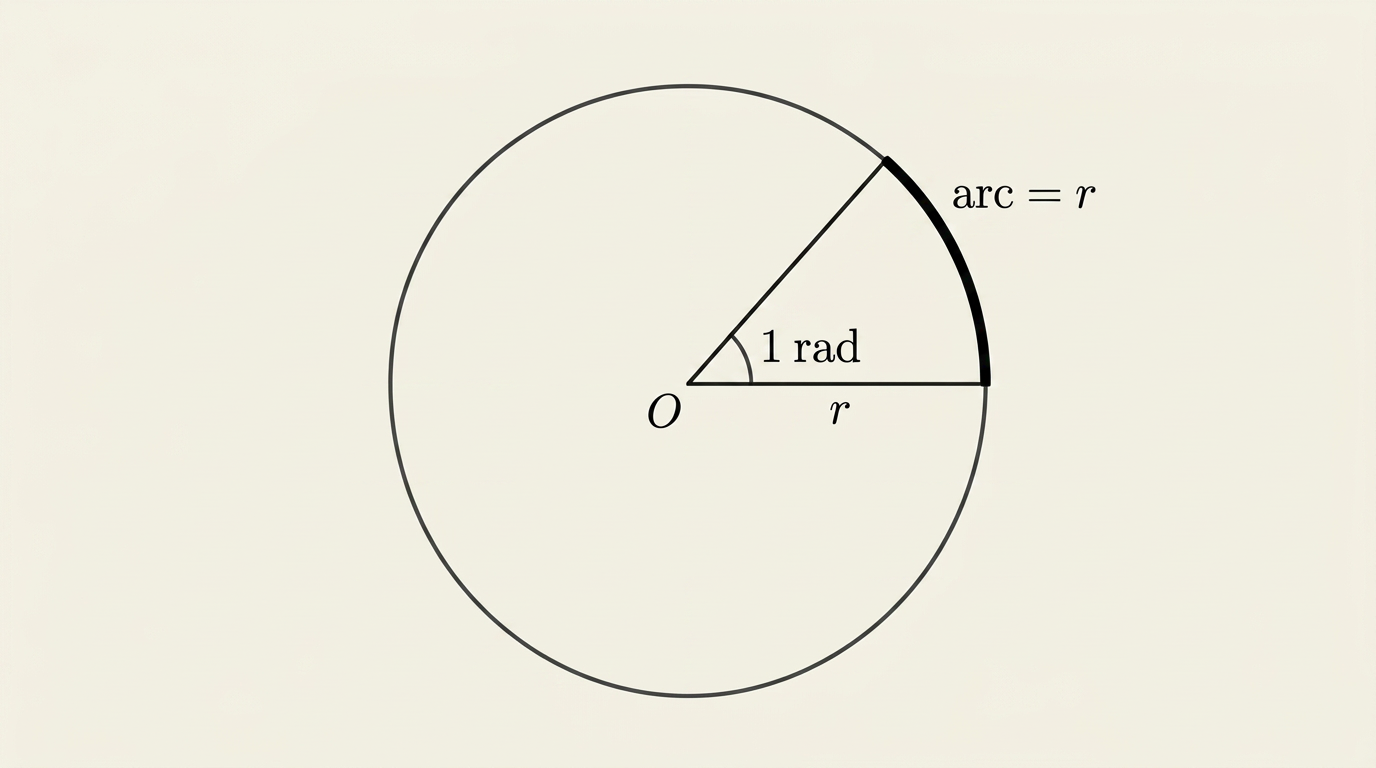
A radian isn't an arbitrary unit — it's the angle a circle's own radius carves out of its circumference, and it's what makes the formula for an arc's length remarkably simple.
7 min read4 worked examples
Defining the radian
So far, angles have been measured in degrees, where a full turn is split into $360$ equal parts. But there's a second, more natural unit: the radian. One radian is defined as the angle subtended at the centre of a circle by an arc whose length equals the circle's radius.
When the arc cut off equals the radius r in length, the angle at the centre is defined to be 1 radian (≈ 57.3°).
Since the full circumference of a circle is $2\pi r$ — that is, $2\pi$ "radius-lengths" — a complete turn measures exactly $2\pi$ radians. This gives the fundamental conversion:
$\pi \text{ radians} = 180°$
From this, converting between the two units is just scaling: multiply a degree value by $\dfrac{\pi}{180}$ to get radians, or multiply a radian value by $\dfrac{180}{\pi}$ to get degrees. Radians are often left in exact form as multiples of $\pi$, which is why the common angles from Year 1 reappear here in a new guise:
All the exact trig values memorised in Year 1 — $\sin\dfrac{\pi}{6}=\dfrac12$, $\cos\dfrac{\pi}{4}=\dfrac{1}{\sqrt2}$, $\tan\dfrac{\pi}{3}=\sqrt3$, and so on — carry over unchanged. Only the label on the angle has changed from degrees to radians; the geometry, and therefore the ratio, is identical.
Arc length
For a circle of radius $r$, an arc subtending an angle $\theta$ measured in radians at the centre has length:
$s = r\theta$
DerivationArc length as a proportion of the circumference
1
The full circumference of a circle of radius $r$ is $2\pi r$, corresponding to the full angle $2\pi$ radians.
Standard circumference formula, and a complete turn is $2\pi$ radians.
2
An arc subtending angle $\theta$ is the same proportion of the full circumference as $\theta$ is of the full turn: $\dfrac{s}{2\pi r} = \dfrac{\theta}{2\pi}$.
Arc length scales directly with the angle it subtends.
3
Multiply both sides by $2\pi r$: $s = 2\pi r \cdot \dfrac{\theta}{2\pi} = r\theta$.
The $2\pi$ cancels, leaving a remarkably simple formula.
▪ QED
Radians are non-negotiable here
$s=r\theta$ is only valid when $\theta$ is measured in radians. Using a degree value directly gives a wrong answer by a factor of $\dfrac{\pi}{180}$ — always convert first if an angle is given in degrees. The next lesson builds on this same idea to find the area of a sector.
Worked example 1
Converting between degrees and radians
Convert (a) $150°$ to radians in terms of $\pi$, and (b) $\dfrac{5\pi}{4}$ radians to degrees.
MethodMultiply by the appropriate conversion factor
$4.4$ radians is more than $\pi\approx3.14$ (a straight line, $180°$) but less than $2\pi\approx6.28$ (a full turn), so the angle should land somewhere between $180°$ and $360°$ — and $252.1°$ does exactly that. This is a reflex angle, which is perfectly valid for an arc subtending more than half the circle.
Worked example 4
Perimeter of a sector · Challenge
A sector $OAB$ has radius $6\text{ cm}$ and angle $\theta = \dfrac{\pi}{5}$ radians. Find the exact perimeter of the sector.
MethodCombine two straight radii with the curved arc length
1
The perimeter of a sector is made of two straight radii $OA$, $OB$, plus the curved arc $AB$: perimeter $= 2r + s$.
A sector's boundary has two straight edges and one curved edge.
Add the two radii to the arc length; leave in exact π form as requested.
▪ solved
Look deeper — a sector isn't just an arc
A common slip is to give the arc length $\dfrac{6\pi}{5}$ alone as "the perimeter" — but a sector's boundary has two straight radii as well as the curved edge. Always sketch the sector and count all three sides of its boundary before adding.
Common mistake
Plugging a degree value straight into $s=r\theta$ without converting to radians first — this silently multiplies the correct answer by a factor of roughly $57.3$ (since $1$ radian $\approx 57.3°$). Always check the angle's units before substituting, and convert with $\times\frac{\pi}{180}$ if it's given in degrees.
Check yourself
A sector has radius $7\text{ cm}$ and perimeter $25\text{ cm}$. Find the angle $\theta$ in radians, and hence the area of the sector. (Hint: perimeter $=2r+r\theta$ — rearrange for $\theta$ first, then use $A=\frac12r^2\theta$ for the area.)
Method
1
Perimeter $= 2r+r\theta = 2(7)+7\theta = 14+7\theta$, so $25=14+7\theta$.
Write the perimeter in terms of r and θ, then substitute the given values.