The same proportion argument that gave a clean formula for arc length works just as well for area — and one extra step, subtracting a triangle, unlocks the area cut off by a chord.
8 min read3 worked examples
Sector area
The area of a sector (a "pizza slice" of the circle) with angle $\theta$ measured in radians is:
$A = \dfrac{1}{2}r^2\theta$
DerivationSector area as a proportion of the full circle
1
The full area of a circle of radius $r$ is $\pi r^2$, corresponding to the full angle $2\pi$ radians.
Standard area formula, over the full turn.
2
A sector of angle $\theta$ is the same proportion of the full area: $\dfrac{A}{\pi r^2} = \dfrac{\theta}{2\pi}$.
Sector area scales directly with the angle it subtends, exactly as arc length did in the previous lesson.
3
Multiply both sides by $\pi r^2$: $A = \pi r^2 \cdot \dfrac{\theta}{2\pi} = \dfrac{1}{2}r^2\theta$.
The $\pi$ cancels, leaving the compact formula.
▪ QED
Worked example 1
Sector area, finding the radius
A sector of a circle has angle $1.2$ radians and area $54\text{ cm}^2$. Find the radius of the circle.
MethodSubstitute into $A=\frac12 r^2\theta$ and solve for $r$
1
$54 = \dfrac{1}{2}r^2(1.2)$.
Substitute the given area and angle into the sector area formula.
Take the positive square root, since radius must be positive.
▪ solved
Examiner's eye
Keep the angle in radians throughout — plugging $\theta=1.2$ straight into the formula only works because it's already in the correct unit. If a question instead gives the angle in degrees, convert to radians as the very first step.
Segment area
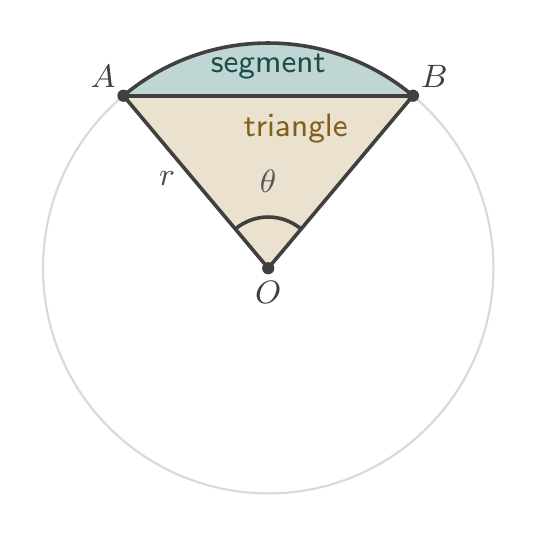
A chord — a straight line joining two points on a circle — divides the circle into two regions. The smaller region, bounded by the chord and the minor arc, is called a segment. A segment is not a sector: it's what's left of a sector once the triangle formed by the two radii and the chord is cut away.
Sector $OAB$ splits along the chord $AB$ into two pieces: triangle $OAB$ (gold) and the segment (teal). Subtract one from the whole sector to get the other.
DerivationSegment area via the sector-minus-triangle idea
1
The sector $OAB$ (angle $\theta$, radius $r$) has area $\dfrac12r^2\theta$.
The sector area formula, exactly as above.
2
Triangle $OAB$ has two sides of length $r$ with included angle $\theta$, so its area is $\dfrac12r^2\sin\theta$.
The Year 1 "$\frac12ab\sin C$" area formula, with $a=b=r$ and $C=\theta$.
3
Segment area $= \dfrac12r^2\theta - \dfrac12r^2\sin\theta = \dfrac12r^2(\theta-\sin\theta)$.
Subtract the triangle from the sector and factor out $\frac12r^2$.
▪ QED
Why this needs radians even more than arc length does
$A_{\text{segment}}=\dfrac12r^2(\theta-\sin\theta)$ mixes $\theta$ used two different ways in the same expression — once directly (from the sector) and once inside $\sin\theta$ (from the triangle). Both uses require $\theta$ in radians; there's no way to patch this formula up for a degree-valued angle.
Worked example 2
Segment area
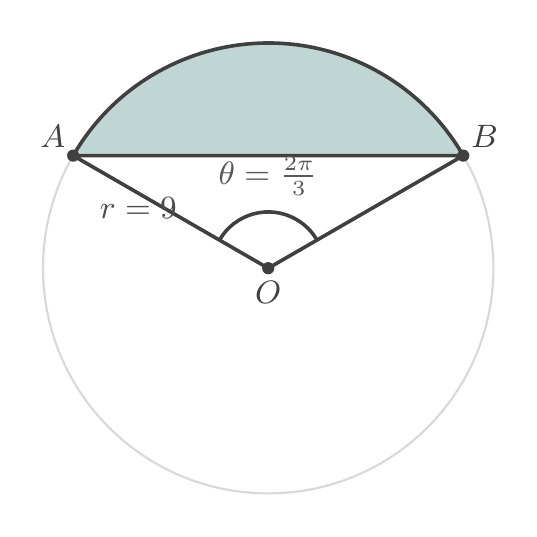
A sector $OAB$ has radius $9\text{ cm}$ and angle $\dfrac{2\pi}{3}$ radians. Find the area of the segment cut off by the chord $AB$, correct to 3 significant figures.
The shaded segment is the region to find — bounded by chord $AB$ and the minor arc, not the whole sector.
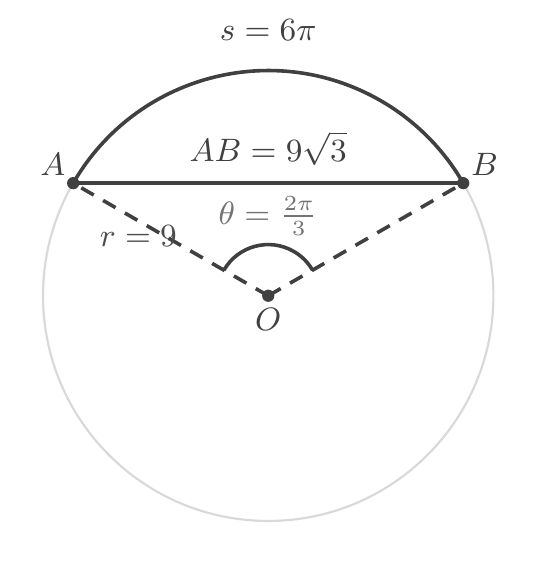
Chord length: splitting triangle $OAB$ down the middle gives $AB = 2r\sin\left(\dfrac{\theta}{2}\right) = 2(9)\sin\left(\dfrac{\pi}{3}\right) = 18\times\dfrac{\sqrt3}{2} = 9\sqrt3$.
Bisecting the isosceles triangle formed by the two radii and the chord gives two right-angled triangles, each with hypotenuse $r$ and angle $\theta/2$.
4
Perimeter $= 6\pi + 9\sqrt3$ cm (exact).
Add the curved arc to the straight chord.
▪ solved
Chord length, on demand
$AB=2r\sin\left(\dfrac{\theta}{2}\right)$ is worth remembering as a standalone result — it turns up any time a question needs the straight-line distance between two points on a circle, not just when finding a segment's perimeter.
Common mistake
Treating a segment's perimeter as arc $+$ two radii (copying the sector formula) — a segment has no radii on its boundary at all. Equally common: computing "segment area" as $\frac12r^2\theta$ alone, forgetting to subtract the triangle. Always ask whether the shape includes the two straight radii (a sector) or is bounded only by the chord (a segment).
Check yourself
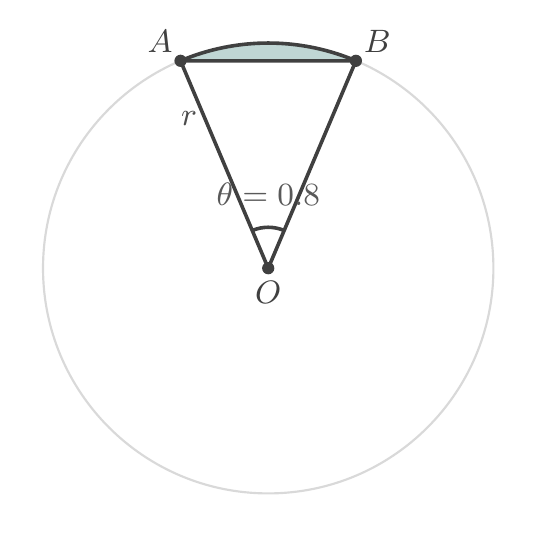
A sector has area $40\text{ cm}^2$ and angle $0.8$ radians. Find the radius, and hence find the area of the segment cut off by the corresponding chord, correct to 3 significant figures. (Hint: find r from $A=\frac12r^2\theta$ first, then apply $A_{\text{segment}}=\frac12r^2(\theta-\sin\theta)$.)
The unknown radius $r$ and the given angle $\theta=0.8$ — the shaded segment is what the second part asks for.