Exact Trig Values
SOH–CAH–TOA turns any right-angled triangle into three fixed ratios of its sides — and two simple triangles give the exact surd values every exam expects you to know cold.
What the three ratios mean
Trigonometry begins with a single fact about right-angled triangles: if two right-angled triangles share an angle, they are the same shape, so the ratios of their sides are identical. That's why $\sin$, $\cos$ and $\tan$ depend only on the angle, not the size of the triangle — they're fixed ratios you can look up or compute for any angle.
Relative to an angle $\theta$, label the sides opposite, adjacent, and hypotenuse (the longest, opposite the right angle). Then the three ratios are captured by SOH–CAH–TOA:
$\sin\theta = \dfrac{\text{opp}}{\text{hyp}} \qquad \cos\theta = \dfrac{\text{adj}}{\text{hyp}} \qquad \tan\theta = \dfrac{\text{opp}}{\text{adj}}$
In any right-angled-triangle problem, first mark which side is opposite your angle, which is adjacent, and which is the hypotenuse. Only then pick the ratio that uses the two sides you know (or want). Choosing the ratio before labelling is where most errors start.
Exact values worth knowing by heart
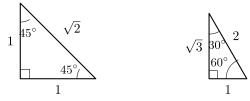
For the special angles $30°, 45°, 60°$, the ratios come out as exact surds — no calculator, and examiners expect them instantly. They come from two simple triangles: a $45°$ right-isosceles triangle (sides $1,1,\sqrt2$) and half of an equilateral triangle (sides $1,\sqrt3,2$).
$\sin 30° = \tfrac12,\ \cos 30° = \tfrac{\sqrt3}{2},\ \tan 30° = \tfrac{1}{\sqrt3}$; $\sin 45° = \cos 45° = \tfrac{1}{\sqrt2},\ \tan 45° = 1$; $\sin 60° = \tfrac{\sqrt3}{2},\ \cos 60° = \tfrac12,\ \tan 60° = \sqrt3$.
If you ever blank on an exact value, reconstruct it from the triangle. A square of side $1$ cut along its diagonal gives a $45°$ triangle with legs $1,1$ and hypotenuse $\sqrt2$ — so $\sin45° = \tfrac{1}{\sqrt2}$ immediately. An equilateral triangle of side $2$ cut in half gives a $30°$–$60°$ triangle with sides $1, \sqrt3, 2$. The exact values aren't arbitrary facts; they're just SOH–CAH–TOA read off these two triangles, which is why you can always rebuild them under pressure.
Worked example 1
Check your calculator is in degrees, not radians — a wrong mode is the most common silent error in trig. And sanity-check the size: the opposite side ($7.71$) is shorter than the hypotenuse ($12$), as it must be, since the hypotenuse is always the longest side.
Worked example 2
$\tan\theta = 0.625$ asks "what angle has a tangent of $0.625$?" — and $\tan^{-1}$ is the operation that answers it. Whenever you know a ratio and want the angle, you invert; whenever you know the angle and want a ratio, you don't. Keeping that direction straight is the heart of every "find the angle vs find the side" decision.
Worked example 3
This is a pure exact-values question — the whole point is to work in surds without a calculator, using the special-angle values from the two triangles.
Notice that $\sin 60°$ and $\cos 30°$ gave the same value $\tfrac{\sqrt3}{2}$. That's not a fluke: $\sin\theta = \cos(90° - \theta)$ always, because the "opposite" of one acute angle in a right triangle is the "adjacent" of the other. Spotting these relationships lets you simplify surd expressions in your head, exactly as intended.
$\sin^{-1}$, $\cos^{-1}$, $\tan^{-1}$ mean the inverse functions (find the angle), not reciprocals: $\sin^{-1}(x)$ is not $\dfrac{1}{\sin x}$. Use the inverse only when you know a ratio and want the angle — and always make sure the number you're inverting is a ratio, not an angle.
Check yourself
A ladder of length $6\,\text{m}$ leans against a wall, making an angle of $65°$ with the ground. Find the height it reaches up the wall, to 3 s.f.
(Hint: the ladder is the hypotenuse; the height is opposite the $65°$ angle.)
Opposite + hypotenuse points to sine every time; the height ($5.44$) is sensibly less than the ladder's length ($6$).