Angles in All Four Quadrants
The unit circle splits into four quadrants, and in each one a different combination of sin, cos and tan is positive — the CAST diagram turns that pattern into a single picture you can read off in seconds.
Four quadrants, four sign patterns
The unit circle splits naturally into four quadrants, numbered anticlockwise from the positive $x$-axis: 1st ($0°$–$90°$), 2nd ($90°$–$180°$), 3rd ($180°$–$270°$), 4th ($270°$–$360°$). Since a point on the circle at angle $\theta$ has coordinates $(\cos\theta, \sin\theta)$, the signs of $\sin\theta$ and $\cos\theta$ are just the signs of that point's $y$- and $x$-coordinates — and those flip as the point moves from quadrant to quadrant.
1st quadrant: $x>0, y>0$, so $\sin,\cos$ both positive (and $\tan=\sin/\cos$ positive too). 2nd quadrant: $x<0, y>0$, so only $\sin$ is positive. 3rd quadrant: $x<0, y<0$, so both are negative — but $\tan = \sin/\cos$ is a negative divided by a negative, which is positive. 4th quadrant: $x>0, y<0$, so only $\cos$ is positive.
The CAST diagram
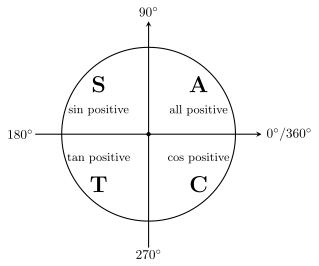
That pattern is exactly what the CAST diagram summarises: label the four quadrants, anticlockwise starting from the 4th, with the letters C, A, S, T — each letter marking which ratios are positive in that quadrant.
Everywhere a letter doesn't appear, that ratio is negative. "CAST", read anticlockwise starting just below the $x$-axis, is simply a mnemonic for the sign pattern the circle already gives you.
Reference angles
The other half of the picture is the reference angle: the acute angle between the radius and the (nearest) $x$-axis. Every angle's ratio has the same size as its reference angle's ratio — only the sign, decided by CAST, can differ.
1st quadrant: reference angle $=\theta$ itself. 2nd quadrant: reference angle $=180°-\theta$. 3rd quadrant: reference angle $=\theta-180°$. 4th quadrant: reference angle $=360°-\theta$. In every case, it's the acute "distance" from $\theta$ back to the nearest end of the $x$-axis.
Worked example 1
Two separate questions, two separate steps: which acute angle gives the same size (the reference angle), and what sign does this quadrant give that ratio (CAST). Keeping them apart avoids the common slip of getting the right number with the wrong sign.
Worked example 2
CAST and reference angles turn every angle's exact trig value into one of the handful you already know for $30°, 45°, 60°$ — you're never actually evaluating a new ratio, just relocating a familiar one and fixing its sign.
Worked example 3
Normally a negative cosine gives two candidate quadrants (2nd and 3rd) — but the given range rules one of them out before you even start.
Don't just take $\cos^{-1}(-0.6)$ on the calculator and stop — it returns $126.9°$, the 2nd-quadrant solution, which falls outside the given range here. Always find the reference angle from the positive version of the ratio, then use CAST and the given range together to place it in the correct quadrant(s).
Worked example 4
This is exactly the method the next lesson formalises into a general procedure for solving trig equations: find the reference angle from the size of the given ratio, use CAST to identify every quadrant with the right sign, then place the reference angle in each one using the four quadrant rules. Two negative-tan quadrants means two solutions — never fewer, never more, within one $360°$ cycle.
The reference angle is always taken from the acute, positive version of the ratio — never plug a negative value straight into $\sin^{-1}$, $\cos^{-1}$ or $\tan^{-1}$ and expect the calculator's output to already be the reference angle you need; check what quadrant it's actually landed you in first.
Check yourself
State the quadrant, reference angle, and exact value of $\sin 240°$.
(Hint: 240° is between 180° and 270°.)