Pure Mathematics · Sequences & Series · Year 1

Pascal's Triangle

A triangle of numbers built from nothing but addition — and hidden inside it, every coefficient you'll ever need to expand $(a+b)^n$.

9 min read 4 worked examples

Building the triangle

Pascal's triangle is a triangular array of numbers, built by one simple rule: each entry is the sum of the two entries directly above it. Every row starts and ends with $1$, since there's only ever one number above those outer positions to "carry down".
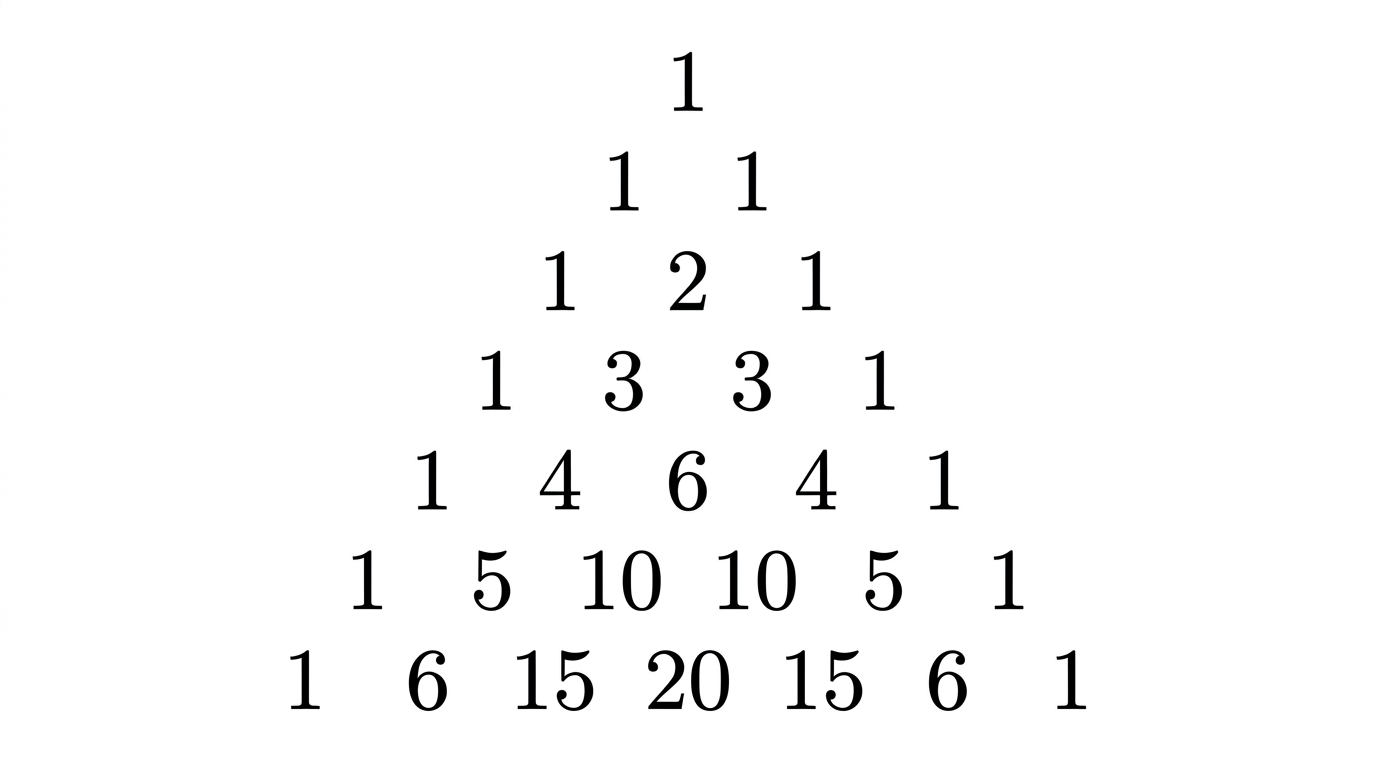
Pascal's triangle drawn as a symmetric triangle of numbers from row 0 to row 6, each row centred beneath the one above, showing 1, 1 1, 1 2 1, 1 3 3 1, and so on down to row 6.
Pascal's triangle, rows 0 to 6 — each entry is the sum of the two entries directly above it.

Rows are numbered starting from $\mathbf{0}$: the single $1$ at the top is row 0, then $1,1$ is row 1, then $1,2,1$ is row 2, and so on. Within a row, entries are also numbered from $0$, so row $4$ reads $1,4,6,4,1$ at positions $0,1,2,3,4$.

Why "sum of the two above" is the right rule

Think of each row as the coefficients of $(a+b)^n$ (you'll prove this properly in the next lessons). Going from row $n-1$ to row $n$ means multiplying by one more $(a+b)$. Every existing term gets hit twice — once by the new $a$, once by the new $b$ — so each new coefficient is built from two old ones added together. The addition rule isn't a curiosity; it's multiplication by $(a+b)$, written as a picture.

Two patterns worth knowing

Symmetry: every row reads the same forwards and backwards — the entry at position $r$ equals the entry at position $n-r$. Row sum: the entries of row $n$ always add up to $2^n$ — row $2$ sums to $1+2+1=4=2^2$, row $4$ sums to $1+4+6+4+1=16=2^4$, and so on.

Where this is going

Pascal's triangle is quick to build but slow to extend by hand — writing out row $20$ one addition at a time is painful. The next lesson introduces factorial notation and the $\binom{n}{r}$ formula, which computes any single entry of any row directly, without building the rows above it. Pascal's triangle is the picture; factorials are the shortcut.

Worked example 1

Extending the triangle by two rows
Row 6 of Pascal's triangle is $1, 6, 15, 20, 15, 6, 1$. Write down row 7 and row 8.
MethodAdd each adjacent pair, keeping the outer 1s
1
Row 7 starts and ends with $1$. The interior entries are sums of adjacent pairs from row 6: $1{+}6=7$, $6{+}15=21$, $15{+}20=35$, $20{+}15=35$, $15{+}6=21$, $6{+}1=7$.
Each new entry sits between the two it's added from.
2
So row 7 is $1, 7, 21, 35, 35, 21, 7, 1$.
Eight entries, symmetric about the middle.
3
Repeat for row 8 using row 7: $1{+}7=8$, $7{+}21=28$, $21{+}35=56$, $35{+}35=70$, then the mirror image back down.
Same rule, one row further.
4
So row 8 is $1, 8, 28, 56, 70, 56, 28, 8, 1$.
Nine entries, symmetric about the central 70.
▪ built
Examiner's eye

The number of entries in row $n$ is always $n+1$ (because counting starts at $0$). Row $8$ has $9$ entries — a quick way to check you haven't dropped one while adding.

Worked example 2

Using row sums
Without adding the entries directly, find the sum of the numbers in row 10 of Pascal's triangle.
MethodApply the row-sum pattern $2^n$
1
The sum of row $n$ is always $2^n$.
Verified on small rows: row 2 sums to 4, row 4 sums to 16.
2
For row 10: sum $=2^{10}$.
Substitute $n=10$.
3
$2^{10} = 1024$.
Evaluate the power.
▪ solved
The key insight

This pattern isn't a coincidence to memorise blindly: setting $a=b=1$ in $(a+b)^n$ gives $(1+1)^n = 2^n$ on one side, and "the sum of all the coefficients" on the other — because every power of $1$ is just $1$. Row sums and powers of $2$ are the same fact seen two ways.

Worked example 3

Reading off coefficients for an expansion
Use Pascal's triangle to write down the expansion of $(x+y)^5$.
MethodRow 5 gives the coefficients directly
1
Build down to row 5: row 3 is $1,3,3,1$; row 4 is $1,4,6,4,1$; row 5 is $1,5,10,10,5,1$.
Add adjacent pairs each time.
2
These six numbers are the coefficients of the six terms, with powers of $x$ counting down from $5$ and powers of $y$ counting up from $0$.
Each term's powers sum to 5.
3
$(x+y)^5 = x^5 + 5x^4y + 10x^3y^2 + 10x^2y^3 + 5xy^4 + y^5$.
Coefficient, then $x$-power, then $y$-power, in each term.
▪ expanded
Common mistake

The number of terms in the expansion of $(x+y)^n$ is $n+1$, not $n$ — easy to forget when $n$ is odd, like here, where $5$ gives $6$ terms. Count row entries, not the power itself.

Worked example 4

Identifying a row from a single entry · Challenge
The third entry (position $r=2$) of a certain row of Pascal's triangle is $45$. Using only the addition rule — no formula — find which row this is.

Position $2$ of each row (the third number along) follows its own pattern as you move down the triangle. Building that single column, row by row, tracks down the answer without needing a formula.

MethodTrack the position-2 entry down successive rows
1
Row 2 is $1,2,1$: position 2 is $1$.
The smallest row with a position 2 at all.
2
Row 3 is $1,3,3,1$: position 2 is $3$. Row 4 is $1,4,6,4,1$: position 2 is $6$.
Build each row from the one before.
3
Row 5: position 2 is $10$. Row 6: position 2 is $15$. Row 7: position 2 is $21$. Row 8: position 2 is $28$. Row 9: position 2 is $36$.
Each value increases by one more than the last increase: $+2,+3,+4,+5,+6,+7,+8$ — the triangular numbers.
4
Row 10: position 2 is $36+9=45$.
Continuing the same pattern one more step.
5
So the entry $45$ first appears at position 2 in row 10.
Matches the target value exactly.
▪ solved
Look deeper — the hidden triangular numbers

The position-2 column of Pascal's triangle — $1, 3, 6, 10, 15, 21, 28, 36, 45, \ldots$ — is exactly the sequence of triangular numbers, because each one is built by adding one more than the previous increase. Pascal's triangle quietly contains other well-known number sequences inside it; spotting them is often faster than building full rows.

Common mistake

Miscounting which row or position you're on is the single biggest source of error in this topic — always double check by re-deriving a couple of rows from row $0$ rather than trusting a remembered row from memory.

Check yourself

Row 9 of Pascal's triangle is $1, 9, 36, 84, 126, 126, 84, 36, 9, 1$. Write down row 10, and state the sum of its entries.
(Hint: add adjacent pairs from row 9, then use $2^n$ for the sum.)

Method
1
Adding adjacent pairs of row 9: $1{+}9=10$, $9{+}36=45$, $36{+}84=120$, $84{+}126=210$, $126{+}126=252$, then the mirror.
2
Row 10 is $1, 10, 45, 120, 210, 252, 210, 120, 45, 10, 1$.
Eleven entries, symmetric about 252.
3
Sum $= 2^{10} = 1024$.
No need to add all eleven numbers by hand.
▪ solved