Pure Mathematics · Graphs & Transformations · Year 1
Transforming Functions
Reflections complete the transformation toolkit — and once translations, stretches and reflections can be combined in sequence, any curve can be sketched from a handful of key points.
11 min read4 worked examples
Reflections
Alongside translations and stretches, the outside/inside rule extends to reflections too:
$-f(x)$ (outside): reflects the curve in the $x$-axis — every $y$-value flips sign, $x$-values unchanged. $f(-x)$ (inside): reflects the curve in the $y$-axis — every $x$-value flips sign, $y$-values unchanged.
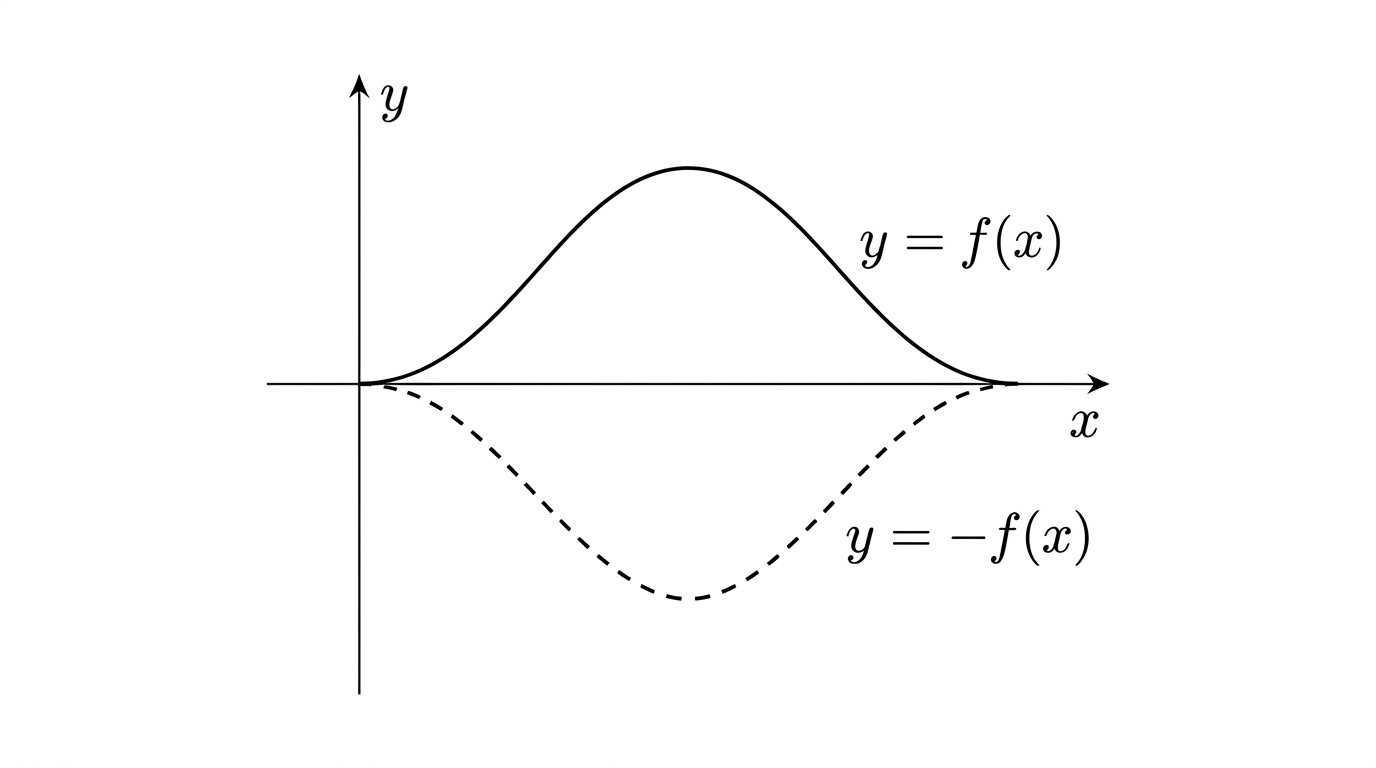
A curve (solid) and its reflection in the x-axis (dashed) — every y-value flips sign.
The full picture — four core transformations
Outside (touches y, intuitive): $f(x)+a$ shifts up by $a$; $a\,f(x)$ stretches vertically by $a$; $-f(x)$ reflects in the $x$-axis. Inside (touches x, reversed): $f(x+a)$ shifts left by $a$; $f(ax)$ stretches horizontally by $\tfrac1a$; $f(-x)$ reflects in the $y$-axis.
Combining transformations in sequence
When several transformations act together, apply them to a point one at a time, in the order the equation builds them up — working from the innermost change outward mirrors how the function itself would compute the output. Since inside changes only ever affect $x$ and outside changes only ever affect $y$, the two coordinates can be tracked independently without them interfering with each other.
Worked example 1
A single reflection
The point $Q(-3, 5)$ lies on $y=f(x)$. State the coordinates of the image of $Q$ under (a) $y=-f(x)$ and (b) $y=f(-x)$.
MethodApply each reflection rule to the relevant coordinate
1
(a) $-f(x)$ is outside: reflects in the $x$-axis, flipping the sign of $y$ only. $Q(-3,5) \to (-3,-5)$.
x unchanged, y negated.
2
(b) $f(-x)$ is inside: reflects in the $y$-axis, flipping the sign of $x$ only. $Q(-3,5) \to (3,5)$.
y unchanged, x negated.
▪ solved
Examiner's eye
It's easy to muddle which axis each reflection is "in" — a reflection in the $x$-axis flips $y$ (points move vertically), while a reflection in the $y$-axis flips $x$ (points move horizontally). Sketching a tiny example, like reflecting $(1,2)$, is a fast way to check you have the right one.
Worked example 2
Sketching a transformed quadratic · combining a reflection and shifts
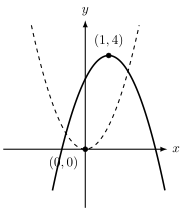
The curve $y=x^2$ is transformed to $y=-(x-1)^2+4$. Describe the sequence of transformations and state the new vertex.
This is the completed-square form of a quadratic, read as a sequence of transformations of the basic parabola.
$y=x^2$ (dashed) transformed to $y=-(x-1)^2+4$ (solid) — vertex $(0,0)\to(1,4)$, U flips to $\cap$.
MethodPeel off each transformation in order
1
$(x-1)^2$: inside the bracket, $-1$ shifts $y=x^2$ right by 1.
Input change, reversed → right.
2
The leading $-$ sign, $-(x-1)^2$, is outside — it reflects the parabola in the $x$-axis, flipping the U into a $\cap$.
Output negation → reflect in x-axis.
3
$+4$ is outside — it shifts the whole thing up by 4.
Output change → vertical, normal.
4
Track the vertex $(0,0)$ of $y=x^2$: right 1 → $(1,0)$; reflect (vertex on axis, unmoved) → $(1,0)$; up 4 → $(1,4)$.
Follow the key point through each step.
5
So it's a $\cap$-shaped parabola with vertex $(1,4)$ — a maximum.
The reflection made it a maximum, not a minimum.
▪ described
The key insight
Every completed-square quadratic $a(x-p)^2+q$ is the parabola $y=x^2$ transformed: shifted to vertex $(p,q)$, stretched by $a$, and flipped if $a<0$. Completing the square and transformations are the same idea in different clothes — which is exactly why completing the square reveals the vertex so directly.
Worked example 3
Sketching from a described graph
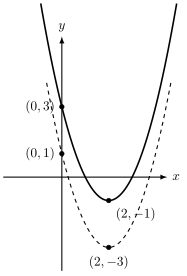
The graph of $y=f(x)$ has a single minimum at $(2,-3)$ and passes through $(0,1)$. Sketch $y=f(x)+2$ and state the new minimum point and $y$-intercept.
$y=f(x)$ (dashed, one possible shape) shifted up 2 to $y=f(x)+2$ (solid) — minimum $(2,-3)\to(2,-1)$.
MethodApply the single outside shift to every key feature
1
$+2$ is outside: a vertical shift up by 2, affecting only $y$-values.
Simple single transformation.
2
The minimum $(2,-3)$ moves to $(2,-3+2)=(2,-1)$; it's still the minimum, since a vertical shift doesn't change the shape.
x unchanged, y increases by 2.
3
The point $(0,1)$ moves to $(0,1+2)=(0,3)$ — this is the new $y$-intercept.
Same shift applied to the second known point.
▪ sketched
Common mistake
A vertical shift never changes which point is the minimum or maximum, nor the curve's overall shape — only where it sits. Don't recalculate a new minimum from scratch; simply shift the known one.
Worked example 4
Three transformations combined · Challenge
The point $M(-2,6)$ lies on $y=f(x)$. Find the image of $M$ under the transformation $y=3f(-x+1)$, working through each transformation in turn.
Three things are happening at once here: a horizontal reflection, a horizontal translation, and a vertical stretch. Untangling the inside expression correctly is the key first step.
MethodRewrite the inside expression, then apply each transformation in turn
1
Rewrite $-x+1$ as $-(x-1)$, factoring out the $-1$ to separate the reflection from the shift.
Reveals the two inside transformations clearly.
2
Rather than separating the reflection and shift into two visual steps, work directly with the combined inside expression $-x+1$: find the new $x$-coordinate $X$ by matching it to the input $f$ is already known at.
Avoids ambiguity in the order of two inside operations.
3
$M$ has $x=-2$ on $f(x)$. We need the new curve's $x$-value $X$ such that $-X+1 = -2$ (matching the original input that gave $f=6$).
Solve for which X reproduces the original input to f.
4
$-X+1=-2 \Rightarrow -X=-3 \Rightarrow X=3$.
Solve the resulting linear equation.
5
The outside factor $3$ multiplies the output: $y=3\times f(-2)=3\times6=18$.
Outside stretch acts on the y-value directly.
6
So $M(-2,6)$ maps to $(3,18)$.
Combine the new x with the scaled y.
▪ solved
Look deeper — solving for x directly sidesteps ordering confusion
When several inside transformations combine into one expression like $-x+1$, rather than trying to apply a reflection and a translation as two separate visual steps (which is easy to get backwards), it's more reliable to set the whole inside expression equal to the original known input and solve for the new $x$ directly. The outside transformation is then applied separately to the output, exactly as usual.
Common mistake
When an inside expression combines a reflection and a shift, such as $f(-x+1)$, don't apply them as if they were $f(-(x+1))$ — factor carefully: $-x+1 = -(x-1)$, not $-(x+1)$. Getting this factoring wrong flips the direction of the shift.
Check yourself
The point $N(5,-2)$ lies on $y=f(x)$. Find the image of $N$ under $y=-2f(x)+1$. (Hint: both transformations here are outside the bracket, so only y changes — apply them in the order the expression is built.)
Method
1
x-coordinate unchanged: $x=5$ (no inside transformation).