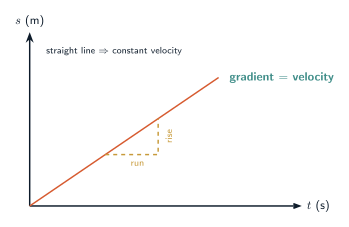
On a displacement–time graph one thing matters: the gradient. Read it correctly and the whole story of a journey — speeding up, slowing down, stopping, reversing — is sitting there in the shape of the line.
9 min read3 worked examples
Reading a displacement–time graph
A displacement–time graph plots an object's displacement from a fixed point against time. It looks like an ordinary line graph, but one feature of it carries all the physics: the gradient.
The gradient is the velocity
Gradient is $\dfrac{\text{change in displacement}}{\text{change in time}}$ — and that is exactly the definition of velocity. So on a displacement–time graph, the gradient at any point is the velocity at that instant. There is no second quantity hiding in the graph the way there is on a velocity–time graph: the area beneath a displacement–time graph means nothing physical, so ignore it entirely.
A straight line means constant velocity. The steeper the line, the greater the speed — and its sign tells you the direction.
What the shapes tell you
Straight line, positive gradient: constant velocity, moving away from the reference point. Steeper means faster.
Horizontal line: zero gradient, so zero velocity — the object is at rest. This is easy to misread as "stopped for good"; it only means stationary for as long as the line stays flat.
Straight line, negative gradient: constant velocity back towards the reference point. The displacement is decreasing, so the velocity is negative.
A curve: the gradient is changing from point to point, so the velocity is changing — the object is accelerating. A curve bending more steeply upward means speeding up; one flattening out means slowing down.
Sign shows direction, not just size
Displacement is a vector, so a displacement–time graph has signed values on the vertical axis. A negative displacement simply means the object is on the other side of the reference point from where it started measuring — it does not mean anything has gone wrong. Read the sign of the gradient the same way: positive means moving in the direction you have called positive, negative means moving the other way.
Worked example 1
Velocities from a multi-stage journey
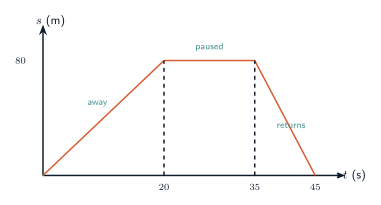
A cyclist rides away from home along a straight road at a constant $4\ \text{m s}^{-1}$ for $20$ seconds, stops for $15$ seconds to check a map, then cycles straight back home at a constant speed, arriving $10$ seconds after setting off again. Sketch the displacement–time graph and find her speed on the return leg.
Three straight-line stages: away at constant speed, a pause, then back at a different constant speed.
MethodFind the displacement at the end of stage 1, then use the gradient of stage 3
1
In the first $20$ s she travels at $4\ \text{m s}^{-1}$, so her displacement from home becomes $4 \times 20 = 80$ m.
Distance = speed × time, for constant speed.
2
The graph is flat at $s = 80$ from $t = 20$ to $t = 35$ — no gradient, so no velocity, while she checks the map.
Horizontal line = at rest.
3
She sets off again at $t = 35$ and arrives home ($s = 0$) at $t = 35 + 10 = 45$.
10 s after setting off again.
4
Her speed on the return leg is the magnitude of the gradient: $\dfrac{80 - 0}{45 - 35} = \dfrac{80}{10} = 8\ \text{m s}^{-1}$.
Gradient of the final stage.
▪ solved
Why the gradient came out negative
Formally the gradient of the last stage is $\dfrac{0-80}{45-35} = -8\ \text{m s}^{-1}$ — negative because displacement is decreasing, i.e. she is moving back towards home. Her speed is the positive number $8\ \text{m s}^{-1}$; her velocity on the way back is $-8\ \text{m s}^{-1}$ if outward is taken as positive. Both statements are correct; they answer slightly different questions.
Worked example 2
Reading a curved graph qualitatively
A sketch of a car's displacement against time shows a curve that starts shallow, becomes steeper and steeper, then levels off to a constant gradient for the rest of the journey. Describe the car's motion in each phase.
MethodTrack how the gradient itself is changing
1
Where the curve is shallow, the gradient — the velocity — is small, so the car is moving slowly.
Shallow gradient = low velocity.
2
As the curve becomes steeper, the gradient is increasing, so the velocity is increasing: the car is accelerating.
Increasing gradient = speeding up.
3
Once the curve settles into a straight line, the gradient is constant, so the velocity is constant: the car has finished accelerating and is now travelling at steady speed.
Straight section = constant velocity.
▪ solved
You are reading the gradient of the gradient
Nothing here requires calculating a number — the question only asks for a description, and it rewards exactly this kind of reasoning: read whether the gradient is small, large, increasing or constant, and translate each directly into a statement about velocity. This is the qualitative skill examiners are testing before you meet calculus-based kinematics.
Worked example 3
Sketching from a description
A ball rolls in a straight line away from a wall at a constant speed, hits a cushion and instantly reverses direction, then rolls back towards the wall at half its original speed until it returns to its starting point. Sketch the displacement–time graph, measuring displacement from the wall.
MethodConvert each phrase into a gradient
1
"Rolls away at constant speed" is a straight line with a positive gradient, starting at the origin (the wall).
Constant speed → straight line.
2
"Instantly reverses direction" means the gradient changes sign abruptly at the moment of impact — there is a sharp corner on the graph, not a smooth curve.
A sudden change in velocity is a kink, not a curve.
3
"Rolls back at half its original speed" is a second straight line with a negative gradient, shallower in magnitude than the first — it takes twice as long to retrace the same distance.
Half the speed means half the gradient's size.
4
The graph ends back at $s = 0$, since the ball returns to the wall.
Same start and end point.
▪ solved
Common mistake
Do not look for meaning in the area under a displacement–time graph — it has none, unlike a velocity–time graph. The other frequent slip is misreading a horizontal section as "the object has stopped moving for the rest of the journey" rather than simply "at rest for this interval". And a steep negative gradient is not slower than a shallow positive one — compare magnitudes, not signs, when comparing speeds.
Check yourself
A runner sets off from a start line and covers $100$ m at a constant speed in $20$ s, rests for $10$ s, then jogs back $40$ m towards the start line over the next $20$ s. Find her speed for each of the two moving stages, and her displacement from the start line at the end. (Hint: speed is the magnitude of the gradient of each straight section.)