Stationary Points
Peaks and valleys sit where the gradient is zero. Solve f′(x)=0 to find them, then use f″(x) to tell which is which.
Where the gradient is zero
A stationary point is a point on a curve where the gradient is zero — the curve is momentarily flat. These are the peaks and valleys: the maximum and minimum points. Because the gradient is $f'(x)$, finding them is simple in principle: solve $f'(x) = 0$. The interesting question is then what kind of stationary point each one is.
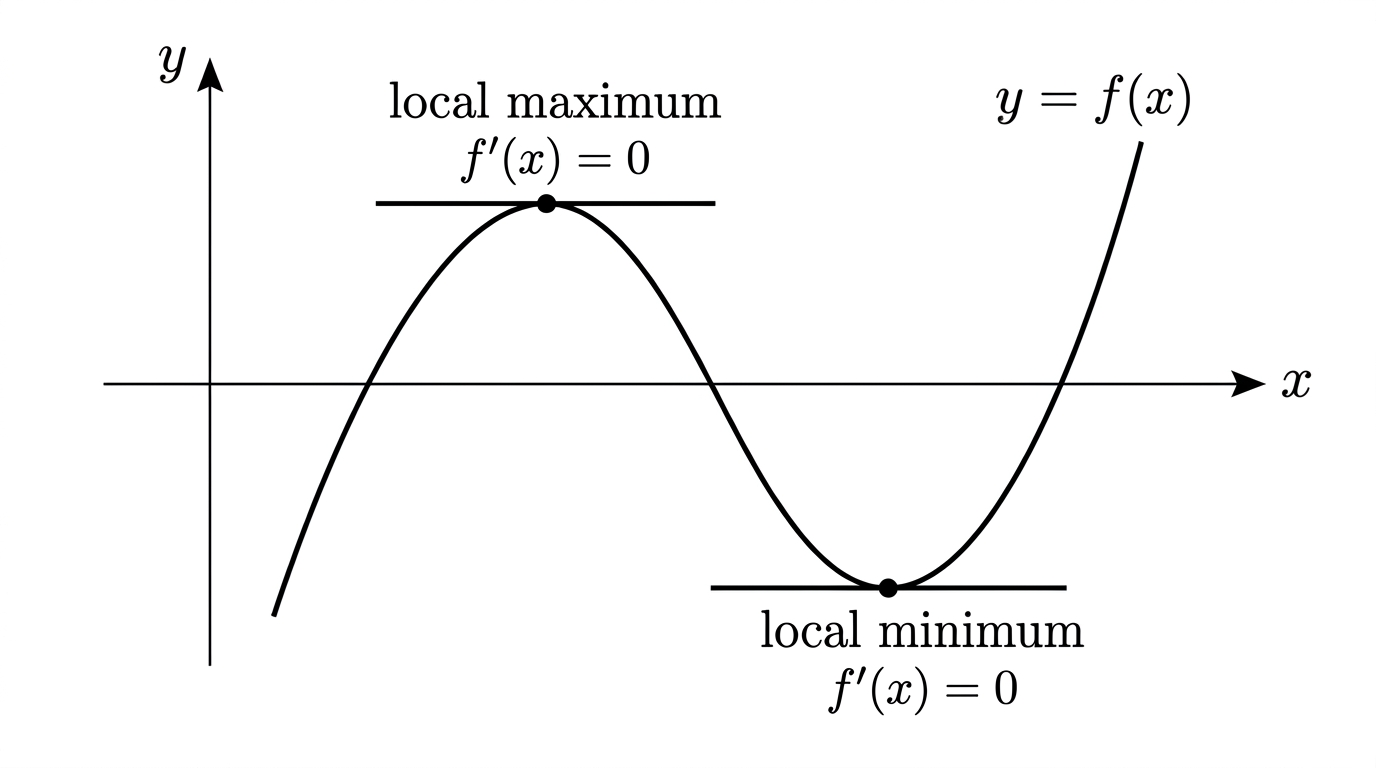
Approaching a maximum, the curve is rising ($f'>0$); just past it, the curve is falling ($f'<0$). Right at the top it is neither — the gradient passes through zero. The same holds at a minimum, with the signs reversed. So every peak and valley sits where $f'(x)=0$. Solving that equation finds all the candidates in one step; classifying them tells you which are peaks and which are valleys.
Classifying with the second derivative
Once you have a stationary point, the second derivative tells you its nature at a glance:
Worked example 1
Always give stationary points as full coordinates $(x, y)$ — the $y$ comes from the original curve, not the derivative. Then state the nature explicitly using the second derivative's sign: positive means minimum, negative means maximum. Doing both the find and the classify is what earns full marks.
Two traps catch most students. First, forgetting to classify: finding $f'(x)=0$ locates a stationary point but doesn't say whether it's a max or min — always test with $f''$. Second, giving only the $x$-value: a stationary point needs its $y$-coordinate too, read off the original curve, not the derivative.
Check yourself
Find the stationary point of $y = x^2 - 6x + 5$ and determine its nature using the second derivative.
(Hint: solve $\tfrac{dy}{dx}=0$ for $x$, find $y$ from the curve, then check the sign of $\tfrac{d^2y}{dx^2}$.)
This is the vertex of an upward parabola, so a minimum is exactly what we expect — and $\tfrac{d^2y}{dx^2}=2>0$ confirms it. The turning point is $(3, -4)$.