The Equation of a Circle
A circle's equation is nothing but Pythagoras in disguise — the distance from the centre, set equal to the radius. See that, and centre, radius and every circle problem become one idea.
A circle is the set of all points a fixed distance — the radius $r$ — from a fixed point, the centre. That definition is geometric, but with coordinates we can turn it into algebra, and the bridge between them is a tool you already own: Pythagoras' theorem. The entire equation of a circle is just the distance formula, rearranged.
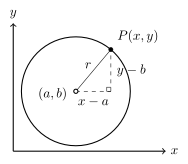
Take a centre $(a, b)$ and any point $(x, y)$ on the circle. Drop a horizontal and a vertical line to form a right-angled triangle: its legs have lengths $(x - a)$ and $(y - b)$, and its hypotenuse is the radius $r$. Pythagoras says the squares of the legs add to the square of the hypotenuse — and that's the equation, immediately.
The standard form $(x - a)^2 + (y - b)^2 = r^2$ isn't something to memorise as a shape — it is Pythagoras' theorem for the distance from $(x,y)$ to the centre $(a,b)$, set equal to $r^2$. Read it aloud: "horizontal gap squared, plus vertical gap squared, equals radius squared." Once you see the equation as the distance formula in disguise, you can reconstruct it any time, and you'll never confuse the signs: the centre coordinates appear with a minus inside the brackets.
The two forms you'll meet
Standard (completed) form: $(x - a)^2 + (y - b)^2 = r^2$ — centre $(a,b)$, radius $r$, both readable at a glance.
Expanded form: $x^2 + y^2 + 2gx + 2fy + c = 0$ — what you get if you multiply the brackets out. Exams often hand you this form, and the job is to complete the square to convert it back and read off the centre and radius.
If you see $x^2$ and $y^2$ terms with $x$ and $y$ terms scattered about, the circle is hiding in expanded form. Group the $x$-terms, group the $y$-terms, and complete the square on each separately. This is exactly the completing-the-square skill from quadratics — now applied twice, once per variable.
Worked example 1
The sign trap is $y+2$: because the centre's $y$-coordinate is $-2$, the bracket is $(y-(-2)) = (y+2)$. Testing a point is just checking whether its distance from the centre equals $r$ — if the left side comes to less than $r^2$ the point is inside, more and it's outside.
Worked example 2
Completing the square is the reverse of expanding the brackets — it rewinds the expanded circle back to the Pythagoras form where the centre and radius are visible. Note the radius is $\sqrt{36}=6$, not $36$: the right-hand side is always $r^2$, so take the square root at the end. Forgetting that root is the single most common slip in this topic.
Worked example 3
The two ends of a diameter tell you everything: the centre is the midpoint of the diameter, and the radius is half the diameter's length — both computable from $A$ and $B$.
Notice step 2 is the same right-angled triangle from the top of this lesson: the distance between two points is $\sqrt{(\Delta x)^2 + (\Delta y)^2}$, which is Pythagoras on the horizontal and vertical gaps. The circle equation, the distance formula, and Pythagoras are three faces of one idea — which is why this topic rewards understanding the triangle rather than memorising three separate formulas.
The right-hand side of the standard form is $r^2$, not $r$. A circle written $(x-1)^2+(y-3)^2 = 49$ has radius $7$, not $49$. Going the other way, a radius of $4$ gives a right-hand side of $16$. Always square when writing the equation, and always square-root when reading the radius off.
Check yourself
Find the centre and radius of the circle $x^2 + y^2 + 4x - 10y + 13 = 0$.
(Hint: group and complete the square on x and y separately, then take the square root at the end.)
Completing the square twice rewinds the expanded form back to Pythagoras form, where centre $(-2,5)$ and radius $4$ read straight off — remembering $16$ is $r^2$, so $r=4$.