A parametric curve can cross the axes, cross itself, or cross another curve entirely — each case comes down to solving for the value(s) of t where two things coincide.
9 min read3 worked examples
Crossing the axes
To find where a parametric curve crosses the $x$-axis, set $y(t)=0$ and solve for $t$, then substitute each solution back into $x(t)$. Crossing the $y$-axis works the same way in reverse: set $x(t)=0$ and solve for $t$, then substitute into $y(t)$.
Worked example 1
Axis crossings — and an unexpected repeat
A curve has parametric equations $x=t^2-3$, $y=t^3-4t$ for $t\in\mathbb{R}$. Find the points where the curve crosses the $x$-axis and the $y$-axis.
MethodSet each coordinate to zero in turn and solve for t
1
y-axis: set $x=0$: $t^2-3=0 \Rightarrow t=\pm\sqrt3$.
The curve meets the y-axis wherever x(t) = 0.
2
At $t=\sqrt3$: $y=3\sqrt3-4\sqrt3=-\sqrt3$. At $t=-\sqrt3$: $y=-3\sqrt3+4\sqrt3=\sqrt3$.
Substitute each t back into y(t).
3
So the curve crosses the $y$-axis at $(0,-\sqrt3)$ and $(0,\sqrt3)$.
Two distinct t-values, two distinct y-axis crossings.
4
x-axis: set $y=0$: $t^3-4t=0 \Rightarrow t(t^2-4)=0 \Rightarrow t=0,\ 2,\ -2$.
The curve meets the x-axis wherever y(t) = 0; factorise fully.
5
At $t=0$: $x=-3$. At $t=2$: $x=4-3=1$. At $t=-2$: $x=4-3=1$ — the same x-value as $t=2$.
Substitute each t back into x(t) and compare.
6
So the curve crosses the $x$-axis at $(-3,0)$, and passes through $(1,0)$ twice — once at $t=2$ and once at $t=-2$.
Three t-values but only two distinct x-axis points, since two of them coincide.
▪ solved
Look deeper
Passing through the same point $(1,0)$ at two different values of $t$ means the curve crosses over itself there — this is called a self-intersection, and it's a genuinely different kind of point from an axis crossing, even though it was found using the same method. The next worked example develops a general method for finding a self-intersection directly, without needing it to fall on an axis by coincidence.
Worked example 2
Finding a self-intersection directly
A curve has parametric equations $x=t^2-1$, $y=t^3-t$ for $t\in\mathbb{R}$. Find the point where the curve crosses itself.
MethodSet x(a) = x(b) and y(a) = y(b) for two different parameter values a ≠ b, then solve simultaneously
1
Suppose the curve passes through the same point at $t=a$ and $t=b$, with $a\ne b$.
A self-intersection means two distinct parameter values give the same (x, y).
2
Matching $x$: $a^2-1=b^2-1 \Rightarrow a^2=b^2 \Rightarrow a=\pm b$. Since $a\ne b$, this forces $a=-b$.
x(a) = x(b) is the first equation; discard the a = b solution since a ≠ b is required.
y(a) = y(b) is the second equation; substitute the relationship found above to reduce to one variable.
4
So $a=0,\ 1,\ -1$. Discarding $a=0$ (which gives $b=0=a$, not a valid distinct pair), the valid solution is $a=1,\ b=-1$.
a = 0 fails the requirement a ≠ b; a = ±1 gives a genuine distinct pair.
5
At $t=1$: $x=1-1=0$, $y=1-1=0$. At $t=-1$: $x=1-1=0$, $y=-1+1=0$ — both give $(0,0)$.
Confirm both t-values really do land on the same point.
6
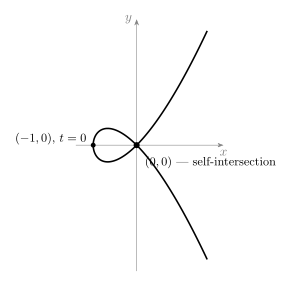
So the curve crosses itself at the origin, $(0,0)$.
Final answer, verified by direct substitution.
▪ solved
Examiner's eye
Always discard the "trivial" solution $a=b$ before reading off the self-intersection — the algebra will often produce it automatically (as $a=0$ did here), and it doesn't describe a genuine crossing, just the single point traced once.
The loop crosses itself at the origin — traced once as $t$ passes through $-1$ and again as $t$ passes through $1$.
Worked example 3
Intersection with a straight line · Challenge
A curve has parametric equations $x=t^2-t$, $y=2t+1$ for $t\in\mathbb{R}$. Find the coordinates of the points where the curve meets the line $y=x+3$.
MethodSubstitute the parametric expressions into the Cartesian equation of the line, then solve for t
1
At a point of intersection, $y=x+3$ holds with $x$ and $y$ given by the curve's parametric equations at the same value of $t$.
The curve and the line meet only where both equations are satisfied simultaneously at one t.
Collect everything on one side and factorise the resulting quadratic in t.
4
At $t=1$: $x=1-1=0$, $y=2+1=3$, giving $(0,3)$. Check: $x+3=3=y$. ✓
Substitute back into the parametric equations and verify against the line.
5
At $t=2$: $x=4-2=2$, $y=4+1=5$, giving $(2,5)$. Check: $x+3=5=y$. ✓
Repeat for the second solution.
6
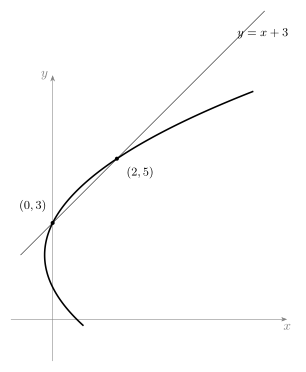
So the curve meets the line $y=x+3$ at $(0,3)$ and $(2,5)$.
Both points verified against the original line equation.
▪ solved
Look deeper
This method generalises directly to finding where a parametric curve meets any Cartesian curve, not just a straight line: substitute $x(t)$ and $y(t)$ into the other curve's equation, solve for $t$, then convert each solution back to a coordinate pair.
The parametric curve crosses the line $y=x+3$ at exactly the two points found algebraically, $(0,3)$ and $(2,5)$.
Common mistake
When finding a self-intersection, forgetting that the two parameter values must be different — the equations $x(a)=x(b)$ and $y(a)=y(b)$ are always satisfied by the trivial case $a=b$, which must be excluded before the genuine self-intersection can be identified.
Check yourself
A curve has parametric equations $x=t^2-4$, $y=t^3-4t$ for $t\in\mathbb{R}$. Find where the curve crosses the $x$-axis, and identify any self-intersection this reveals. (Hint: set y(t) = 0, solve for t, then compare the resulting x-values.)
Method
1
Set $y=0$: $t^3-4t=0 \Rightarrow t(t^2-4)=0 \Rightarrow t=0,\ 2,\ -2$.
Factorise fully to find every t where y(t) = 0.
2
At $t=0$: $x=-4$. At $t=2$: $x=4-4=0$. At $t=-2$: $x=4-4=0$.
Substitute each t back into x(t).
3
So the curve crosses the $x$-axis at $(-4,0)$, and passes through $(0,0)$ twice (at $t=2$ and $t=-2$) — a self-intersection at the origin.
Two distinct x-values from the axis crossing; the repeated x-value at t = ±2 is the self-intersection.