Volumes of Revolution: x- and y-axis
Spin a curve full circle about an axis and the region beneath it sweeps out a solid — sliced into infinitely many thin discs, its volume becomes a single integral.
The disc method
When the region under a curve $y=f(x)$, between $x=a$ and $x=b$, is rotated $360°$ about the $x$-axis, it sweeps out a solid of revolution. Slicing this solid into thin vertical discs of thickness $\delta x$ and radius $y$ gives each disc volume $\pi y^2\,\delta x$ (a cylinder's volume, $\pi r^2h$). Summing every disc and letting $\delta x\to0$ turns the sum into an integral.
$$V = \pi\int_a^b y^2\,\mathrm dx$$
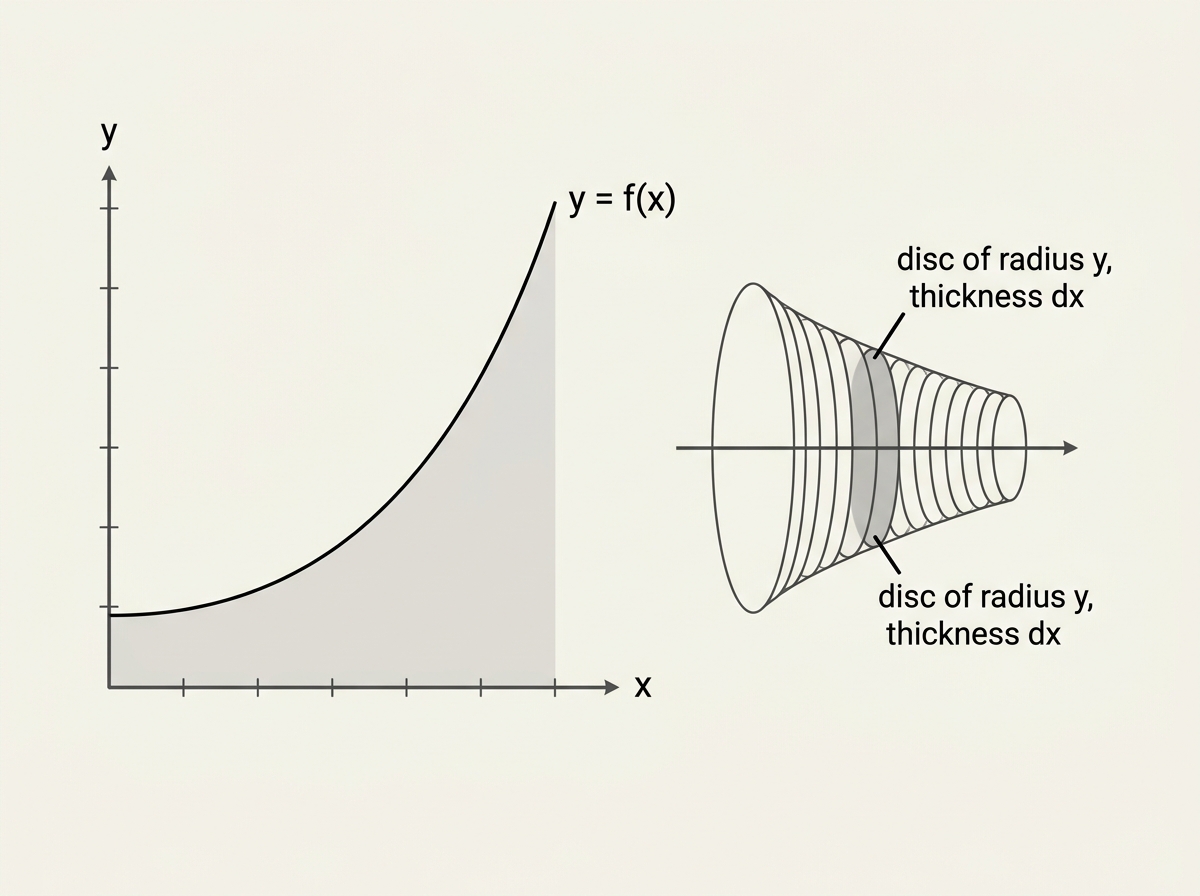
Rotating about the $y$-axis instead works identically, with the roles of $x$ and $y$ swapped: thin horizontal strips of width $\delta y$ and length $x$ sweep out discs of radius $x$.
$$V = \pi\int_c^d x^2\,\mathrm dy$$
$y^2=x$, so:
Since $y=x^2$, we have $x^2=y$ directly, so:
The curve meets the axis where $3-x^2=0$, i.e. $x=\pm\sqrt3$. Then $y^2=(3-x^2)^2=9-6x^2+x^4$.
The antiderivative is an odd function of $x$, so the definite integral is twice its value at $x=\sqrt3$:
So $V = \pi\times2\times4.8\sqrt3 = 9.6\sqrt3\,\pi = \dfrac{48\sqrt3\,\pi}{5}$.
The formula uses $y^2$, not $y$ — always square the function (or the given $y^2$ expression) before integrating, and don't forget the factor of $\pi$ out the front, which is easy to drop when the algebra inside the integral gets busy.
Exam-style questions
Question 1 5 marks
The region bounded by $y=e^x$, the $x$-axis, the $y$-axis and the line $x=\ln2$ is rotated $360°$ about the $x$-axis. Find the exact volume of the solid formed.
$V = \pi\displaystyle\int_0^{\ln2} e^{2x}\,dx = \pi\left[\dfrac{e^{2x}}{2}\right]_0^{\ln2}$ (M1, A1)
$= \dfrac{\pi}{2}\left(e^{2\ln2}-1\right) = \dfrac{\pi}{2}(4-1) = \dfrac{3\pi}{2}$ (M1, A1, A1)
Question 2 4 marks
The region bounded by the curve $y^2=4x$, the $x$-axis, and the line $x=1$ is rotated $360°$ about the $x$-axis. Find the volume of the solid formed.
$V = \pi\displaystyle\int_0^1 4x\,dx = \pi\left[2x^2\right]_0^1 = 2\pi$ (M1, A1, M1, A1)