Combining & Modelling Volumes
Subtract one solid of revolution from another to hollow out a shape, then use the same technique the other way round — to model the capacity of a real container.
Adding and subtracting volumes
When a region is enclosed between two curves and rotated about the $x$-axis, the resulting solid has a cavity running through it — like a napkin ring rather than a solid disc. Each thin slice is now a washer: a disc of radius $y_{\text{outer}}$ with a smaller disc of radius $y_{\text{inner}}$ removed from its centre.
If $y_1\geq y_2\geq0$ on $[a,b]$, rotating the region between $y=y_1$ and $y=y_2$ about the $x$-axis gives $$V = \pi\int_a^b \left(y_1^2-y_2^2\right)\mathrm dx$$
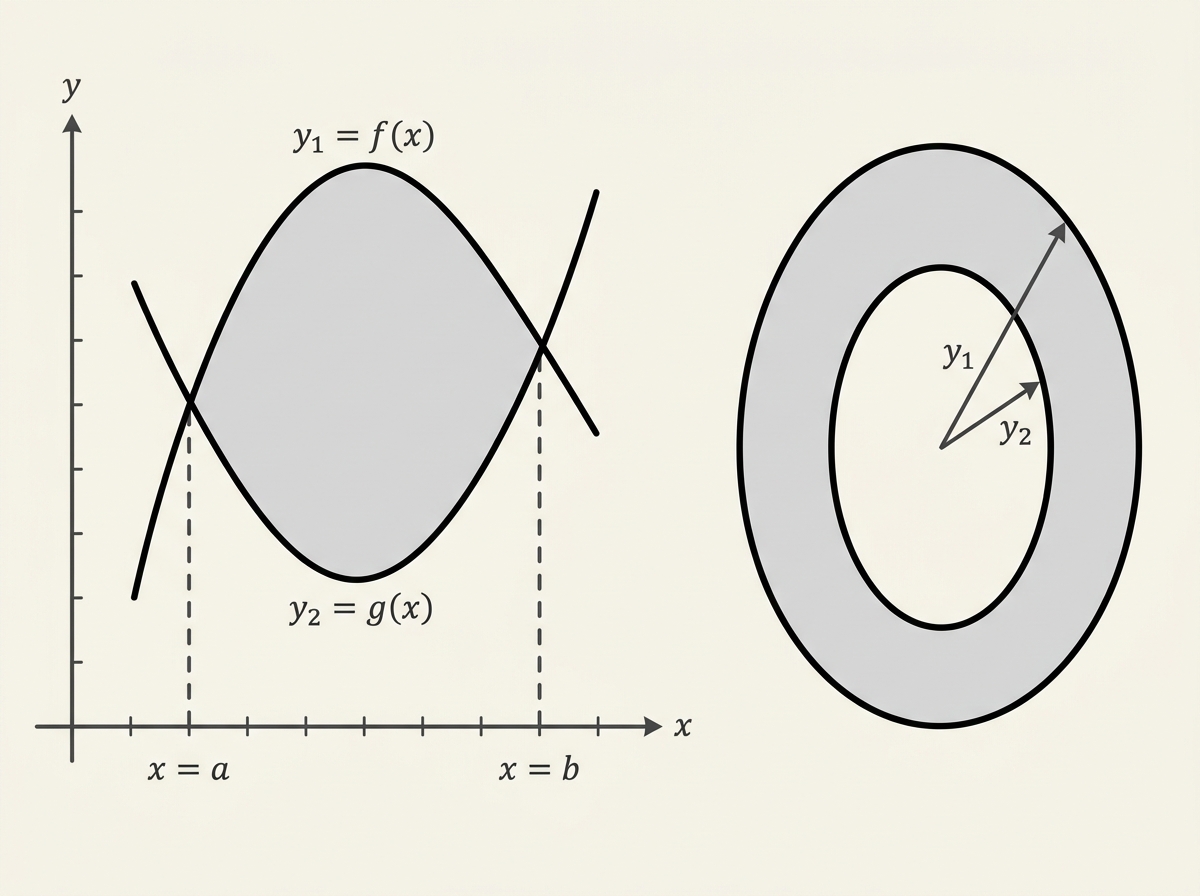
For $-\sqrt2\leq x\leq\sqrt2$, $4-x^2\geq x^2$, so the outer curve is $y_1=4-x^2$ and the inner is $y_2=x^2$.
Since the integrand is even, the integral is twice its value from $0$ to $\sqrt2$:
Modelling with volumes of revolution
The same integral, run in reverse, is how a curve is used to model the shape of a real container — a vase, a bowl, a wine glass — and predict its capacity, or find an unknown parameter given a stated capacity.
At $x=16$: $y=\dfrac12\sqrt{16}=2$, so the vase has height $2$ cm. Rearranging $y=\dfrac12\sqrt x$ gives $x^2=4y^2$.
Since $y=x^2$, we have $x^2=y$ directly.
Always check the model's domain matches the physical object: the height of a container corresponds to a range of $y$ (or $x$) values, and "filled to a depth of $h$" means integrating up to $y=h$, not necessarily to the container's full height. Sketching the curve alongside a rough cross-section of the real object is the fastest way to avoid setting up the wrong limits.
Exam-style questions
Question 1 7 marks
The line $y=x+1$ and the curve $y=x^2-1$ intersect at $x=-1$ and $x=2$. The region enclosed between the line and the curve, for $-1\leq x\leq2$, is rotated $360°$ about the $x$-axis. Find the exact volume of the solid formed.
(Hint: use $y_1^2-y_2^2$ with $y_1=x+1$ as the outer curve.)
$(x+1)^2-(x^2-1)^2 = (x^2+2x+1)-(x^4-2x^2+1) = -x^4+3x^2+2x$ (M1, A1)
$V=\pi\displaystyle\int_{-1}^2(-x^4+3x^2+2x)\,dx = \pi\left[-\dfrac{x^5}{5}+x^3+x^2\right]_{-1}^2$ (M1, A1)
At $x=2$: $-\dfrac{32}{5}+8+4=\dfrac{28}{5}$. At $x=-1$: $\dfrac15-1+1=\dfrac15$. Difference: $\dfrac{28}{5}-\dfrac15=\dfrac{27}{5}$ (M1, A1)
$V=\dfrac{27\pi}{5}$ (A1)
Question 2 5 marks
A bowl is modelled by rotating the curve $y=\dfrac{x^2}{3}$ ($0\leq x\leq3$, cm) $360°$ about the $y$-axis. Find the capacity of the bowl, in cm³, when filled to the brim ($x=3$).
At $x=3$: $y=3$, so the bowl has height 3 cm. From $y=\dfrac{x^2}{3}$, $x^2=3y$ (M1)
$V = \pi\displaystyle\int_0^3 3y\,dy = 3\pi\left[\dfrac{y^2}{2}\right]_0^3 = 3\pi\cdot\dfrac92 = \dfrac{27\pi}{2}\ \text{cm}^3$ (M1, A1, A1, A1)