Successive Transformations & Three Dimensions
Combining transformations means combining matrices — but the order you multiply in is the order the transformations are applied, read right to left.
Combining transformations
If transformation $M_1$ is applied first, followed by $M_2$, the single matrix representing the combined transformation is $M_2M_1$ — not $M_1M_2$. The matrix applied first is written on the right, closest to the coordinate vector.
Read composite transformations right to left: in $M_2M_1\mathbf{x}$, $\mathbf{x}$ is transformed by $M_1$ first, then the result is transformed by $M_2$. Getting this order backwards is one of the most common errors in this topic.
The combined matrix is $M_2M_1$:
This composite matrix represents reflection in the line $y=-x$.
Transformations in three dimensions
A $3\times3$ matrix transforms points in 3D space in the same way: the columns are the images of $\mathbf{i}=(1,0,0)$, $\mathbf{j}=(0,1,0)$, $\mathbf{k}=(0,0,1)$. Rotations about the coordinate axes have standard forms — for example, rotation by $\theta$ about the $z$-axis:
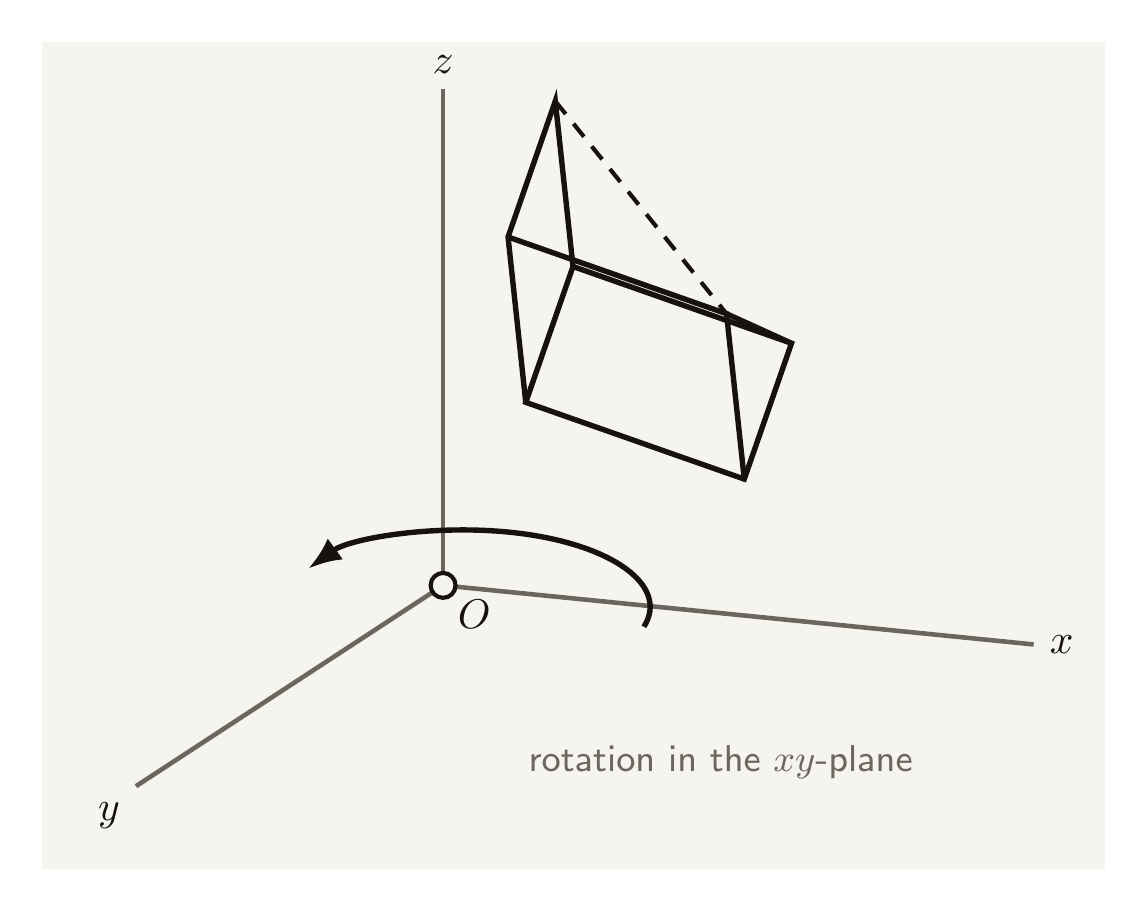
$\mathbf{i}\to\mathbf{i}$, $\mathbf{j}\to\mathbf{j}$, $\mathbf{k}\to-\mathbf{k}$, so the columns give:
Rotation matrix with $\theta=90°$: $R=\begin{pmatrix}0&-1&0\\1&0&0\\0&0&1\end{pmatrix}$. Reflection matrix: $F=\begin{pmatrix}1&0&0\\0&1&0\\0&0&-1\end{pmatrix}$.
Combined matrix (rotation first, so it's on the right): $FR$.
The image is $(-2,1,-3)$.
Writing $M_1M_2$ instead of $M_2M_1$ for "M₁ then M₂" is the single most common error in this topic — since matrix multiplication is not commutative, the two orders generally give completely different transformations.
Exam-style questions
Question 1 6 marks
$M_1$ represents an enlargement scale factor $2$; $M_2=\begin{pmatrix}0&1\\1&0\end{pmatrix}$ represents reflection in $y=x$. Find the single matrix for "enlargement, then reflection" and use it to find the image of $(3,-1)$.
$M_1=\begin{pmatrix}2&0\\0&2\end{pmatrix}$; combined matrix is $M_2M_1$ (M1)
$M_2M_1=\begin{pmatrix}0&1\\1&0\end{pmatrix}\begin{pmatrix}2&0\\0&2\end{pmatrix}=\begin{pmatrix}0&2\\2&0\end{pmatrix}$ (M1, A1)
$\begin{pmatrix}0&2\\2&0\end{pmatrix}\begin{pmatrix}3\\-1\end{pmatrix}=\begin{pmatrix}-2\\6\end{pmatrix}$ (M1, A1)
Image is $(-2,6)$. (A1)
Question 2 5 marks
Write down the $3\times3$ matrix for a rotation of $180°$ about the $x$-axis (leaving $x$ unchanged, and reversing the sign of $y$ and $z$), and find the image of $(2,3,-1)$.
$\begin{pmatrix}1&0&0\\0&-1&0\\0&0&-1\end{pmatrix}$ (M1, A1)
$\begin{pmatrix}1&0&0\\0&-1&0\\0&0&-1\end{pmatrix}\begin{pmatrix}2\\3\\-1\end{pmatrix}=\begin{pmatrix}2\\-3\\1\end{pmatrix}$ (M1, A1)
Image is $(2,-3,1)$. (A1)