Refraction & Total Internal Reflection
Light bends when it crosses into a new material because it changes speed there. That single fact — different speed, different bend — is the whole of refraction, and it explains why a glass fibre can trap light inside itself and carry it for kilometres without it escaping through the sides.
Refractive index: a measure of optical density
Light travels fastest in a vacuum, at $c = 3.00\times10^{8}\ \text{m s}^{-1}$. In any other material it travels more slowly, and the amount by which it slows down is captured by a single number: the refractive index of that substance, $n$.
where $c$ is the speed of light in a vacuum and $c_s$ is the speed of light in the substance. Since $c_s \leq c$, refractive index is always $\geq 1$, and as a ratio of two speeds it has no units. A larger refractive index means light travels more slowly and the material is more "optically dense" — glass ($n \approx 1.5$) slows light down more than water ($n \approx 1.33$) does.
Air slows light down so little that its refractive index is taken as approximately 1 throughout this course — refraction problems often treat "through air" and "through a vacuum" as interchangeable.
Snell's law
When a light ray crosses a boundary between two materials at an angle, it changes direction as well as speed — this bending is refraction. Angles are always measured from the normal, the line perpendicular to the boundary at the point the ray crosses it, never from the boundary surface itself.
The relationship between the angles on either side of the boundary follows directly from what refractive index means.
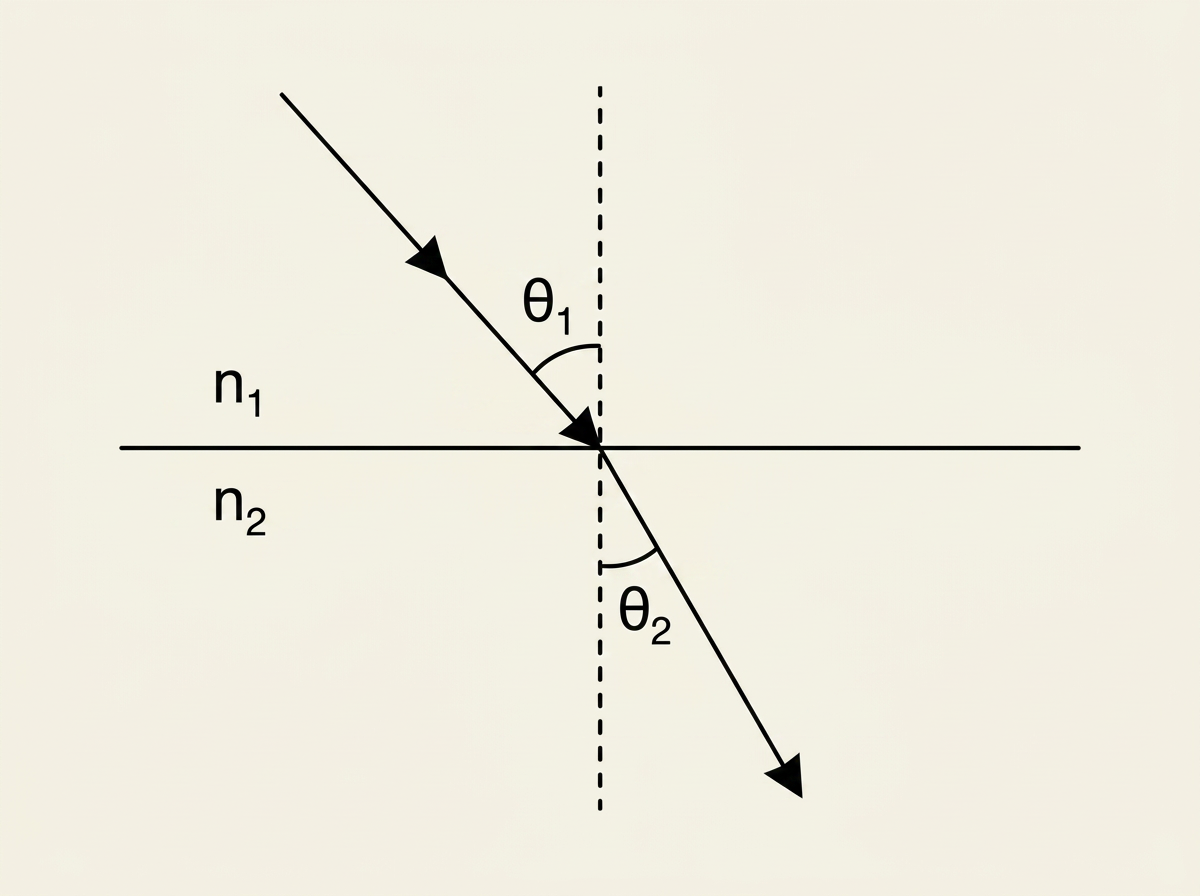
The equation shows the direction of bending: going into a medium with larger $n$ ($n_2 > n_1$), $\sin\theta_2$ must be smaller than $\sin\theta_1$ to balance, so the ray bends towards the normal. Going the other way, out of a denser medium, it bends away from the normal.
The critical angle and total internal reflection
Something distinctive happens when light travels from a denser medium into a less dense one — from glass into air, say. As the angle of incidence inside the glass increases, the refracted ray bends further from the normal, growing faster than the angle of incidence. At a certain angle of incidence, the critical angle $\theta_c$, the refracted ray grazes along the boundary itself, emerging at exactly 90° to the normal.
Push the angle of incidence past $\theta_c$ and there's no refracted ray left — all the light reflects back into the denser medium, obeying the ordinary law of reflection. This is total internal reflection (TIR); the critical angle marks the boundary between "some light refracts out" and "all of it reflects."
The most common exam situation is light escaping from glass, water or a fibre core into air, where $n_2 \approx 1$. The formula then simplifies to $\sin\theta_c = \dfrac{1}{n_1}$, usually written $\sin C = \dfrac{1}{n}$, where $n$ is the refractive index of the denser medium. Keep both versions ready: the general $\sin\theta_c = n_2/n_1$ for a named boundary, and $\sin C = 1/n$ for light meeting an air boundary.
Total internal reflection needs both things to be true at once: the light must be travelling from a denser medium into a less dense one ($n_1 > n_2$), and the angle of incidence must exceed the critical angle. Miss either condition — going the wrong way across the boundary, or hitting it at too shallow an angle of incidence — and you just get ordinary refraction (plus a weaker partial reflection), not TIR.
Fibre optics: trapping light with total internal reflection
An optical fibre is a long, thin strand of glass or plastic, thinner than a human hair, built to carry light along its length by total internal reflection. This course considers the simplest design, the step-index fibre, which has two layers: a central core with a high refractive index, surrounded by cladding with a lower refractive index.
That difference in refractive index is the entire point of the design. Light injected into the core at a shallow enough angle strikes the core–cladding boundary beyond the critical angle, so it's totally internally reflected, bounces back into the core, hits the opposite boundary, reflects again, and so on — bouncing down the fibre by repeated TIR rather than escaping through the sides.
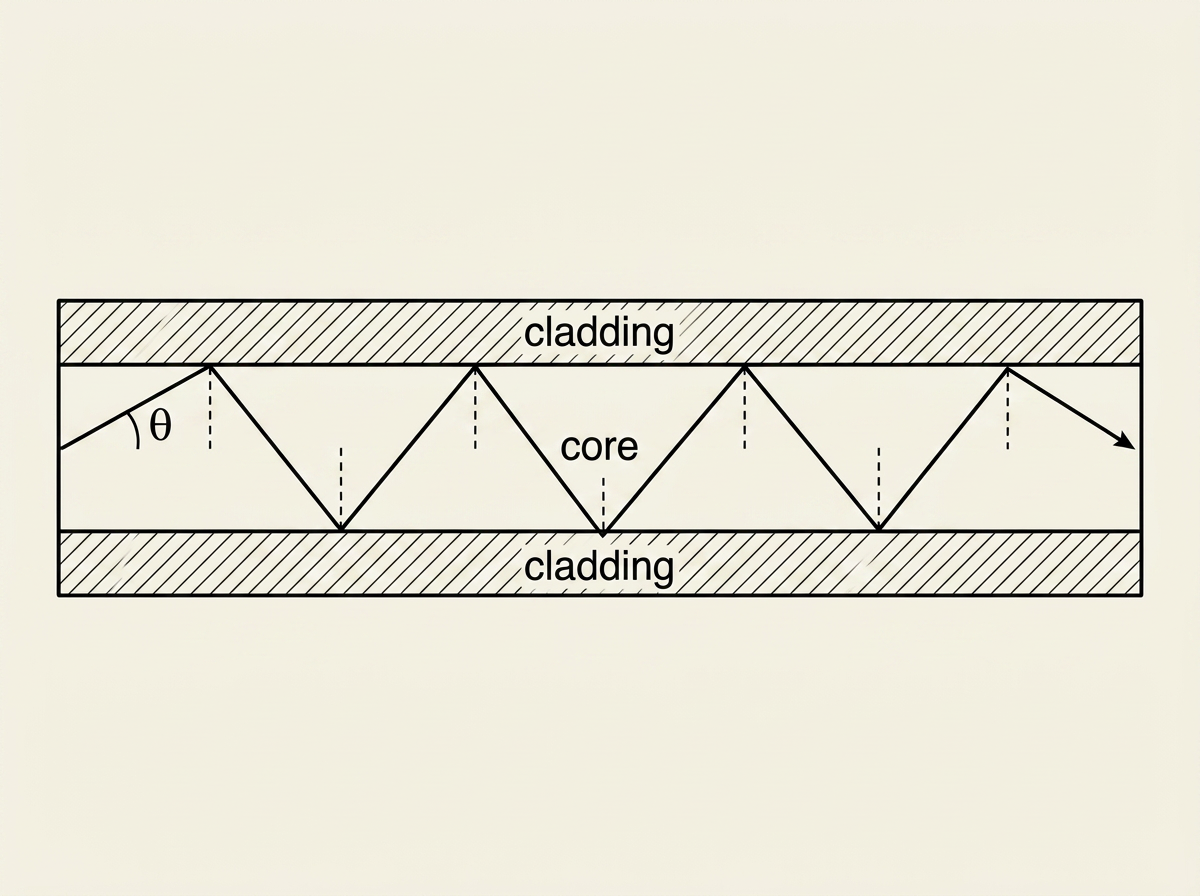
Without the cladding, the core's outer surface would be in contact with air or whatever the fibre happened to be touching — dust, moisture, another fibre. That would change the refractive index unpredictably at the surface and let light leak out wherever the fibre was disturbed. The cladding gives a clean, constant refractive index along the boundary, so the critical-angle condition holds along the fibre's entire length.
Why signals degrade: dispersion and absorption
A fibre doesn't carry a signal perfectly forever — several effects limit how much information it can carry and how far it can travel before needing a boost.
- Modal dispersion: rays entering at different angles take different zigzag paths down the core, so they travel different total distances despite heading to the same place. Steeper rays travel further and arrive slightly later, so a single sharp pulse arrives spread out in time — pulse broadening.
- Material dispersion: refractive index depends slightly on wavelength, and no real light source is a single wavelength. Different wavelengths travel at slightly different speeds through the core, adding to the broadening over a long fibre.
- Absorption: the core isn't a perfectly lossless medium, so some of the light's energy is absorbed as it travels, weakening the pulse on top of spreading it out.
Pulse broadening matters because if pulses are sent too close together, broadening can cause successive pulses to overlap by the time they reach the far end, so the receiver can't tell them apart — limiting how fast data can be sent down a given fibre.
Key takeaways
- Refractive index $n = c/c_s$ compares the speed of light in a vacuum to its speed in a substance; the refractive index of air is taken as approximately 1.
- Snell's law, $n_1\sin\theta_1 = n_2\sin\theta_2$, follows from the fact that the ratio of sines at a boundary equals the ratio of wave speeds either side of it.
- Light bends towards the normal entering a denser medium, and away from the normal entering a less dense one.
- Total internal reflection occurs only when light travels from a denser into a less dense medium, at an angle of incidence greater than the critical angle $\theta_c$, where $\sin\theta_c = n_2/n_1$ — simplifying to $\sin C = 1/n$ for the common case of light exiting into air.
- A step-index optical fibre has a high-refractive-index core surrounded by lower-refractive-index cladding, so light entering at a shallow angle is repeatedly totally internally reflected and stays trapped inside the core.
- The cladding gives a stable, controlled refractive index boundary, preventing light loss from surface contamination or contact with other fibres.
- Modal and material dispersion cause pulse broadening, and absorption reduces pulse amplitude — together these limit the rate at which information can be sent down a fibre before pulses start overlapping.