Young's Double-Slit Experiment
In 1801, Thomas Young shone light through two narrow slits and saw something Newton's particle theory had no way to explain: a pattern of alternating bright and dark bands. It was strong evidence for the wave nature of light — and it was ignored, or actively dismissed, for over a decade.
The experiment
By 1801, the debate between Newton's corpuscular theory (light as a stream of particles) and Huygens' wave theory had run for well over a century, with Newton's view dominant mainly on the strength of his reputation. Thomas Young set out an experiment simple enough to describe in a sentence, but decisive enough to eventually settle the question. He allowed light to pass through a single narrow slit first, to create one small, coherent source, and then let that light fall on a barrier containing two further slits, placed very close together — separated by a distance of a fraction of a millimetre. Beyond the two slits, he placed a screen.
What appeared on the screen was not two bright lines, as a naive particle picture might suggest, but a whole series of evenly spaced bright and dark bands — fringes — stretching across the screen, fading gradually in brightness away from the centre. This pattern is the direct result of light spreading out from each of the two slits (by diffraction) and then overlapping in the space beyond, so that at any given point on the screen, light has arrived there having travelled two slightly different path lengths — one from each slit.
The qualitative wave explanation
No numerical fringe-spacing calculation is needed here — that belongs to the AS Waves topic, where the mathematics of two-source interference is treated in full. What matters at this level is the qualitative picture of why bright and dark bands appear at all, because that qualitative picture is the entire argument for the wave theory.
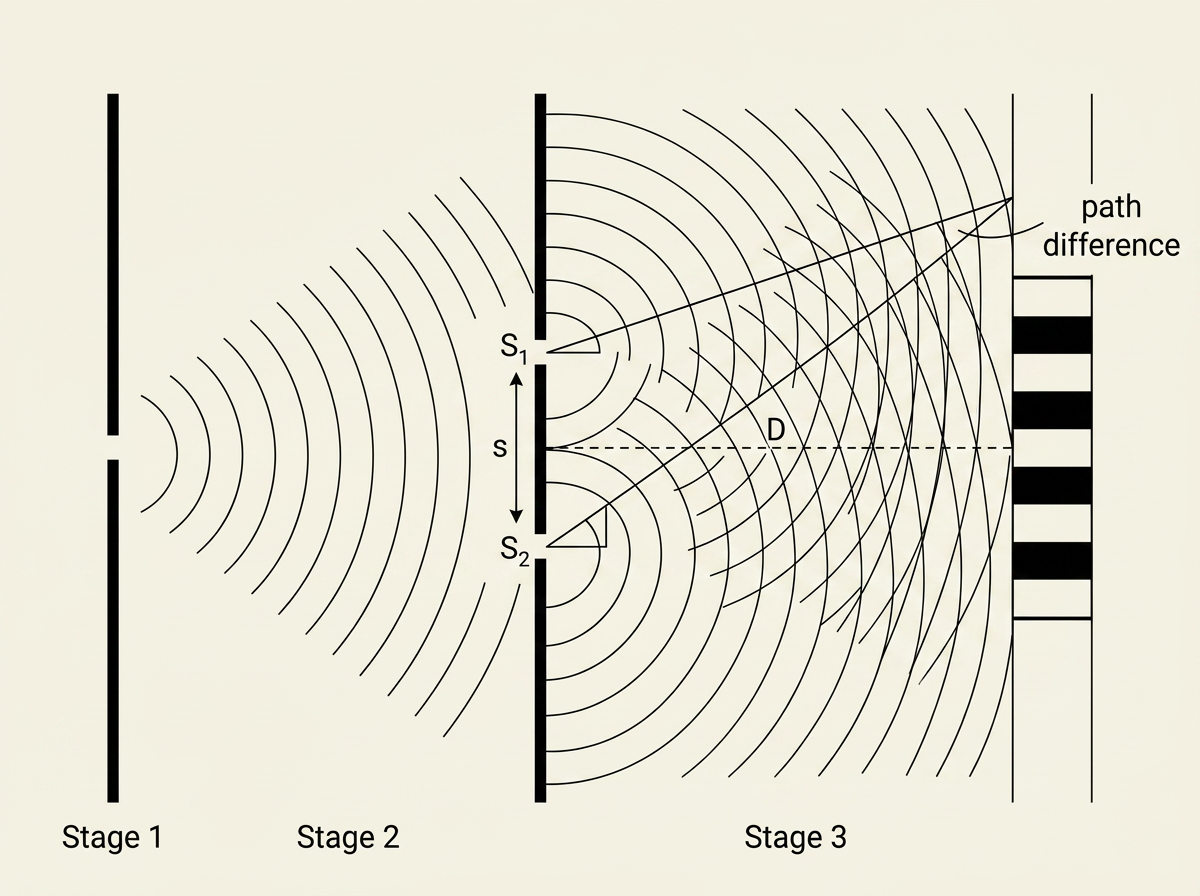
At any point on the screen, two waves arrive — one having travelled from the top slit, one from the bottom slit — and they superpose. Where the two waves arrive in phase (crest lining up with crest, trough with trough), they reinforce one another and produce a region of maximum brightness: constructive interference, seen as a bright fringe. Where the two waves arrive exactly out of phase (crest lining up with trough), they cancel each other out almost completely, producing a region of near-total darkness: destructive interference, seen as a dark fringe. Moving along the screen shifts the small difference in the two path lengths, which shifts the phase relationship between the two arriving waves, which is why the pattern alternates regularly between bright and dark rather than showing just one bright and one dark patch.
A stream of classical particles passing through two slits, travelling in straight lines and never interacting with each other, could only ever build up two overlapping smudges of brightness directly behind the two slits, fading smoothly outward — with no dark bands at all, and certainly no regular alternating pattern. There is no mechanism by which a particle arriving via one slit could "cancel out" a particle arriving via the other slit. Interference of this alternating, regularly repeating kind is only possible for something that can be in two places' worth of phase at once and combine additively or subtractively — that is, a wave. This is why Young's fringes count as such strong evidence: the pattern itself, not just its details, requires a wave explanation.
A strong result — but not an immediate one
Given how directly this result seems to rule out the particle theory, it might be expected that physicists abandoned Newton's corpuscular theory within months. They did not. Acceptance of the wave theory of light was delayed by well over a decade, for reasons that were as much social and institutional as they were scientific.
- Newton's authority. Newton's reputation as the towering figure of physics carried enormous weight, particularly in Britain, and his corpuscular theory was treated by many as close to settled fact rather than one hypothesis among others.
- Young's explanation lacked rigorous backing. Young presented his interference idea largely in qualitative and geometric terms. Without a fuller mathematical treatment showing precisely how the wave theory predicted the fringe spacing, reflection, refraction and other established behaviours of light all at once, critics could dismiss the interference explanation as suggestive rather than proven.
- Some influential physicists rejected it outright. Young's work was reviewed harshly by prominent critics who defended the established corpuscular view, and the resulting reception discouraged the wave theory from being taken up quickly, even among physicists who might otherwise have found the fringe evidence persuasive.
Young's fringes are, with hindsight, about as clean a piece of evidence as physics offers for a specific theoretical claim — yet they didn't win the argument on their own. It took Augustin-Jean Fresnel's much fuller mathematical treatment of wave optics, over a decade later, before the wave theory became the accepted mainstream view (the next lesson covers this in full). And even the wave theory's eventual triumph was not the end of the story: the same double-slit apparatus, used with electrons over a century later, produces a diffraction-and-interference pattern that forces physicists to accept that matter has a wave character too — a reminder that "settled" physics has repeatedly had to be revisited as new evidence and better theory emerged.
What finally cemented the wave theory as fact, beyond any reasonable doubt, was not more fringes but a completely different kind of evidence: James Clerk Maxwell's electromagnetic theory, decades later, which showed that light had to be a wave as a mathematical consequence of the laws of electricity and magnetism themselves. That result is covered in full a little further into this module, once diffraction and interference as general wave phenomena have been established.
Key takeaways
- Young's 1801 experiment passed light through two closely spaced slits and produced a pattern of alternating bright and dark fringes on a screen beyond.
- Bright fringes occur where light waves from the two slits arrive in phase and interfere constructively; dark fringes occur where they arrive out of phase and interfere destructively.
- This is a purely qualitative explanation at this level — no fringe-spacing calculation is required here (see the AS Waves topic for that).
- A stream of classical particles could never produce an alternating bright-dark pattern, since particles travelling independently in straight lines cannot cancel each other out — only waves can interfere.
- Despite this strong evidence, the wave theory was not immediately accepted: Newton's reputation, the lack of rigorous mathematical backing in Young's own account, and outright dismissal by influential critics delayed acceptance for over a decade.
- It took Fresnel's mathematical treatment of wave optics, and much later Maxwell's electromagnetic theory, to finally settle the debate for good.