The Photoelectric Effect
Planck's quantum trick fixed one spectrum. The photoelectric effect showed the crack in classical physics ran far deeper — light hitting a metal surface behaved in ways a continuous wave simply could not produce, no matter how the wave theory was adjusted.
Recap: what the photoelectric effect is
The photoelectric effect is covered in full — including the stopping-potential apparatus, the graph of maximum kinetic energy against frequency, the work function, and worked numerical examples — in the core Photoelectric Effect lesson under the Electromagnetic Radiation and Quantum Phenomena topic. This lesson assumes that groundwork and only recaps the essential picture, since the point here is historical and conceptual: to spell out exactly why classical wave theory cannot explain this phenomenon, and to frame the puzzle that Einstein's photon model resolves.
In brief: when electromagnetic radiation of a high enough frequency strikes the surface of a metal, electrons are ejected from that surface. This is the photoelectric effect. Three specific features of how this emission actually behaves, measured carefully in the laboratory, turn out to be completely incompatible with treating light as a continuous, classical electromagnetic wave.
Failure one: kinetic energy depends on frequency, not intensity
A continuous wave carries energy spread evenly across its wavefront, with the total energy delivered per second to a given area set by the wave's intensity — a brighter (more intense) light source delivers energy faster than a dimmer one at the same frequency. On this picture, a more intense beam should be able to pump more energy into an electron at the metal surface, so the maximum kinetic energy of ejected electrons ought to increase as the light is made brighter.
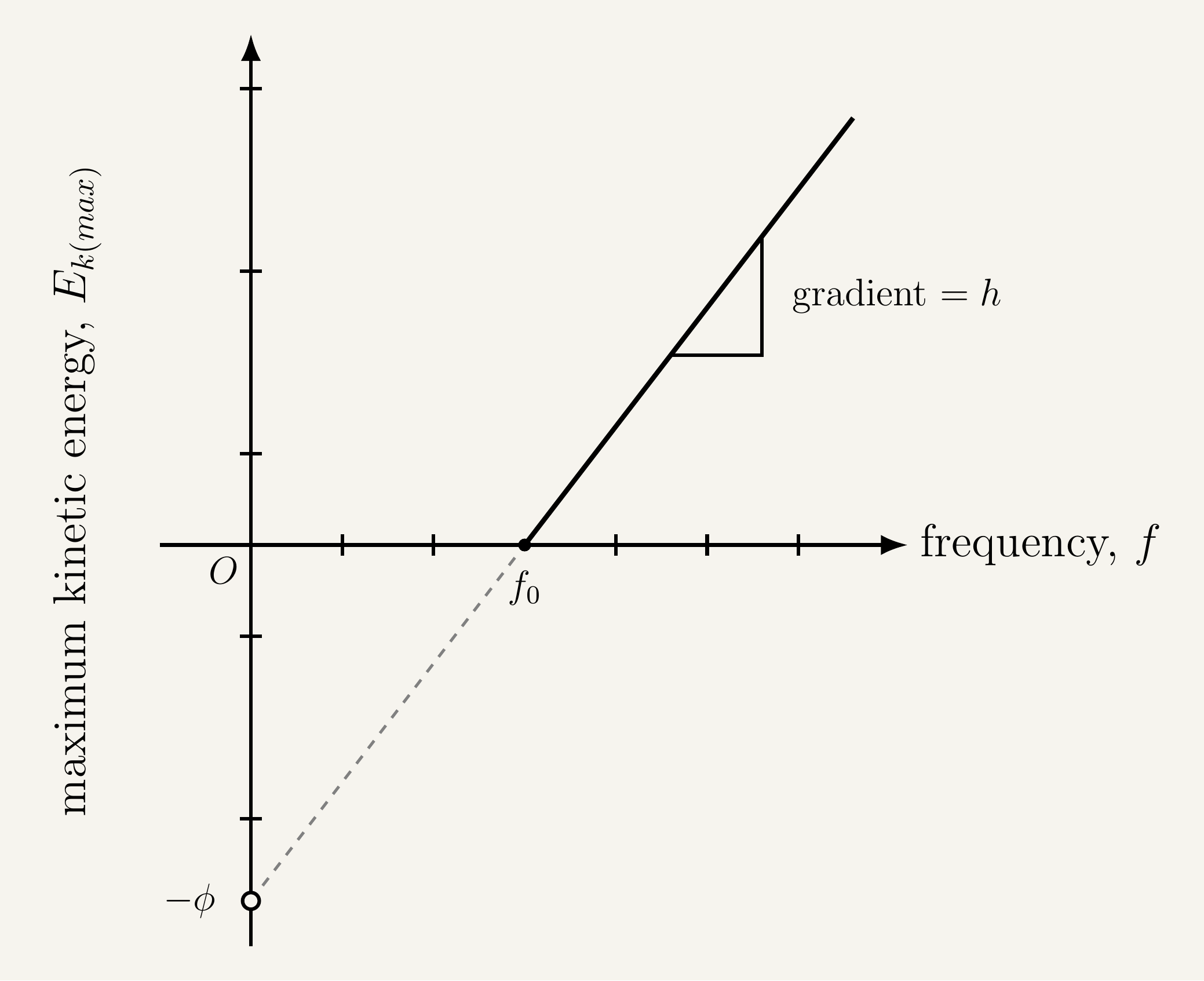
That is not what happens. Experimentally, the maximum kinetic energy of the emitted electrons, $KE_{max}$, depends only on the frequency of the incident light, and is completely unaffected by intensity. Increasing the intensity of light at a fixed frequency increases the number of electrons emitted per second (more energy arriving overall means more individual emission events), but every single one of those electrons still leaves with the same maximum kinetic energy as before. Classical wave theory has no mechanism to explain why intensity should control the emission rate but have zero effect on each individual electron's energy.
Failure two: a sharp threshold frequency
A classical wave, given enough time and a large enough amplitude, should eventually be able to deliver enough energy to free an electron from the metal at any frequency at all — a dim beam of low-frequency light should still work eventually, since energy just needs to accumulate at some point on the surface until it's enough to release an electron.
Instead, every metal shows a sharp threshold frequency, $f_0$: below this specific frequency, no photoelectric emission occurs whatsoever, regardless of how intense the light is or how long it shines on the surface. A dim beam above the threshold frequency causes emission (of fewer electrons); an arbitrarily intense beam below the threshold frequency causes no emission at all, however long it's left shining. Classical wave theory offers no reason why frequency alone, rather than total energy delivered, should determine whether emission happens at all.
Failure three: emission is instantaneous
If a classical wave is depositing energy continuously and gradually across the metal's surface, a very dim beam (just above the threshold frequency) should take a measurable amount of time to build up enough energy at any one point to release an electron — a detectable delay between the light switching on and the first electrons appearing, growing longer as intensity is reduced.
No such delay is observed. Whenever the incident frequency is above the threshold frequency, photoelectric emission begins instantaneously, with no measurable time lag at all — even for extremely dim light. Classical wave theory predicts a build-up period that simply does not exist in reality.
All three failures point to the same underlying issue: classical wave theory treats a beam of light as continuously spread-out energy, shared smoothly across the whole wavefront, that any single electron gradually accumulates over time. Every one of the three observed behaviours instead looks as if a single electron receives its entire share of energy in one abrupt, all-or-nothing event, whose size depends only on frequency — not on the total intensity of the beam, and not on any accumulation time at all.
Maximum kinetic energy vs. intensity: a wave predicts $KE_{max}$ should rise with intensity; observation shows $KE_{max}$ depends only on frequency. Threshold frequency: a wave predicts any frequency should eventually cause emission; observation shows a sharp cut-off frequency below which nothing happens, at any intensity. Time delay: a wave predicts a build-up period at low intensity; observation shows emission is instantaneous. Three independent measurements, three independent contradictions of the same classical wave picture — and, as it turns out, one single new idea that resolves all three at once.
That single new idea is Einstein's 1905 photon hypothesis: treating light itself, not just the exchange of energy as Planck had it, as made of discrete quanta of energy $E=hf$, each one interacting with at most one electron in an instantaneous, all-or-nothing event. The next lesson works through exactly how that picture resolves all three of the failures described here.
Key takeaways
- The photoelectric effect is light striking a metal surface and ejecting electrons — see the core Photoelectric Effect lesson (Electromagnetic Radiation and Quantum Phenomena) for the full derivation and worked examples.
- Classical wave theory predicts $KE_{max}$ should increase with intensity; observation shows $KE_{max}$ depends only on frequency, and is unaffected by intensity.
- Classical wave theory predicts any frequency should eventually cause emission given enough time or intensity; observation shows a sharp threshold frequency below which no emission occurs at all.
- Classical wave theory predicts a measurable time delay at low intensity, as energy builds up; observation shows emission is instantaneous whenever frequency exceeds the threshold.
- All three failures point to the same problem: light appears to transfer energy to electrons in discrete, all-or-nothing events depending on frequency, not as continuously spread-out wave energy depending on intensity.
- These three specific contradictions form the exact puzzle that Einstein's photon model, covered in the next lesson, is designed to resolve.