Electron Energy Levels
Thomson's discovery didn't just show that electrons exist — it immediately raised the question of how they're arranged inside the atom. The answer is one of the strangest and most important ideas in twentieth-century physics: electrons can only exist at certain fixed energies, never anywhere in between.
From "an electron exists" to "where is it?"
Once Thomson had shown that atoms contain electrons, the obvious next question was how those electrons are actually arranged. A tempting first guess, developed shortly afterward, was that electrons might simply orbit the nucleus the way planets orbit the Sun, free to sit at any distance and any energy at all. That guess turned out to be wrong in a very specific and important way — worked out chiefly by Niels Bohr in the following decades — and the correct picture is one of the pillars of quantum physics.
Bohr's model proposed that an electron bound to an atom cannot have just any energy. Instead, it can only occupy one of a specific, limited set of allowed energies, called energy levels. Between these allowed levels lie forbidden gaps: energies an electron in that atom is simply never found to have. This is what's meant by saying the electron's energy is quantised — restricted to a discrete set of values, rather than able to vary continuously.
A simple picture: levels and a falling electron
It helps to picture an atom's energy levels as a set of horizontal lines stacked on a vertical energy scale, a little like the rungs of a ladder, though unevenly spaced. The lowest line represents the ground state — the lowest-energy, most stable arrangement, and the one an isolated atom's electron normally occupies. Each line above it represents a higher-energy, excited state that the electron can be raised into, but won't stay in for long.
An electron can move from one level to another, but only by absorbing or emitting energy that exactly matches the gap between the two levels — it cannot make a partial jump, and it cannot sit between two levels even momentarily. Picture an electron sitting on a higher rung of the ladder (an excited state) dropping down to a lower rung (a lower energy level, possibly the ground state). As it drops, it must release exactly the energy difference between the two rungs, and it does this by emitting a single particle of light — a photon — carrying away precisely that amount of energy.
Why every element has its own signature
The exact energies of an atom's allowed levels depend on the detailed internal structure of that particular type of atom — how many electrons it has, how they're arranged, and the strength of the electrical attraction holding them to the nucleus. Because no two elements share exactly the same set of energy levels, no two elements share exactly the same set of possible transitions, and therefore no two elements emit or absorb exactly the same set of photon energies.
Since each transition energy $\Delta E$ corresponds to one exact photon frequency (and therefore one exact wavelength of light, via $c = f\lambda$), this means every element produces its own unique, fixed pattern of wavelengths — a line spectrum — when its electrons are excited and then fall back down through the available levels. Viewed through a spectrometer, this pattern appears as a series of sharp, bright lines at specific wavelengths (an emission spectrum) or as sharp dark gaps in an otherwise continuous spectrum, at the same wavelengths, when light passes through a cooler gas of the same element and photons of just the right energy are absorbed (an absorption spectrum). Because the pattern is unique to each element, it acts like a fingerprint, letting astronomers and chemists identify which elements are present in a light source — from a laboratory flame test to the light arriving from a distant star — purely by analysing the wavelengths present.
Discrete atomic energy levels and their line spectra are covered in full, with worked spectral-line calculations and the numerical energy-level structure of hydrogen, in the Atomic Line Spectra lesson under the core Electromagnetic Radiation and Quantum Phenomena topic. That treatment applies without modification here — Thomson's electron is exactly the particle occupying the energy levels described there.
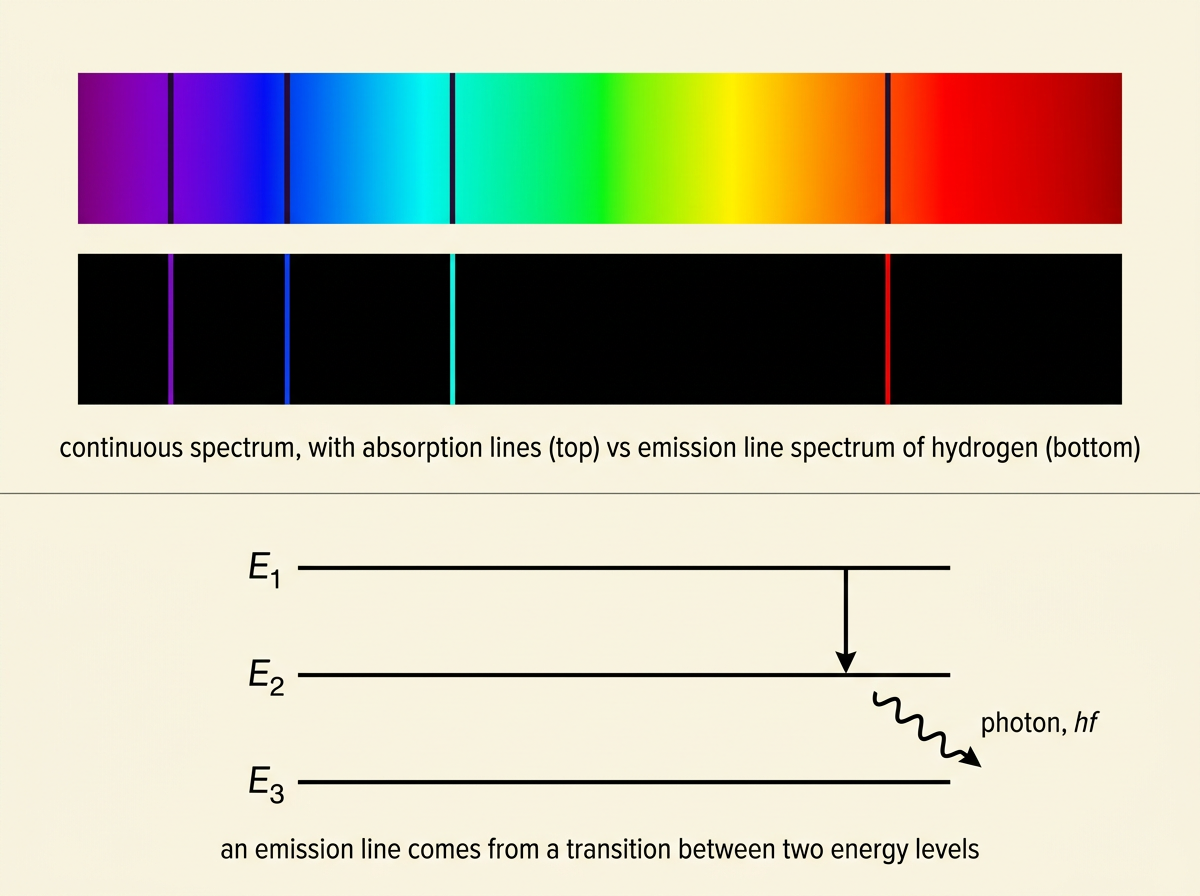
The historically radical part of this picture wasn't that atoms contain electrons — Thomson had already established that. It was the discovery that those electrons' energies are restricted to a discrete set of allowed values at all, rather than varying smoothly like the energy of a planet in orbit at any distance from the Sun. That discreteness is a genuinely quantum phenomenon, with no equivalent in the everyday, classical physics of orbits and continuous energy that came before it.
Key takeaways
- Thomson's discovery of the electron raised the question of how electrons are arranged inside an atom.
- Bohr's model shows electrons can only occupy certain discrete, quantised energy levels, not a continuous range of energies.
- The lowest energy level is the ground state; higher levels are excited states.
- An electron moving between two levels absorbs or emits a photon whose energy exactly matches the gap between them, $\Delta E = hf$, and never any other amount.
- Because each element's energy levels are arranged differently, each element has a unique set of possible transitions and therefore a unique line spectrum.
- Line spectra (emission or absorption) let elements be identified from the light they give out or absorb, from laboratory samples to distant stars.
- The full derivation and worked spectral-line examples are covered in the Atomic Line Spectra lesson under Electromagnetic Radiation and Quantum Phenomena.