The Photoelectric Effect
Shine a dim blue light on a clean zinc plate and electrons fly off immediately. Shine an intensely bright red light on the same plate and nothing happens, no matter how long you wait. That stubborn observation forced physicists to accept that light, in some situations, behaves as a stream of particles rather than a spreading wave.
What the photoelectric effect is
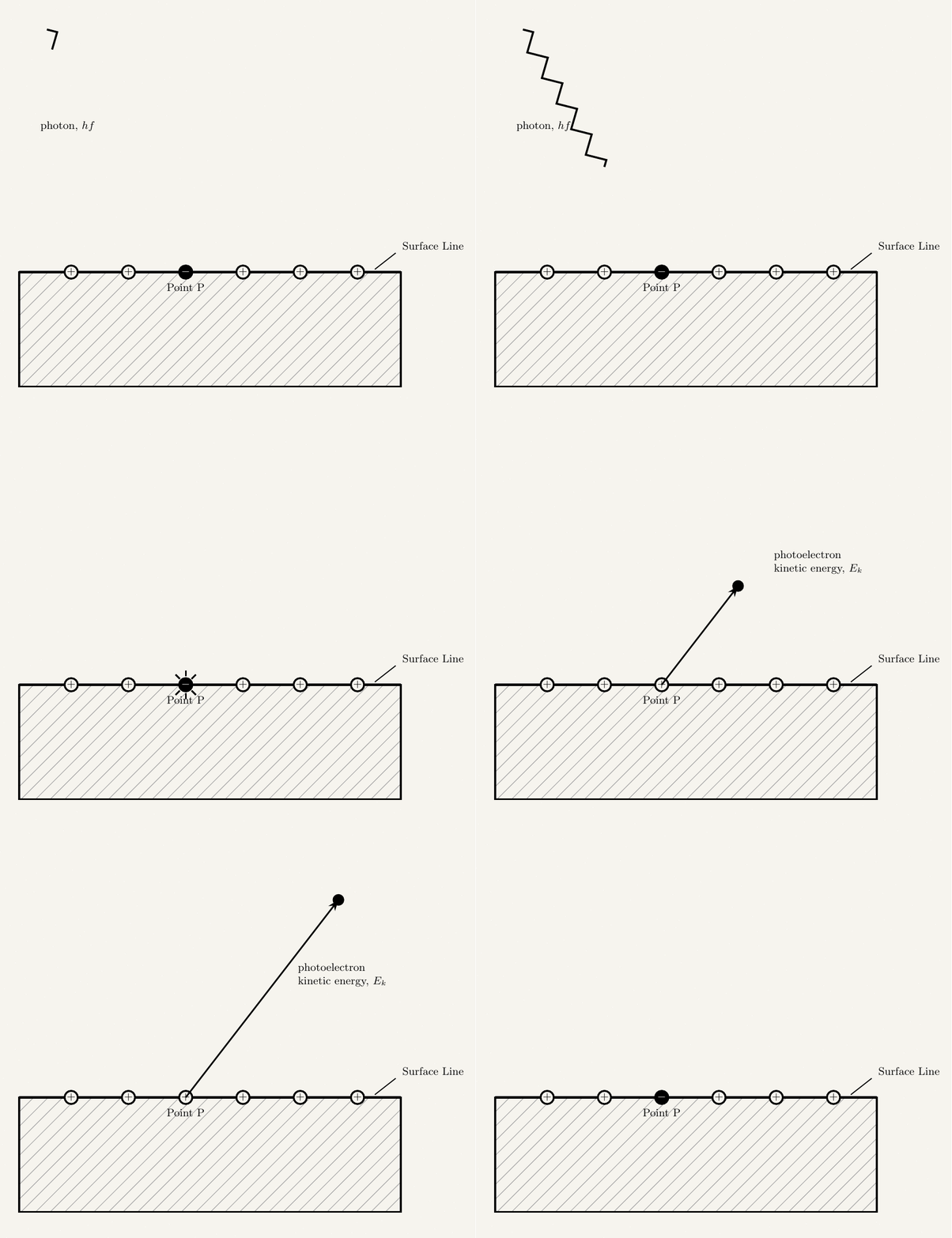
When electromagnetic radiation of a high enough frequency is shone onto a metal surface, electrons are emitted. These ejected electrons are called photoelectrons, and the phenomenon is the photoelectric effect. It happens because electrons in a metal are held by the attraction of surrounding positive metal ions, and absorbing enough energy from incoming radiation lets an electron break free and escape the surface.
Threshold frequency
For any given metal, photoelectrons are only emitted if the frequency of incident radiation is above a certain minimum, the threshold frequency. Below it, no electrons are emitted at all, regardless of intensity or exposure time. Above it, electrons are emitted essentially instantly, even at very low intensity.
That's exactly what the wave model of light cannot explain.
Why this broke the wave model of light
Treating light as a continuous wave, its energy is spread across the wavefront, and intensity measures energy delivered per second. On that picture, a dim light should just deliver energy more slowly — an electron would gradually accumulate energy over time and eventually escape, whatever the frequency, given enough exposure.
None of that is observed. Below the threshold frequency, no amount of intensity or waiting produces a single photoelectron. Above it, electrons appear with no measurable delay, even from a very dim source. Intensity controls how many photoelectrons are emitted per second, not whether they're emitted — the opposite of the wave model's prediction.
The explanation requires treating light as arriving in discrete packets of energy, photons, rather than a continuous wave. Each photon carries fixed energy set by its frequency, $E = hf$, where $h$ is the Planck constant. The effect happens one photon at a time: a single electron absorbs a single photon. If that photon doesn't carry enough energy, the electron can't escape, however many other photons arrive elsewhere — more intensity just means more photons per second, each still carrying the same amount of energy. This is why the threshold frequency exists: it's where a single photon's energy first becomes just enough to free an electron.
Explaining the photoelectric effect this way established that light has a particulate nature, alongside its well-established wave behaviour (diffraction, interference). This is the first half of a two-way argument for wave-particle duality — the second half, that particles can behave like waves, is the subject of a later lesson.
Work function and stopping potential
The minimum energy needed to remove an electron from a metal's surface is the work function, $\phi$, measured in joules (often quoted in electronvolts) — a fixed property of the metal reflecting how strongly its surface electrons are bound.
Photoelectrons don't all leave with the same kinetic energy. Some sit right at the surface and lose only the work function's worth of energy escaping; others sit deeper and lose additional energy through collisions on the way out, leaving with less kinetic energy. The fastest photoelectrons define the maximum kinetic energy, $E_{k(\max)}$, for a given frequency of light.
This can be measured using a stopping potential: the minimum reverse potential difference that just stops even the fastest photoelectrons reaching a collector. The work done against it in decelerating the fastest electrons to rest must equal their initial kinetic energy:
where $V_s$ is the stopping potential and $e$ is the electron's charge — the definition of the electronvolt applied to this situation.
Beyond the concept above, it's worth knowing the experimental method too. Light of fixed frequency is shone onto a photocathode inside an evacuated photocell, in a circuit with a variable power supply and a microammeter. Forward-biased, a photocurrent flows and is measured; the supply is then reversed and its voltage gradually increased, decelerating the photoelectrons so the photocurrent falls. The stopping potential $V_s$ is the reverse voltage at which the photocurrent just reaches zero — the point where even the fastest photoelectrons are turned back. Repeating for several frequencies and plotting $V_s$ against $f$ gives a straight line of gradient $h/e$, confirming $E_{k(\max)} = hf-\phi$ experimentally.
The photoelectric equation
Putting photon energy, work function and maximum kinetic energy together gives the central equation of this topic, following directly from conservation of energy applied to a single photon–electron interaction.
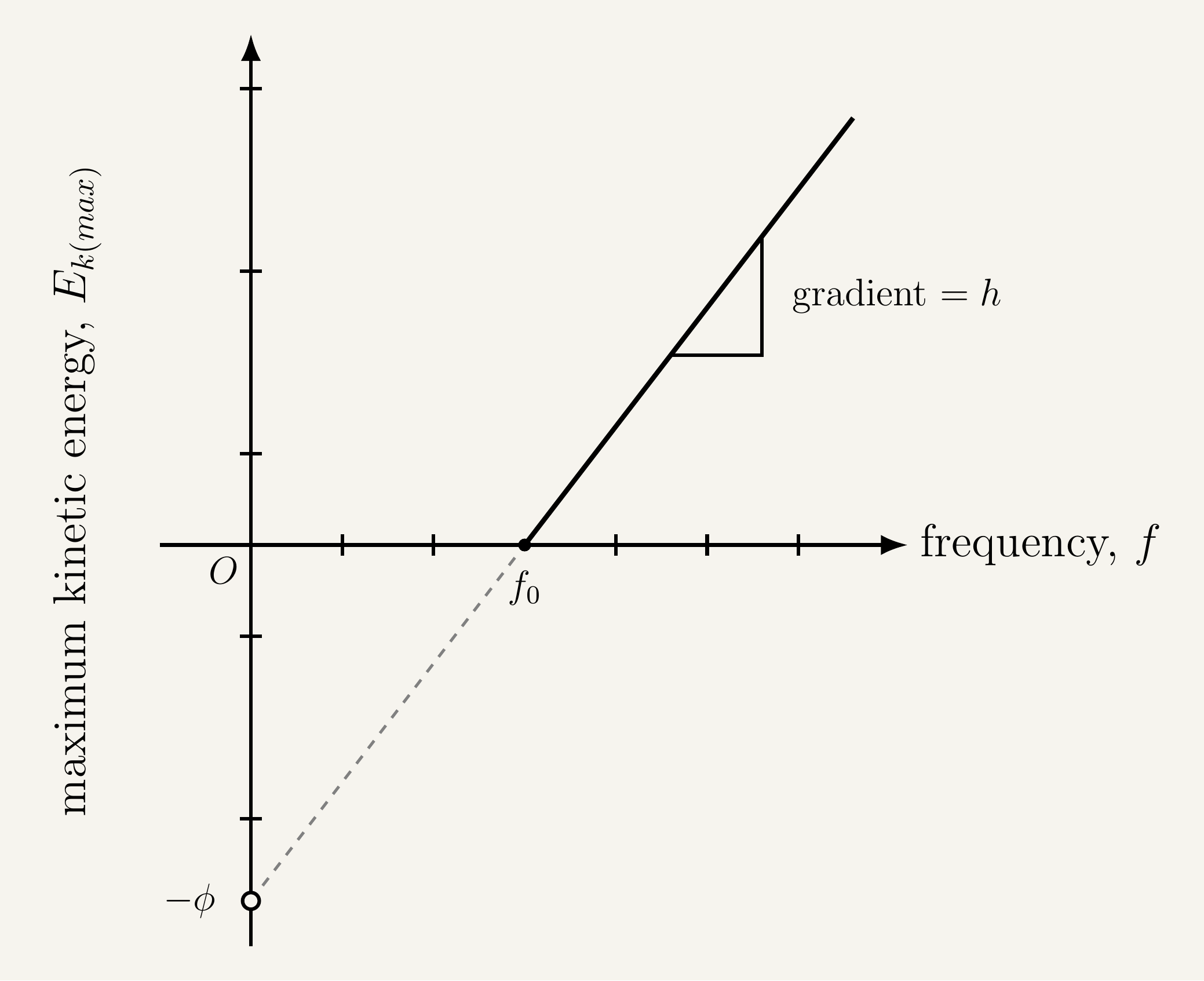
$E_{k(\max)}$ specifically appears here, rather than an average, because electrons bound deeper in the metal give up more energy escaping past neighbouring ions, leaving with less kinetic energy. Only electrons starting right at the surface keep the full leftover amount, $hf - \phi$ — every other emitted electron has strictly less.
Every joule of a photon's energy goes to one of two places once absorbed: a fixed "entry fee" set by the metal ($\phi$), and whatever's left over as kinetic energy. Increasing frequency increases photon energy, which increases $E_{k(\max)}$ directly — this is why maximum kinetic energy depends on frequency, not intensity. Increasing intensity increases the number of photoelectrons emitted per second, but does nothing to each photon's energy.
Key takeaways
- The photoelectric effect is the emission of photoelectrons from a metal surface when radiation above a threshold frequency is incident on it.
- Below the threshold frequency, no photoelectrons are emitted at any intensity; above it, emission is effectively instantaneous even at low intensity — this contradicts the wave model of light, which predicts intensity alone should determine emission.
- The photon model resolves this: light arrives in discrete packets of energy $E = hf$, and one electron absorbs one photon in a single event.
- The work function $\phi$ is the minimum energy needed to remove an electron from a given metal's surface.
- Stopping potential is the minimum reverse pd needed to just stop the fastest photoelectrons reaching a collector, giving an electrical way to measure $E_{k(\max)}$ via $eV_s = E_{k(\max)}$: increase the reverse pd until the photocurrent falls to zero.
- The photoelectric equation, $hf = \phi + E_{k(\max)}$, follows from energy conservation applied to a single photon absorption. E.g. for sodium ($\phi=3.78\times10^{-19}\,\text{J}$) and 450 nm light, $E=4.42\times10^{-19}\,\text{J} > \phi$, so emission occurs with $E_{k(\max)} = 6.4\times10^{-20}\,\text{J}$.
- $E_{k(\max)}$ applies to surface electrons specifically, since electrons bound deeper lose extra energy escaping and so leave with less kinetic energy.
- The photoelectric effect was key evidence that light has a particulate nature, alongside its established wave behaviour.