Position vectors locate every point in space at once — subtract two of them, and the line joining them falls out for free.
13 min read6 worked examples
Arithmetic and parallel vectors in 3D
Addition, subtraction, and scalar multiplication of 3D vectors all work exactly as in 2D, applied component-by-component across all three entries. Two non-zero vectors $\mathbf{a}$ and $\mathbf{b}$ are parallel precisely when one is a scalar multiple of the other, $\mathbf{b}=\lambda\mathbf{a}$ for some scalar $\lambda$ — which in 3D means each corresponding pair of components must share the same scale factor.
Checking parallelism componentwise
For $\mathbf{a}=\begin{pmatrix}a_1\\a_2\\a_3\end{pmatrix}$ and $\mathbf{b}=\begin{pmatrix}b_1\\b_2\\b_3\end{pmatrix}$ to be parallel, $\dfrac{b_1}{a_1}=\dfrac{b_2}{a_2}=\dfrac{b_3}{a_3}$ must all give the same value of $\lambda$. If even one ratio disagrees, the vectors are not parallel — this is a stricter check than in 2D, since there's a third component that must also agree.
Position vectors and displacement in 3D
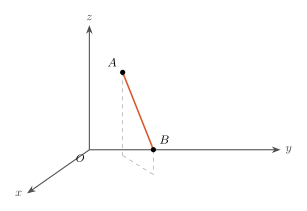
A position vector locates a point relative to a fixed origin $O$; the point $A=(a_1,a_2,a_3)$ has position vector $\overrightarrow{OA}=\mathbf{a}=a_1\mathbf{i}+a_2\mathbf{j}+a_3\mathbf{k}$. Exactly as in 2D, the displacement vector from one point to another is found by subtracting position vectors:
$\overrightarrow{AB} = \mathbf{b}-\mathbf{a}$
This single relationship is the engine behind almost every 3D geometric problem: once two points' position vectors are known, the vector connecting them — and hence the direction, and (via the magnitude formula) the distance between them — follows immediately.
Distance between two points in 3D
The distance between points $A(x_1,y_1,z_1)$ and $B(x_2,y_2,z_2)$ is the magnitude of $\overrightarrow{AB}$, giving the 3D distance formula:
This is simply the 3D magnitude formula from the previous lesson, applied to the displacement vector $\mathbf{b}-\mathbf{a}$ rather than to a position vector directly.
Worked example 1
Distance between two points in 3D
Points $A$ and $B$ have position vectors $\mathbf{a}=2\mathbf{i}-\mathbf{j}+5\mathbf{k}$ and $\mathbf{b}=6\mathbf{i}+3\mathbf{j}-\mathbf{k}$. Find the exact distance $AB$.
The distance AB is the length of the straight segment joining the two points — the magnitude of the displacement vector b − a.
MethodFind the displacement vector, then take its magnitude
Apply the 3D magnitude formula to the displacement vector.
3
$=2\sqrt{17}$.
Simplify the surd: 68 = 4 × 17.
▪ solved
Worked example 2
Finding the fourth vertex of a parallelogram
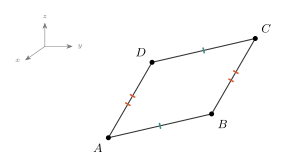
$ABCD$ is a parallelogram with $A(1,2,-1)$, $B(4,0,3)$, and $C(6,5,2)$. Find the coordinates of $D$.
In parallelogram ABCD, opposite sides are equal and parallel as vectors: AB = DC and BC = AD.
MethodUse the fact that opposite sides of a parallelogram are equal vectors
1
In parallelogram $ABCD$, side $AB$ is parallel and equal in length to side $DC$, and both are traversed in the same rotational sense, so $\overrightarrow{AB} = \overrightarrow{DC}$.
This is the defining property of a parallelogram, expressed vectorially.
Since $\overrightarrow{DC}=\mathbf{c}-\mathbf{d}$, and this must equal $\overrightarrow{AB}$: $\mathbf{c}-\mathbf{d} = 3\mathbf{i}-2\mathbf{j}+4\mathbf{k} \Rightarrow \mathbf{d} = \mathbf{c}-(3\mathbf{i}-2\mathbf{j}+4\mathbf{k})$.
Rearrange to make d (the unknown position vector) the subject.
Either pair of opposite sides can be used ($\overrightarrow{AB}=\overrightarrow{DC}$ or $\overrightarrow{BC}=\overrightarrow{AD}$) — both express the same parallelogram property and give the same point $D$. Choosing the pair that isolates $\mathbf{d}$ most directly just keeps the algebra tidier.
Worked example 3
Finding a missing vertex of a square
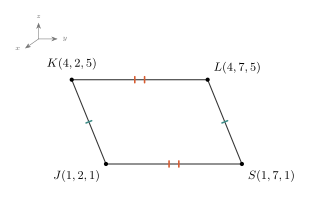
$JKLS$ is a square, with $J(1,2,1)$, $K(4,2,5)$ and $L(4,7,5)$. Find the coordinates of $S$, and verify that $JKLS$ is indeed a square by checking that $\overrightarrow{JK}$ and $\overrightarrow{KL}$ are perpendicular and equal in length.
Square JKLS in 3D space — the same "opposite sides are equal vectors" idea as the parallelogram, with the added conditions of a right angle and equal side lengths.
MethodUse JS = KL to locate S, then check perpendicularity and length with the two known sides
In square $JKLS$ (vertices in order), side $\overrightarrow{JS}$ is equal and parallel to side $\overrightarrow{KL}$, so $\mathbf{s} = \mathbf{j}+\overrightarrow{KL} = (\mathbf{i}+2\mathbf{j}+\mathbf{k})+(5\mathbf{j}) = \mathbf{i}+7\mathbf{j}+\mathbf{k}$.
Exactly the same "opposite sides are equal vectors" idea used to find D in the parallelogram above.
Equal adjacent side lengths, together with the right angle, confirm JKLS really is a square (not just a rectangle or rhombus).
▪ solved
Proving a shape, not just locating it
Finding a missing vertex only uses the "opposite sides equal" property, which alone just proves a parallelogram. Confirming a right angle (via a zero dot product) and equal adjacent side lengths (via the magnitude formula) are what upgrade that parallelogram to a genuine square — the same two checks distinguish a rectangle (right angles, unequal sides) or a rhombus (equal sides, no right angle) from a square.
Worked example 4
Showing three points are collinear
Points $P$, $Q$, $R$ have position vectors $\mathbf{p}=\mathbf{i}+3\mathbf{j}-2\mathbf{k}$, $\mathbf{q}=4\mathbf{i}+5\mathbf{j}-3\mathbf{k}$, $\mathbf{r}=10\mathbf{i}+9\mathbf{j}-5\mathbf{k}$. Show that $P$, $Q$, $R$ are collinear.
MethodShow two displacement vectors are parallel and share a point
Check whether PR is a scalar multiple of PQ, componentwise: 9/3 = 6/2 = (−3)/(−1) = 3.
4
Since $\overrightarrow{PR}$ is a scalar multiple of $\overrightarrow{PQ}$, the two vectors are parallel; and since they share the common point $P$, the points $P$, $Q$, $R$ all lie on the same straight line.
Parallel vectors from a shared point force collinearity.
▪ solved
The key insight
Parallel alone is not enough to prove collinearity — two parallel vectors could describe separate parallel lines. It's the shared point $P$ that forces $Q$ and $R$ onto the same line as $P$; always state both conditions explicitly in a collinearity proof.
Worked example 5
Dividing a line segment in a given ratio
The point $R$ divides the line segment $AB$ in the ratio $AR:RB = 2:3$, where $A(1,-2,4)$ and $B(11,8,-6)$. Find the coordinates of $R$.
MethodTravel the appropriate fraction of the way along AB, starting from A
R's position vector is A's position vector plus the displacement AR.
5
$R = (5,2,0)$.
Read off the coordinates.
▪ solved
The section formula, in general
For $R$ dividing $AB$ in the ratio $m:n$, $\mathbf{r} = \mathbf{a}+\dfrac{m}{m+n}(\mathbf{b}-\mathbf{a})$ — equivalently, $\mathbf{r}=\dfrac{n\mathbf{a}+m\mathbf{b}}{m+n}$. Setting $m=n=1$ recovers the familiar midpoint formula, $\mathbf{r}=\tfrac12(\mathbf{a}+\mathbf{b})$.
Worked example 6
Midpoint and an isosceles triangle condition · Challenge
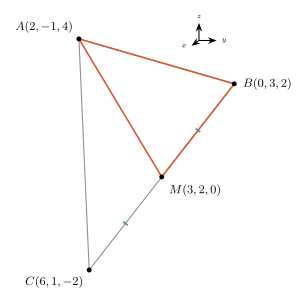
Triangle $ABC$ has $A(2,-1,4)$, $B(0,3,2)$, $C(6,1,-2)$. Let $M$ be the midpoint of $BC$. Find the coordinates of $M$, and determine whether triangle $ABM$ is isosceles.
Triangle $ABC$ with $M$ the midpoint of $BC$ (tick marks show $BM=MC$). The highlighted triangle $ABM$ is the one being tested for isosceles sides.
MethodFind M using the midpoint formula, then compare side lengths using the distance formula
Distance from B to M, to complete all three sides of triangle ABM.
6
The three side lengths $\sqrt{26}$, $\sqrt{24}$, $\sqrt{14}$ are all different, so triangle $ABM$ is not isosceles.
An isosceles triangle needs at least two equal side lengths — none match here.
▪ solved
Look deeper — the midpoint formula in 3D
Just as with magnitude, the midpoint formula extends from 2D to 3D by simply averaging the extra component — no new theory is required, only the willingness to carry an established 2D idea one dimension further. This pattern (extend componentwise, apply Pythagoras twice for lengths) covers the vast majority of 3D vector geometry problems.
Common mistake
Assuming two vectors are parallel after checking only one or two of the three component ratios. In 3D, all three ratios $\dfrac{b_1}{a_1},\dfrac{b_2}{a_2},\dfrac{b_3}{a_3}$ must agree — a pair of vectors that "looks" parallel from two coordinates can easily diverge in the third, so every component must be checked before concluding parallelism (or collinearity, which relies on it).
Check yourself
$A(1,0,2)$, $B(3,4,-2)$, $C(5,8,-6)$ are three points. Show that $A$, $B$, $C$ are collinear, and find the ratio $AB:BC$. (Hint: find AB and BC as vectors, and check whether one is a scalar multiple of the other.)
$\overrightarrow{BC} = 1 \times \overrightarrow{AB}$, so the vectors are parallel (equal, in fact), and since they share point $B$, $A$, $B$, $C$ are collinear.
Parallel vectors sharing a common point force collinearity.
3
Since $\overrightarrow{AB}=\overrightarrow{BC}$, the ratio $AB:BC = 1:1$.
Equal vectors mean equal lengths, so B is the midpoint of AC.