Mathematics/Lessons/Trigonometric Ratios/Sine, Cosine & Tangent Graphs
Pure · Trigonometric Ratios · Year 1

Sine, Cosine & Tangent Graphs

The unit circle turns sin, cos and tan into functions for every angle — periodic waves whose whole shape, symmetry and behaviour come straight from a point moving round a circle of radius 1.

9 min read 3 worked examples

From triangle to unit circle

So far, angles have lived inside triangles, capped at $90°$. But $\sin$, $\cos$ and $\tan$ are really functions defined for every angle — including obtuse, negative, and angles beyond $360°$. To see how, we move from the triangle to the unit circle: a circle of radius $1$ centred at the origin. For a point on the circle at angle $\theta$ (measured anticlockwise from the positive $x$-axis), its coordinates are exactly $(\cos\theta,\ \sin\theta)$.
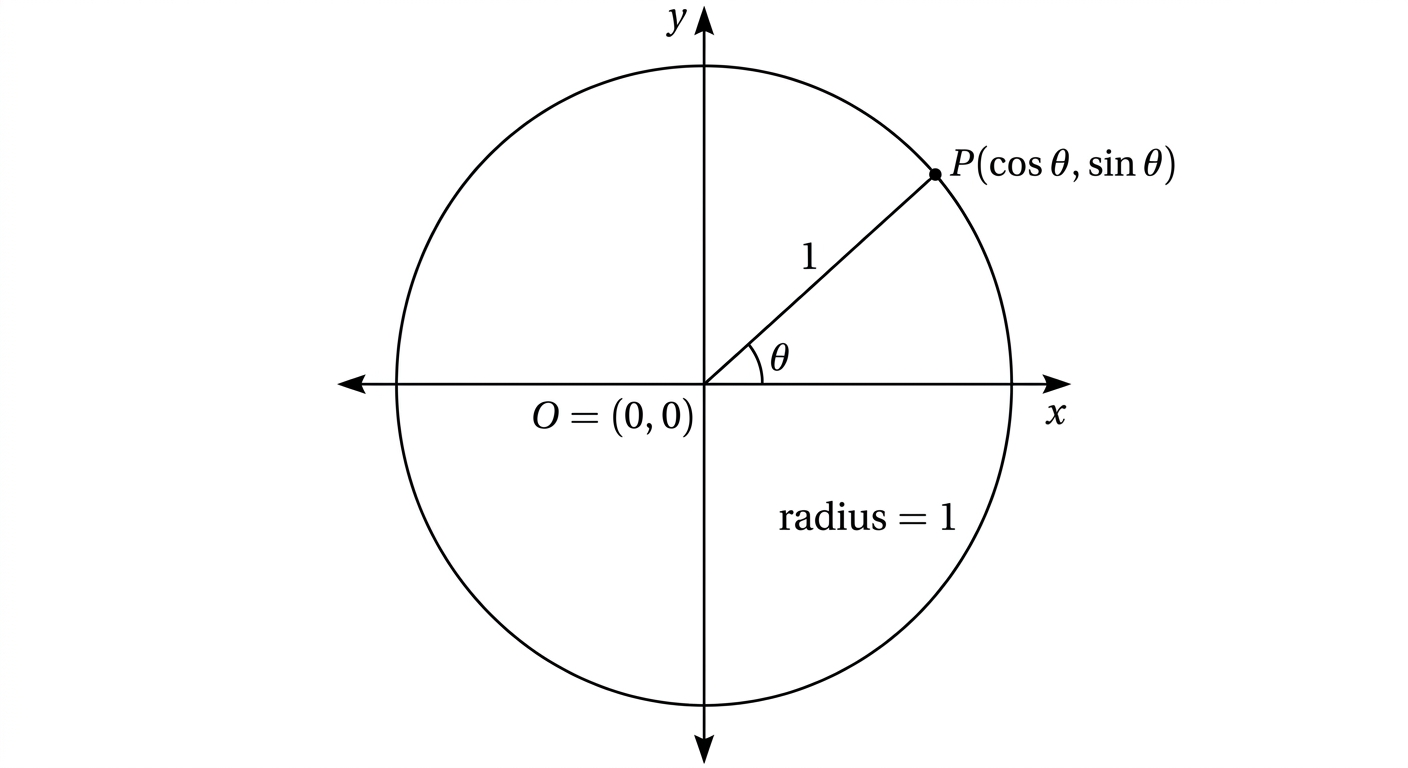
A unit circle of radius 1 centred at the origin O. A radius makes an angle theta with the positive x-axis, meeting the circle at the point P with coordinates (cos theta, sin theta).
On the unit circle, the point P at angle θ has coordinates (cos θ, sin θ). As θ sweeps round, the x-coordinate traces cosine and the y-coordinate traces sine.

That single definition unlocks everything. As $\theta$ sweeps around the circle, the $x$-coordinate traces out the cosine graph and the $y$-coordinate traces the sine graph — smooth waves that repeat every $360°$. The values simply keep going round, which is why the graphs are periodic.

Why the graphs look the way they do

Everything about the sine and cosine graphs falls out of the circle. They oscillate between −1 and 1 because that's the range of a coordinate on a unit-radius circle. They repeat every 360° because going once round returns you to the start. $\sin$ starts at $0$ (the point $(1,0)$ has height $0$) while $\cos$ starts at $1$ (that same point has $x$-coordinate $1$) — the two graphs are the same wave shifted by $90°$. You never have to memorise the graphs; you can read them straight off a point moving round the circle.

The graphs and their key features

$y = \sin\theta$: starts at $0$, peaks at $1$ (at $90°$), back to $0$ (at $180°$), down to $-1$ (at $270°$), repeats every $360°$.
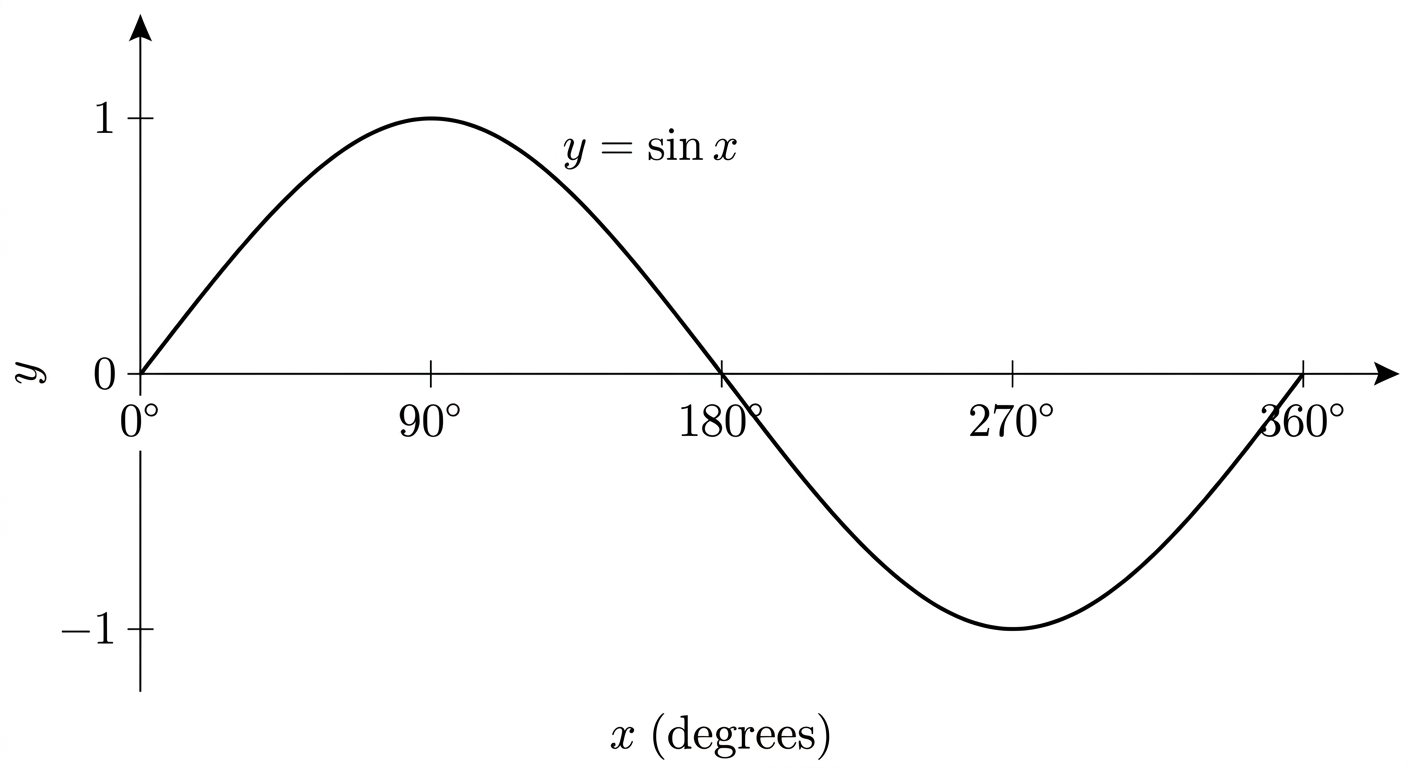
The graph of y = sin x for x from 0 to 360 degrees. It starts at 0, rises to a maximum of 1 at 90 degrees, returns to 0 at 180 degrees, falls to a minimum of minus 1 at 270 degrees, and returns to 0 at 360 degrees.
y = sin x: a smooth wave from 0, peaking at +1 at 90° and dipping to −1 at 270°, repeating every 360°.

$y = \cos\theta$: starts at $1$, down to $0$ (at $90°$), $-1$ (at $180°$), repeats every $360°$ — identical to sine but shifted left by $90°$.
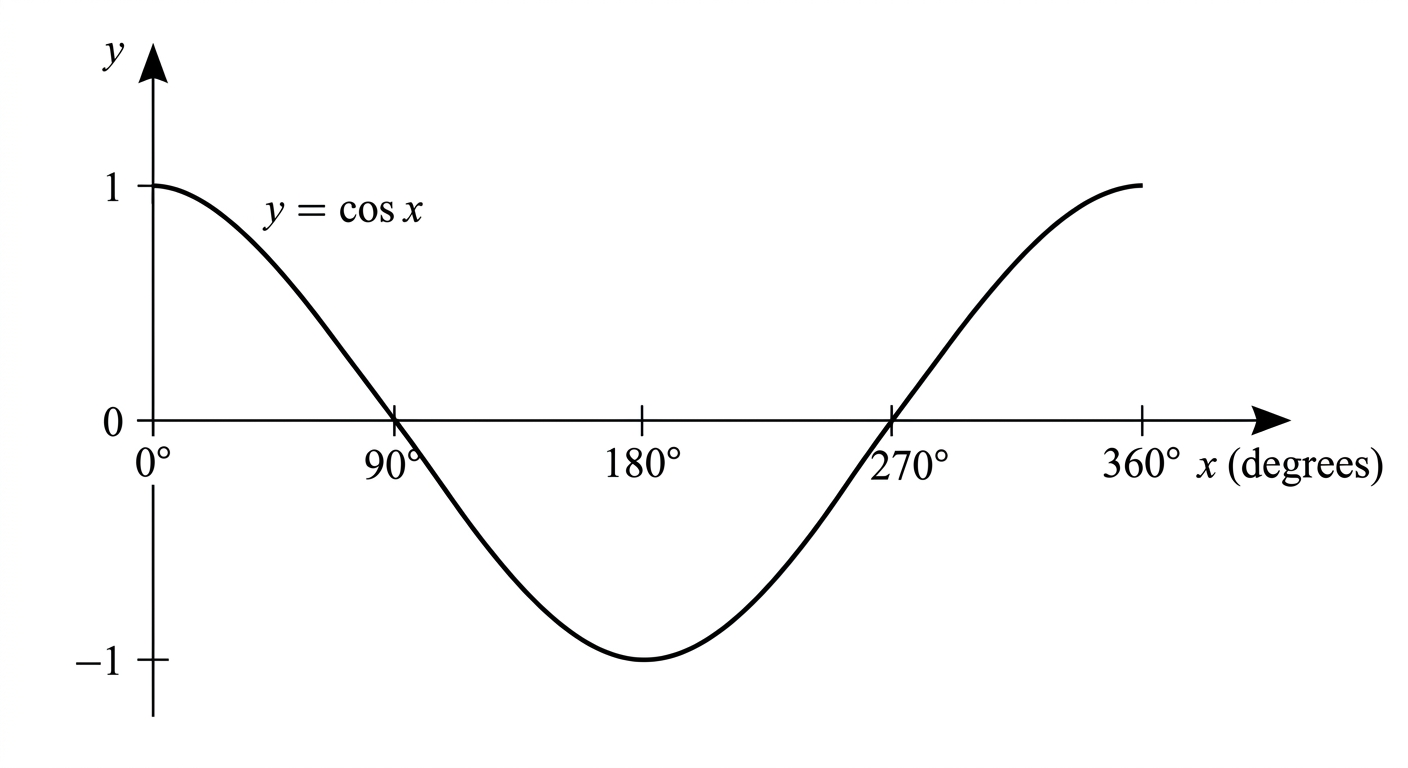
The graph of y = cos x for x from 0 to 360 degrees. It starts at 1, falls through 0 at 90 degrees to a minimum of minus 1 at 180 degrees, back through 0 at 270 degrees, and returns to 1 at 360 degrees.
y = cos x: the same wave shape as sine but starting at +1 — equivalently, sine shifted left by 90°.

$y = \tan\theta$: quite different from the other two — it repeats every $180°$ (not $360°$) and tends to $\pm\infty$ as $\theta$ approaches $90°, 270°, \ldots$ (vertical asymptotes), because $\tan\theta = \tfrac{\sin\theta}{\cos\theta}$ is undefined wherever $\cos\theta = 0$.
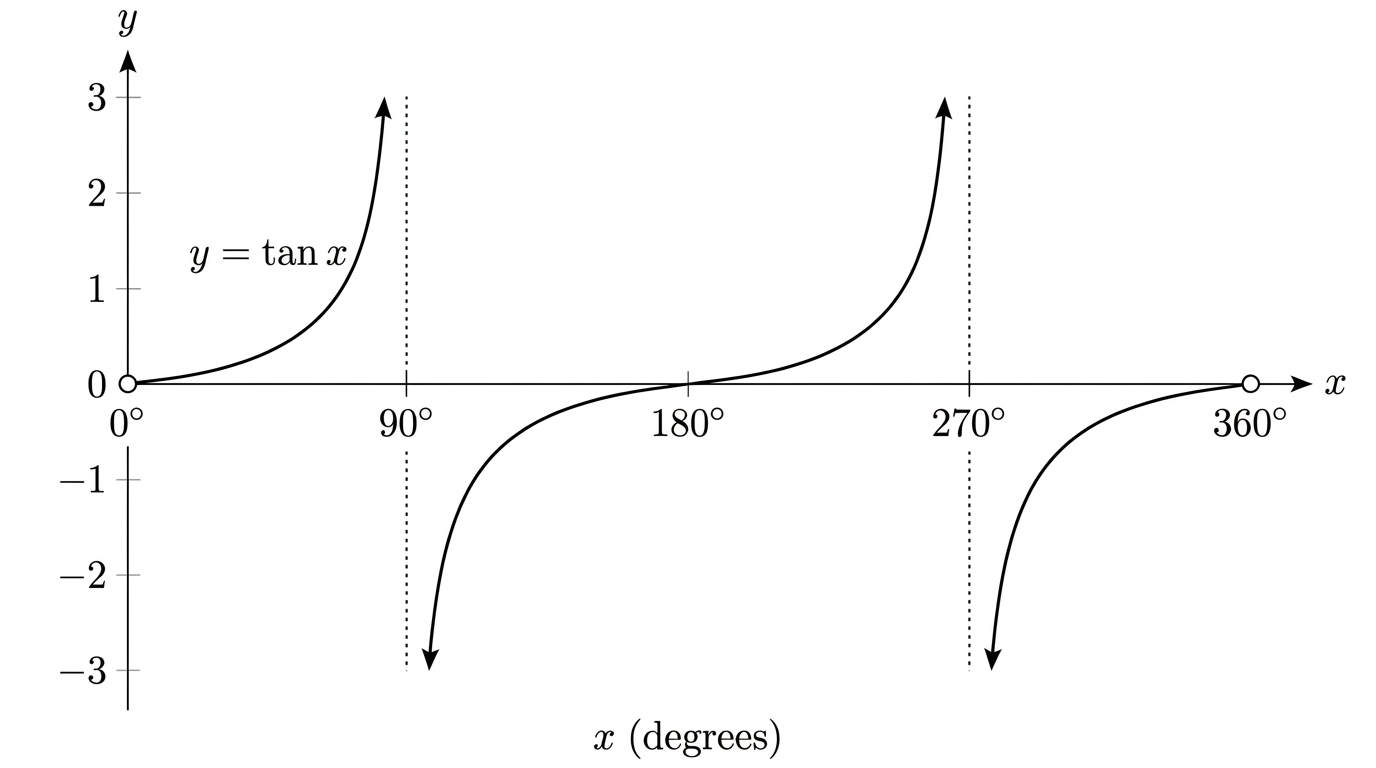
The graph of y = tan x for x from 0 to 360 degrees, showing repeating branches with vertical asymptotes at 90 and 270 degrees. Each branch rises from minus infinity to plus infinity, crossing zero at 0, 180 and 360 degrees.
y = tan x: repeating branches every 180°, shooting toward ±∞ at the asymptotes 90° and 270° where cos θ = 0.
The three graphs at a glance

Sine and cosine: range $[-1,1]$, period $360°$, no asymptotes, defined for every real angle. Tangent: range is all real numbers, period $180°$, vertical asymptotes at $90°, 270°, \ldots$ wherever $\cos\theta = 0$. Knowing these three facts about each graph answers most "state the period / range" exam questions without a calculator.

Worked example 1

Reading off key features · maxima, minima and roots
For $0° \le \theta \le 360°$, state the coordinates of the maximum and minimum points of $y = \cos\theta$, and the values of $\theta$ where the graph crosses the $\theta$-axis.
MethodRead the shape of y = cos θ directly
1
$\cos\theta$ starts at its maximum: the point $(0°, 1)$.
cos θ = 1 when θ = 0°.
2
It falls to its minimum at $\theta = 180°$: the point $(180°, -1)$.
cos θ = −1 halfway round.
3
It returns to its maximum at $\theta = 360°$: the point $(360°, 1)$, completing one period.
Period is 360°.
4
The graph crosses the axis (cos θ = 0) at $\theta = 90°$ and $\theta = 270°$.
Quarter and three-quarter turns.
▪ solved
Examiner's eye

No calculator needed here — questions like this test whether you can picture the wave, not whether you can evaluate it. Sketch a quick wave in the margin before answering; it turns a memory question into a reading-off question.

Worked example 2

Use the graph's reflection symmetry
Given that $\sin 30° = 0.5$, use the symmetry of the sine graph to write down the values of $\sin 150°$ and $\sin 210°$.

Rather than a calculator, use how the sine wave is built from the circle: it's symmetric about $90°$, and negative in the third and fourth quadrants.

MethodUse the sine graph's reflection symmetry
1
The sine graph is symmetric about $\theta = 90°$, so $\sin(180° - \theta) = \sin\theta$.
Reflection symmetry of the wave.
2
Thus $\sin 150° = \sin(180° - 30°) = \sin 30° = 0.5$.
150° mirrors 30°.
3
Between $180°$ and $360°$ the sine graph is below the axis (negative). And $\sin(180° + \theta) = -\sin\theta$.
Third-quadrant sine is negative.
4
So $\sin 210° = \sin(180° + 30°) = -\sin 30° = -0.5$.
Same size, opposite sign.
▪ solved
The key insight

Every angle's sine relates back to an acute reference angle (here $30°$), with the sign decided by which part of the graph — which quadrant — you're in. The next lesson turns this quadrant-by-quadrant sign pattern into a single memorable diagram. Learn to picture the wave and you rarely need to compute more than one value.

Worked example 3

The tangent graph's period · using period 180° and an odd function
Given that $\tan 40° = 0.839$ (3 s.f.), use the properties of the tangent graph to find $\tan 220°$ and $\tan(-140°)$.
MethodApply the 180° period, then the odd symmetry
1
The tangent graph repeats every $180°$: $\tan(\theta + 180°) = \tan\theta$.
Tan's period is half that of sin/cos.
2
$\tan 220° = \tan(40° + 180°) = \tan 40° = 0.839$.
One full tan-period on from 40°.
3
The tangent graph has rotational symmetry through the origin: $\tan(-\theta) = -\tan\theta$.
Tan is an odd function.
4
$\tan(-140°) = \tan(-140° + 180°) = \tan 40° = 0.839$, using the period to bring it into a familiar branch.
Shift by one period first, then read off.
▪ solved
Common mistake

It's tempting to apply the $360°$ period from sine and cosine out of habit — but tan repeats twice as often, every $180°$. Forgetting this is one of the most common slips when angles beyond the first quadrant appear.

Check yourself

Given that $\cos 25° = 0.906$ (3 s.f.), use the symmetry of the cosine graph to write down the value of $\cos 335°$, and explain why $\cos(-25°) = \cos 25°$.
(Hint: 335° = 360° − 25°; cosine is symmetric about θ = 0° and θ = 360°.)

Method
1
$335° = 360° - 25°$, and cosine is symmetric about a full turn: $\cos(360° - \theta) = \cos\theta$.
2
So $\cos 335° = \cos 25° = 0.906$.
3
$\cos(-25°)$ rotates $25°$ clockwise instead of anticlockwise from $(1,0)$ — landing at the same height on the circle, since reflecting in the $x$-axis doesn't change the $x$-coordinate. So $\cos(-\theta) = \cos\theta$ always, meaning $\cos(-25°) = \cos 25° = 0.906$ too.
Cosine is an even function.
▪ solved