Flip a trig ratio upside down and it explodes into a new landscape of vertical asymptotes — three new graphs built entirely from the ones you already know.
8 min read2 worked examples
The reciprocal trig functions
Three new functions are built by taking reciprocals of sine, cosine and tangent:
Secant ($\sec$), cosecant ($\csc$, sometimes written $\text{cosec}$) and cotangent ($\cot$) are undefined wherever the function underneath is zero, since division by zero is impossible. That means:
Where each is undefined
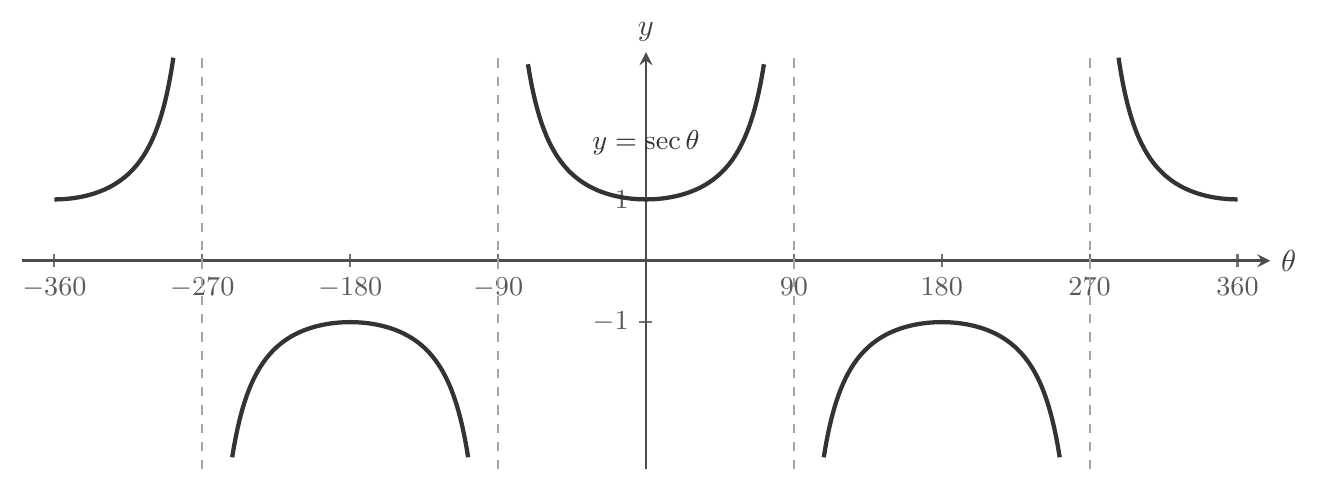
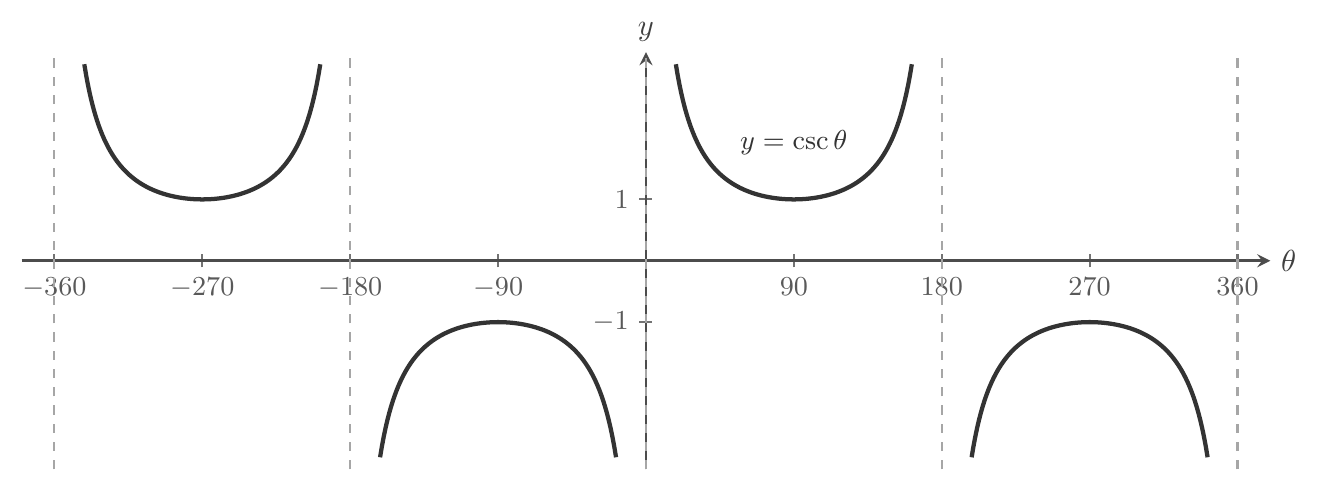
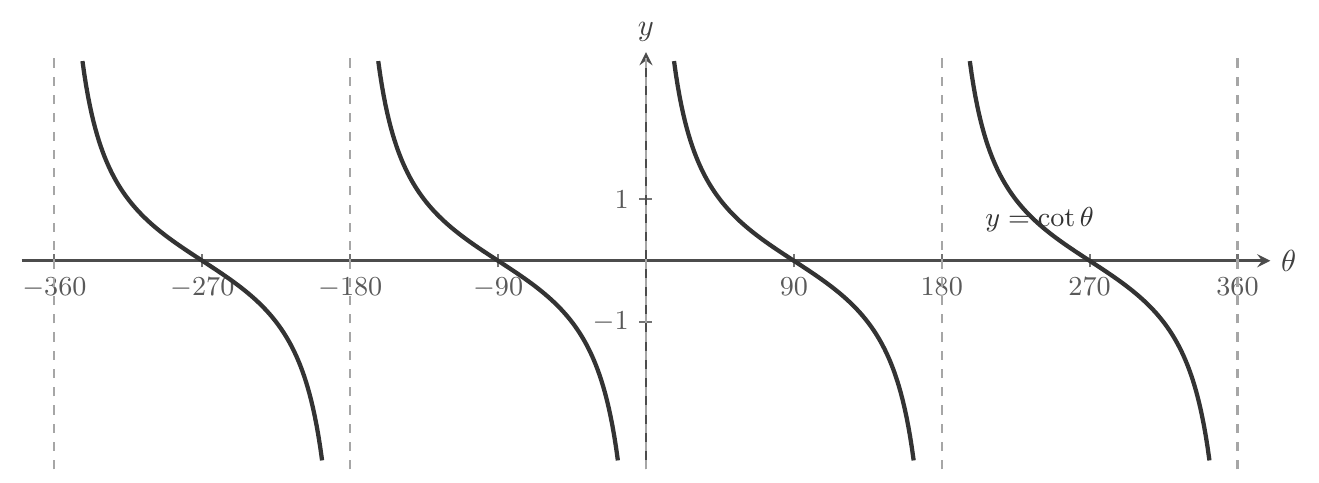
$\sec\theta$ is undefined when $\cos\theta=0$, i.e. $\theta = 90°, 270°, \dots$ (or $\dfrac{\pi}{2}+n\pi$ in radians). $\csc\theta$ is undefined when $\sin\theta=0$, i.e. $\theta=0°,180°,360°,\dots$ ($n\pi$). $\cot\theta$ is undefined when $\sin\theta=0$ as well, for the same reason it appears in the denominator of $\dfrac{\cos\theta}{\sin\theta}$.
At each of these values the graph has a vertical asymptote — the function shoots off to $+\infty$ on one side and $-\infty$ on the other. Because $-1\le\cos\theta\le1$ and $-1\le\sin\theta\le1$ (excluding zero), taking the reciprocal forces $|\sec\theta|\ge1$ and $|\csc\theta|\ge1$ always: neither function ever takes a value strictly between $-1$ and $1$.
y = csc θ: vertical asymptotes wherever sin θ = 0, mirroring the shape of sec θ but shifted by 90°.
y = cot x — domain and range
Domain: $\theta\in\mathbb{R},\ \theta\ne180n°\ (n\in\mathbb{Z})$. Range: $y\in\mathbb{R}$ (unlike sec and csc, cot passes through every value).
y = cot θ: vertical asymptotes wherever sin θ = 0, but unlike sec and csc, each branch passes through every real value — including zero, at θ = ±90° and ±270°.
Worked example 1
Evaluating reciprocal trig functions exactly
Find the exact value of (a) $\sec 60°$, (b) $\csc\dfrac{\pi}{4}$, (c) $\cot 150°$.
MethodRewrite each as a reciprocal of a known exact value
150° is in the second quadrant, where tan is negative; use the related acute angle 30°.
▪ solved
Worked example 2
Solving an equation involving a reciprocal function
Solve $\sec x = 2$ for $0 \le x < 360°$.
MethodConvert to cosine, then solve as a standard trig equation
1
$\sec x = 2 \Rightarrow \cos x = \dfrac{1}{2}$.
Take the reciprocal of both sides to return to a function with familiar exact values.
2
Principal value: $\arccos\left(\dfrac12\right) = 60°$.
The reference angle from known exact values.
3
Cosine is positive in quadrants 1 and 4, so $x = 60°$ or $x = 360°-60° = 300°$.
Use the CAST diagram / symmetry of cosine to find all solutions in range.
4
$x = 60°$ or $x = 300°$.
Both values lie within the given interval.
▪ solved
Why this works
Because $\sec x$ is only ever undefined where $\cos x = 0$, converting a reciprocal-function equation back into cosine, sine or tangent is always valid — you never divide by zero doing this, since $\sec x = 2$ already tells you $\cos x = \dfrac12 \ne 0$.
Check yourself
Find the exact value of $\csc 210°$. (Hint: use the related acute angle 30°, and check the sign of sine in that quadrant first.)
Method
1
$210°$ is in the third quadrant, where sine is negative: $\sin 210° = -\sin 30° = -\dfrac12$.
Use the related acute angle 30° and the sign of sine in quadrant 3.