Sine, cosine and tangent each map infinitely many angles to the same value — restrict the domain to a single well-chosen slice, and a genuine inverse function appears.
9 min read3 worked examples
Why domains need restricting
Sine, cosine and tangent are many-to-one over their full domains — e.g. infinitely many angles give $\sin\theta=0.5$ — so none has a true inverse until the domain is restricted to a region where the function is one-to-one. Restricting sensibly gives three new functions, $\arcsin$, $\arccos$, $\arctan$ (also written $\sin^{-1}$, $\cos^{-1}$, $\tan^{-1}$):
Restricted domains, by convention
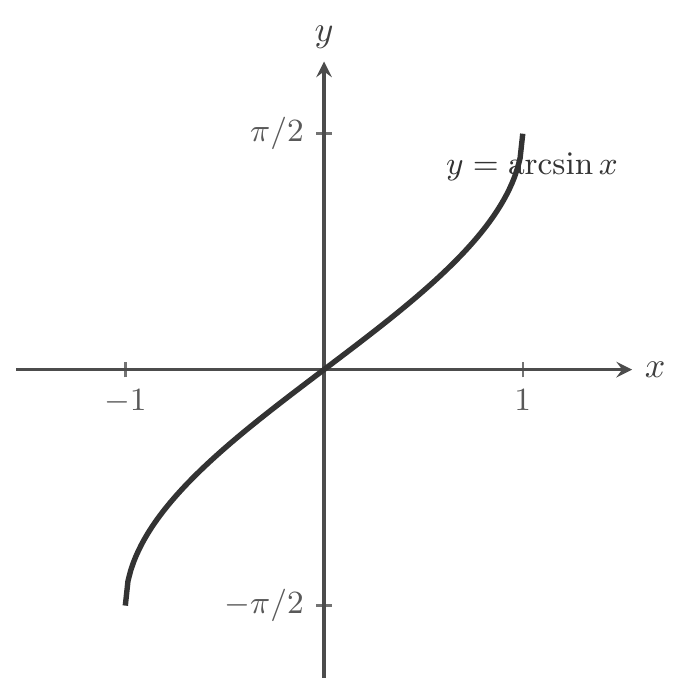
$\arcsin: [-1,1] \to \left[-\dfrac{\pi}{2},\dfrac{\pi}{2}\right]$ — inverse of $\sin\theta$ restricted to $-\dfrac{\pi}{2}\le\theta\le\dfrac{\pi}{2}$.
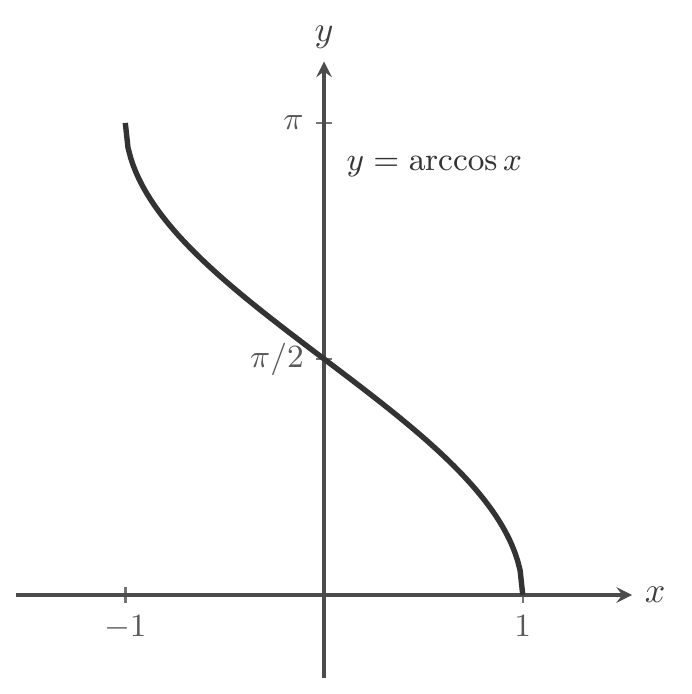
$\arccos: [-1,1] \to [0,\pi]$ — inverse of $\cos\theta$ restricted to $0\le\theta\le\pi$.
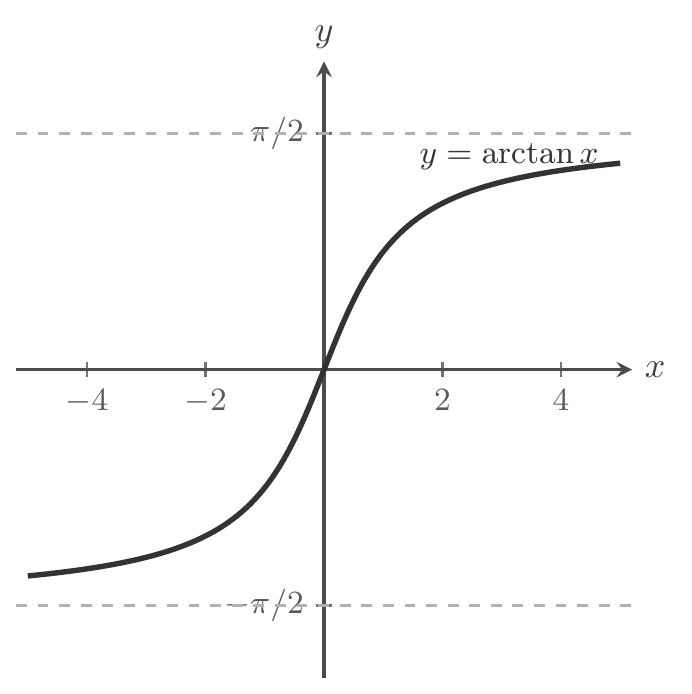
$\arctan: \mathbb{R} \to \left(-\dfrac{\pi}{2},\dfrac{\pi}{2}\right)$ — inverse of $\tan\theta$ restricted to $-\dfrac{\pi}{2}<\theta<\dfrac{\pi}{2}$.
Why the domain restriction matters
Without restricting the domain first, "the inverse of sine" would have to map $0.5$ to infinitely many angles at once ($30°, 150°, 390°,\dots$) — not a function at all. Chopping the domain down to $\left[-\dfrac{\pi}{2},\dfrac{\pi}{2}\right]$ is the smallest continuous piece of $\sin\theta$ that still covers the whole range $[-1,1]$ exactly once, which is exactly what's needed for a genuine inverse to exist.
Each inverse graph is the reflection of the restricted original in the line $y=x$ — so the domain and range simply swap. Since $\sin\theta$ and $\cos\theta$ only ever output values in $[-1,1]$, their inverses can only accept inputs in $[-1,1]$; feeding $\arcsin$ or $\arccos$ anything outside that interval is undefined. $\arctan$, by contrast, accepts every real number, since $\tan\theta$'s range is unrestricted — its graph has horizontal asymptotes at $y=\pm\dfrac{\pi}{2}$ instead.
y = arcsin x: domain [-1, 1], range [-π/2, π/2].y = arccos x: domain [-1, 1], range [0, π].
y = arctan x: domain all real x, range (-π/2, π/2), with horizontal asymptotes at y = ±π/2.
Worked example 1
Evaluating inverse trig functions exactly
Find the exact value, in radians, of (a) $\arcsin\left(\dfrac{1}{2}\right)$, (b) $\arccos\left(-\dfrac{1}{\sqrt2}\right)$.
MethodFind the angle in the correct restricted range
1
(a) Need $\theta \in \left[-\dfrac{\pi}{2},\dfrac{\pi}{2}\right]$ with $\sin\theta = \dfrac12$: $\theta = \dfrac{\pi}{6}$.
π/6 lies within arcsin's restricted range and sin(π/6) = 1/2.
2
So $\arcsin\left(\dfrac12\right) = \dfrac{\pi}{6}$.
Only one value in range satisfies this — the inverse is well-defined.
3
(b) Need $\theta \in [0,\pi]$ with $\cos\theta = -\dfrac{1}{\sqrt2}$. Since cosine is negative, $\theta$ is in the second quadrant: $\theta = \pi - \dfrac{\pi}{4} = \dfrac{3\pi}{4}$.
arccos's range is [0, π], which includes the second quadrant where cosine is negative.
4
So $\arccos\left(-\dfrac{1}{\sqrt2}\right) = \dfrac{3\pi}{4}$.
Final answer, checked to lie in [0, π].
▪ solved
Examiner's eye
Always check the output lies in the correct restricted range for that inverse function — a calculator will enforce this automatically, but when working exactly by hand it's easy to give an angle outside the valid range (e.g. a reflex angle) by mistake.
Worked example 2
Solving an equation with arcsin
Solve $\sin x = 0.3$ for $0 \le x < 2\pi$, giving both solutions in radians to 3 s.f.
MethodUse arcsin for the principal value, then find the second solution
1
Principal value: $x = \arcsin(0.3) = 0.305$ (3 s.f.).
arcsin gives the unique solution in its range, [-π/2, π/2], which lies inside [0, 2π).
2
Sine is also positive in the second quadrant, giving a second solution $x=\pi-0.305=2.84$ (3 s.f.).
Use the identity sin(π - θ) = sin θ to find the other solution with the same sine value.
3
$x=0.305$ or $x=2.84$ (3 s.f.).
Both lie within 0 ≤ x < 2π.
▪ solved
Worked example 3
Domain and range of a transformed inverse function · Challenge
The function $f(x) = 2\arcsin(x) + \pi$ is defined for $x$ in the domain of $\arcsin$. State the domain and range of $f$.
MethodTrack how each transformation stretches and shifts the range
1
$\arcsin(x)$ has domain $[-1,1]$ and range $\left[-\dfrac{\pi}{2},\dfrac{\pi}{2}\right]$.
Standard domain and range of arcsin, recalled from theory.
2
The domain of $f$ is unchanged, since $x$ still only feeds into $\arcsin(x)$: domain $= [-1,1]$.
Multiplying and shifting the output doesn't affect which inputs are valid.
3
Multiplying by 2 doubles the range: $2\arcsin(x) \in [-\pi,\pi]$.
A vertical stretch by factor 2 scales the range by the same factor.
4
Adding $\pi$ shifts the range up: $2\arcsin(x)+\pi \in [-\pi+\pi, \pi+\pi] = [0, 2\pi]$.
A vertical translation shifts every value in the range by the same amount.
5
Domain of $f$ is $[-1,1]$; range of $f$ is $[0,2\pi]$.
Final answer, combining both transformations.
▪ solved
Look deeper
This is the same logic used for transforming any function's range (as with $y=af(x)+c$ style transformations elsewhere in the course) — only the domain of the inner function $\arcsin$ constrains what $x$-values are allowed; everything applied afterwards only reshapes the output.
Common mistake
Confusing $\cos^{-1}\theta$ (i.e. $\arccos\theta$) with $\sec\theta$ purely because both involve "$-1$" in some notation — they are entirely different objects. $\sec\theta = \dfrac{1}{\cos\theta}$ is the reciprocal of cosine, while $\cos^{-1}\theta = \arccos\theta$ is the inverse function of cosine. Never treat $\cos^{-1}\theta$ as $\dfrac{1}{\cos\theta}$; that identity is simply false.
Check yourself
Find $\arctan(-1)$ in radians. (Hint: recall arctan's restricted range and find the angle within it.)
Method
1
Need $\theta \in \left(-\dfrac{\pi}{2},\dfrac{\pi}{2}\right)$ with $\tan\theta=-1$: $\theta=-\dfrac{\pi}{4}$.
−π/4 lies within arctan's restricted range and tan(−π/4) = −1.