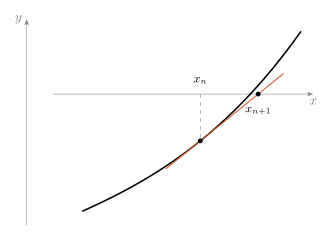
Follow the tangent line down to the x-axis, and land closer to the root than where you started.
10 min read4 worked examples
Deriving the formula
Fixed-point iteration needs a rearrangement, and not every rearrangement converges. The Newton–Raphson method takes a different, more direct route to a root of $f(x)=0$: at each estimate, follow the tangent line to $y=f(x)$ down to where it crosses the x-axis, and treat that crossing point as the next, usually better, estimate.
ProofDeriving $x_{n+1}$ from the tangent at $x_n$
1
At the point $(x_n,f(x_n))$ on the curve, the tangent line has gradient $f'(x_n)$.
The gradient of the tangent at any point equals the derivative there.
2
The tangent line's equation is $y-f(x_n)=f'(x_n)(x-x_n)$.
Standard point-gradient form of a line, using the point (xₙ, f(xₙ)) and gradient f'(xₙ).
3
Let $x_{n+1}$ be where this tangent crosses the x-axis, i.e. where $y=0$: $0-f(x_n)=f'(x_n)(x_{n+1}-x_n)$.
Substitute $y=0$ and $x=x_{n+1}$ into the tangent's equation.
Expand and rearrange to isolate the term containing $x_{n+1}$.
5
Dividing by $f'(x_n)$ (valid provided $f'(x_n)\ne0$): $x_{n+1}=x_n-\dfrac{f(x_n)}{f'(x_n)}$.
Isolate $x_{n+1}$ completely — the Newton–Raphson formula.
▪ proven
$x_{n+1}=x_n-\dfrac{f(x_n)}{f'(x_n)}$
Geometric interpretation
Starting from an estimate $x_n$, the method draws the tangent to $y=f(x)$ at $(x_n,f(x_n))$ and follows it down to where it crosses the x-axis — that crossing point becomes the new, usually more accurate, estimate $x_{n+1}$. Unlike fixed-point iteration, there's no rearrangement to choose: the formula only needs $f(x)$ and $f'(x)$, and it typically homes in on the root far faster.
The tangent to y = f(x) at (xₙ, f(xₙ)) crosses the x-axis at xₙ₊₁ — usually a closer approximation to the root than xₙ was.
When the method fails
Newton–Raphson usually converges fast, but it can fail or behave badly in certain situations — most commonly when the gradient $f'(x_n)$ is zero or very close to zero.
Near a turning point
If $x_n$ is close to a turning point of $f$, then $f'(x_n)\approx0$, making the tangent line almost horizontal. Dividing by a near-zero $f'(x_n)$ in the formula produces a huge jump, sending $x_{n+1}$ far away from the root — sometimes even further away than $x_n$ was, or into a completely different part of the curve where a different root (or no root) lies nearby.
Why this happens geometrically
An almost-horizontal tangent line travels a very long way before it reaches the x-axis — so the crossing point $x_{n+1}$ can land far from where the tangent was drawn. In the worst case, if $f'(x_n)=0$ exactly, the tangent is perfectly horizontal and never crosses the x-axis at all, so $x_{n+1}$ is undefined and the formula breaks down completely.
Because of this, it's good practice to choose a starting value $x_0$ reasonably close to the root and away from any turning points, and to sanity-check that successive iterates are actually converging rather than jumping erratically.
Worked example 1
One iteration of Newton–Raphson
Use one application of the Newton–Raphson method with $x_0=1$ to find $x_1$ for $f(x)=x^3+3x-6$.
$x_2$ and $x_3$ agree to 3 d.p. ($1.288$), so the root is $x\approx1.288$ (3 d.p.).
Convergence is confirmed once successive iterates agree to the required accuracy.
▪ solved
Fast convergence
Just three iterations pinned the root down to 3 decimal places — markedly faster than the fixed-point iterations from the previous lesson, which needed several more steps for comparable accuracy. This rapid convergence is Newton–Raphson's main advantage.
Worked example 3
A starting value that fails, at a turning point
$f(x)=x^3-12x+7$ has a turning point at $x=2$. Show that applying Newton–Raphson with $x_0=2$ fails, and explain why.
MethodAttempt the formula and identify the failure
1
$f'(x)=3x^2-12$.
Differentiate f(x).
2
$f'(2)=3(2)^2-12=12-12=0$.
Evaluate the gradient at x₀ = 2.
3
The Newton–Raphson formula requires dividing by $f'(x_0)=0$, which is undefined.
Division by zero means x₁ cannot be calculated at all.
4
This happens because $x=2$ is exactly a turning point of $f$: the tangent there is horizontal, so it never meets the x-axis, and the method has no way to produce a next estimate.
Confirms this is the "turning point" failure mode described earlier in the lesson.
▪ fails
Choosing a better starting value
Starting instead at $x_0=1.5$ (away from the turning point) gives $f'(1.5)=3(1.5)^2-12=-5.25\ne0$, a well-defined, non-zero gradient — so the iteration proceeds normally from there. Whenever $f'(x_0)$ is zero or suspiciously small, the fix is simply to pick a different, nearby starting value.
Worked example 4
Applying Newton–Raphson in a real context · Challenge
The temperature of a metal casting during controlled cooling, in °C, $t$ hours after cooling begins, is modelled by $\theta(t)=25+60e^{-0.2t}-3t$ for $0\le t\le10$. Use Newton–Raphson with $t_0=2$ to find, correct to 3 decimal places, the time at which the casting reaches $40°C$.
MethodApply Newton–Raphson to θ(t) − 40 = 0, iterating until convergence
1
Let $f(t)=\theta(t)-40=-15+60e^{-0.2t}-3t$. Then $f'(t)=-12e^{-0.2t}-3$.
Subtract the target temperature to get an equation f(t) = 0, then differentiate.
Evaluate f and f' at t₁, then apply the formula again.
5
A further iteration gives $t_3\approx3.995$, and successive iterates then agree to 3 d.p.: the casting reaches $40°C$ at $t\approx3.995$ hours.
Successive iterates are converging rapidly to the same value.
▪ solved
Look deeper
Here $f'(t)=-12e^{-0.2t}-3$ stays comfortably negative throughout $0\le t\le10$ (it never approaches zero, since both terms are negative), so the tangent is never close to horizontal and Newton–Raphson converges reliably however far the starting value is from the true root — exactly the opposite of Example 3's failure case. Checking that $f'$ stays well away from zero across the model's domain is a useful sanity check before trusting a numerical answer in context.
Common mistake
Forgetting to recompute both $f(x_n)$ and $f'(x_n)$ at the new value of $x_n$ before each iteration — reusing an old derivative value produces completely incorrect iterates. Also common: not checking whether $f'(x_n)$ is small before dividing, which can silently produce a wildly inaccurate next estimate without any error being raised.
Check yourself
Use Newton–Raphson with $x_0=1$ to find $x_1$ and $x_2$ for $f(x)=x^3+x-4$, giving answers to 4 decimal places. (Hint: find f'(x) first, then apply the formula twice.)