A force can turn an object as well as move it. The moment of a force — its size times its perpendicular distance from a pivot — measures exactly how much turning effect it has.
11 min read4 worked examples
The moment of a force
Every force considered so far has only ever moved a particle — a point with no size. Real objects have size, and a force applied off-centre can make them turn as well. The turning effect of a force about a point is called its moment, defined as:
$\text{moment} = \text{force} \times \text{perpendicular distance from the point to the line of action of the force}$
Moments are measured in newton-metres ($\text{N m}$). A moment has a sense — clockwise or anticlockwise — which you must state, and you are free to choose which sense counts as positive, provided you are consistent within one problem.
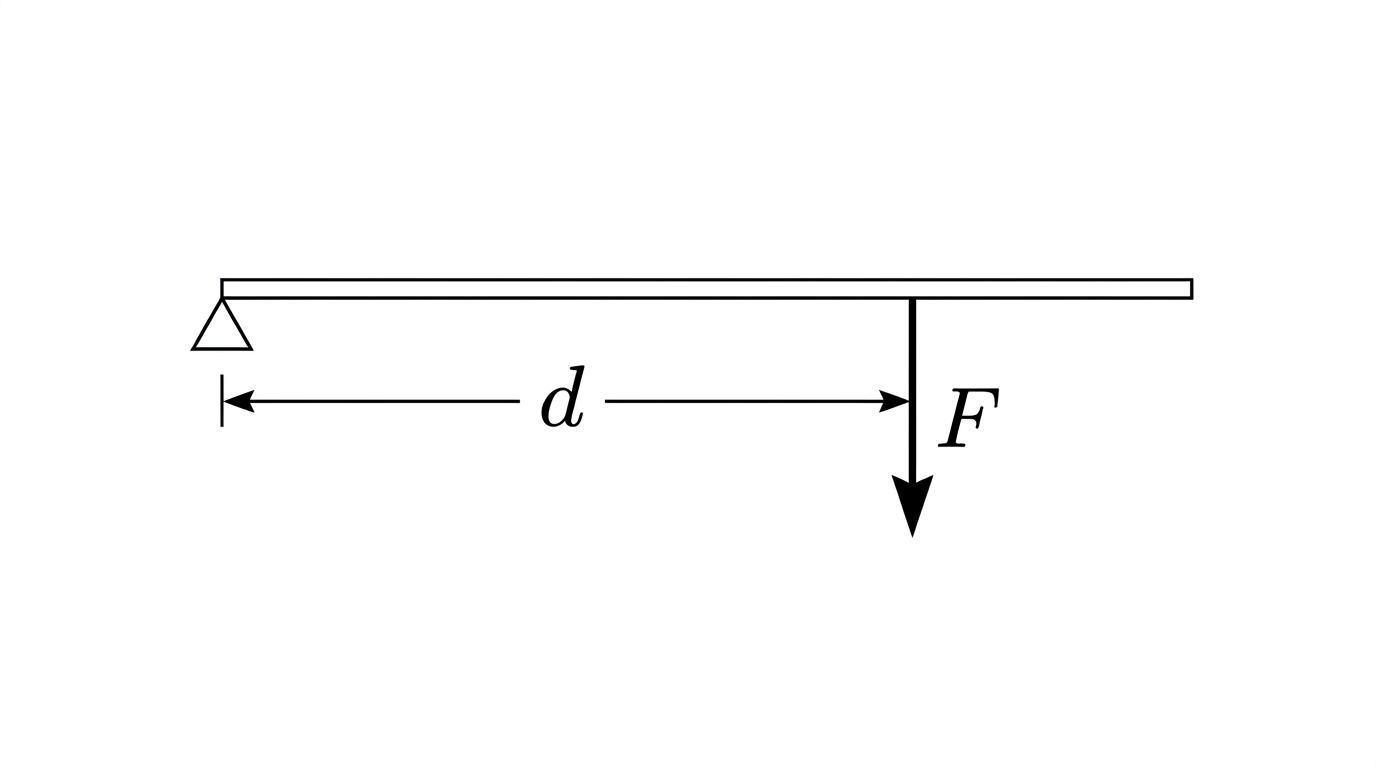
The moment of a force F about a pivot is F multiplied by the perpendicular distance d from the pivot to the force's line of action.
When the force isn't perpendicular to the rod
If a force acts at an angle to the object rather than perpendicular to it, there are two equivalent ways to find its moment: find the true perpendicular distance from the pivot to the force's line of action using trigonometry, or resolve the force into a component perpendicular to the rod and multiply that component by the distance along the rod. Both give the same answer.
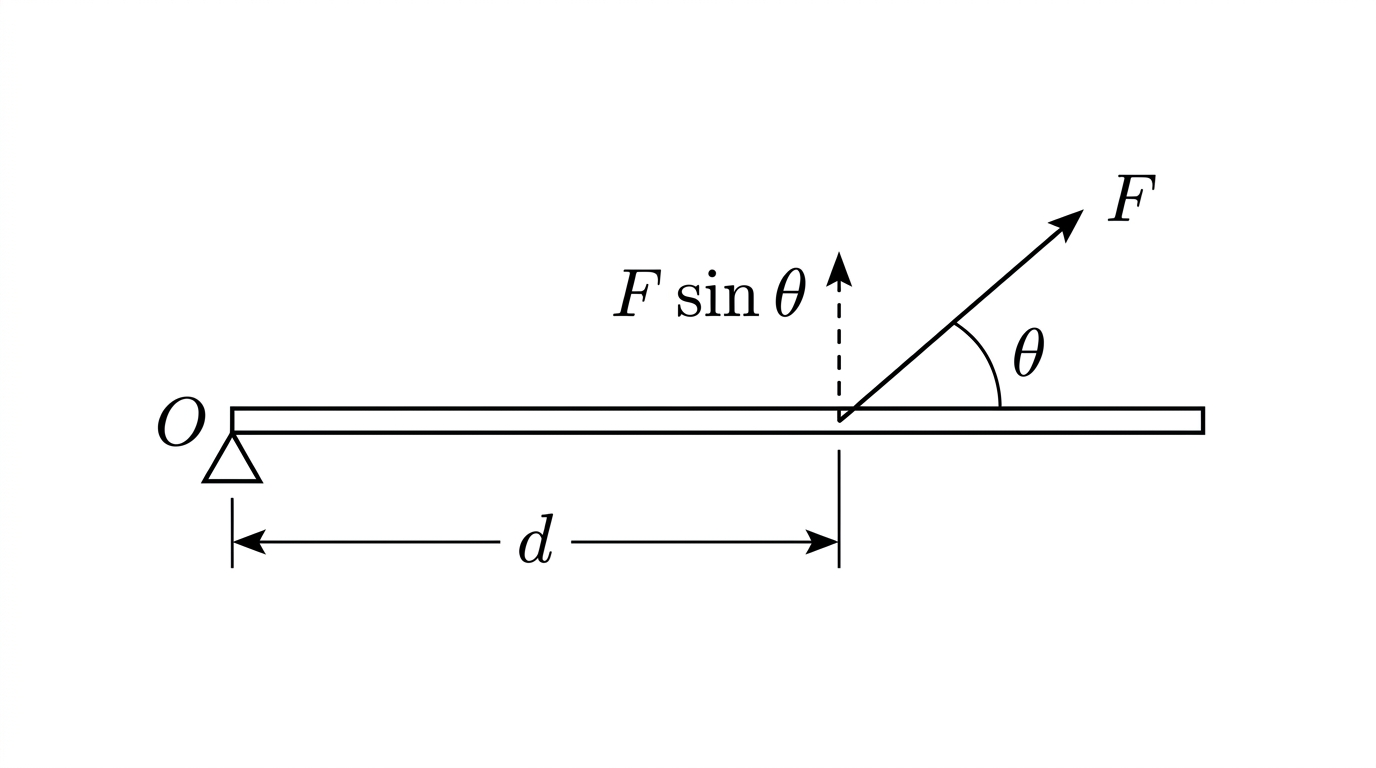
A force at angle θ to a rod: its moment can be found either from the true perpendicular distance d sin θ from the pivot to its line of action, or from its perpendicular component F sin θ multiplied by d — both give Fd sin θ.
MethodTwo equivalent ways to find the moment of an angled force
1
A force $F$ acts at angle $\theta$ to a rod, at a point a distance $d$ from the pivot along the rod.
Set up the general situation.
2
Method A: the perpendicular distance from the pivot to the force's line of action is $d\sin\theta$, so the moment is $F \times d\sin\theta$.
Drop a perpendicular from the pivot onto the extended line of the force.
3
Method B: the component of $F$ perpendicular to the rod is $F\sin\theta$, so the moment is $F\sin\theta \times d$.
Only the perpendicular component of a force has any turning effect.
4
Both give moment $=Fd\sin\theta$ — the same result, since multiplication can be reordered.
The two methods are algebraically identical.
▪ shown
The principle of moments
For a body in rotational equilibrium
Sum of clockwise moments about any point $=$ sum of anticlockwise moments about that same point. This holds about any chosen point, not just an obvious pivot — a useful freedom exploited fully in the next lesson, on full rigid-body equilibrium.
Worked example 1
A single perpendicular force
A force of $20\ \text{N}$ acts perpendicular to a rod, at a point $1.5\ \text{m}$ from the pivot. Find the moment of the force about the pivot.
MethodMoment = force × perpendicular distance
1
Since the force is already perpendicular to the rod, the perpendicular distance is simply $1.5\ \text{m}$.
No resolving needed.
2
Moment $=20 \times 1.5 = 30\ \text{N m}$.
Direct substitution.
▪ solved
Worked example 2
A force at an angle to the rod
A force of $16\ \text{N}$ acts at $50°$ to a rod, at a point $0.8\ \text{m}$ from the pivot. Find the moment of the force about the pivot.
MethodMoment = Fd sin θ
1
Moment $= Fd\sin\theta = 16 \times 0.8 \times \sin 50°$.
Only the component perpendicular to the rod has a turning effect.
2
$=12.8 \times 0.766 = 9.80\ \text{N m}$ (3 s.f.).
Evaluate.
▪ solved
Worked example 3
Balancing a seesaw
A seesaw pivots at its centre. A child of weight $300\ \text{N}$ sits $1.8\ \text{m}$ from the pivot on one side. Find how far from the pivot, on the other side, a child of weight $400\ \text{N}$ must sit for the seesaw to balance.
MethodSet clockwise moment equal to anticlockwise moment
1
Let $x$ be the distance of the second child from the pivot. By the principle of moments: $300 \times 1.8 = 400 \times x$.
The two moments about the pivot must be equal and opposite for balance.
2
$540 = 400x$, so $x = 1.35\ \text{m}$.
Solve for $x$.
▪ solved
Worked example 4
Finding the centre of mass of a non-uniform rodChallenge
A non-uniform rod $AB$ of length $3\ \text{m}$ and weight $50\ \text{N}$ rests horizontally on two supports, one at $A$ and one at $B$. The support at $A$ provides a reaction of $32\ \text{N}$ and the support at $B$ provides $18\ \text{N}$. Find the distance of the rod's centre of mass from $A$.
MethodTake moments about A, using the two given reactions
1
Check the reactions are consistent with vertical equilibrium first: $32+18=50\ \text{N}$, matching the rod's weight. ✓
A useful check before proceeding.
2
Let $x$ be the distance of the centre of mass from $A$. Take moments about $A$: the weight $50\ \text{N}$ acts at distance $x$ (clockwise, say), and the reaction at $B$, $18\ \text{N}$, acts at distance $3$ (anticlockwise).
The reaction at $A$ itself has zero moment about $A$.
3
Principle of moments about $A$: $50x = 18 \times 3 = 54$.
Clockwise moment equals anticlockwise moment.
4
$x = \dfrac{54}{50} = 1.08\ \text{m}$ from $A$.
Solve for $x$.
▪ solved
Taking moments about A was the key choice
Taking moments about $A$ made the reaction at $A$ vanish from the equation entirely, since a force acting exactly at the point you take moments about has zero perpendicular distance, and so zero moment. This is the central technique of the next lesson too: choosing a well-placed point to take moments about can eliminate an unwanted unknown before you've even written the equation.
Common mistake
Using the distance measured along the force's own line of action, rather than the true perpendicular distance from the pivot. A moment always uses the shortest (perpendicular) distance from the pivot to where the force's line of action passes — this equals the distance along the rod only when the force happens to act exactly perpendicular to it.
Check yourself
A force of $15\ \text{N}$ acts perpendicular to a rod, at a point $0.8\ \text{m}$ from the pivot. State the moment of the force, and whether it is clockwise or anticlockwise (the force pushes the rod downward on the side further from the pivot, viewed with the pivot on the left).
Moment $=15\times 0.8=12\ \text{N m}$, and pushing down on the side away from the pivot (with the pivot on the left) turns the rod clockwise.