A rigid body at rest needs two things to hold simultaneously: the forces must balance, and the moments must balance. Choosing the right point to take moments about is what makes these problems solvable.
14 min read4 worked examples
Two conditions for equilibrium
A rigid body — one with size, unlike the particles of earlier lessons — is in equilibrium only when both of the following hold:
Force equilibrium and moment equilibrium
(1) The resultant force is zero: resolving in any two perpendicular directions, both sums are zero. (2) The resultant moment about any point is zero. Satisfying only the first condition tells you the body isn't accelerating in a straight line, but it could still be starting to rotate; satisfying only the second tells you it isn't starting to rotate, but it could still be accelerating sideways. Genuine equilibrium needs both.
Choosing where to take moments
The moment equation holds about any point you choose — this is the single most useful piece of freedom in the whole topic. Taking moments about a point where an unknown force acts makes that force vanish from the equation (it has zero perpendicular distance from itself), often letting you solve for a different unknown immediately, without it ever appearing. Force equilibrium then finishes the problem.
Worked example 1
Two people carrying a plank
A uniform plank $AB$ of length $4\ \text{m}$ and weight $80\ \text{N}$ is carried horizontally by two people, one at each end. Find the force each person supports.
MethodSymmetry, then check with moments
1
"Uniform" means the weight acts at the midpoint, $2\ \text{m}$ from each end — exactly halfway between the two people.
The centre of mass of a uniform rod is its geometric centre.
2
By symmetry, each person supports half the total weight: $80 \div 2 = 40\ \text{N}$ each.
Equal distance from the weight means equal share of the load.
3
Check by taking moments about $A$: $80 \times 2 = R_B \times 4 \Rightarrow R_B = 40\ \text{N}$, matching. ✓
Confirms the symmetry argument formally.
▪ solved
Worked example 2
A beam with an off-centre load
A uniform beam $AB$ of length $6\ \text{m}$ and weight $120\ \text{N}$ rests horizontally on two supports, at $A$ and at $B$. A load of $60\ \text{N}$ is placed $1.5\ \text{m}$ from $A$. Find the reaction at each support.
MethodTake moments about A to find one reaction, then use force equilibrium for the other
1
Take moments about $A$: the beam's weight ($120\ \text{N}$) acts at its midpoint, $3\ \text{m}$ from $A$; the load ($60\ \text{N}$) acts at $1.5\ \text{m}$; the reaction $R_B$ acts at $6\ \text{m}$.
Clockwise moments (both downward forces) equal the anticlockwise moment of $R_B$.
3
$R_B = 75\ \text{N}$.
Solve.
4
Vertical equilibrium: $R_A+R_B = 120+60=180$, so $R_A = 180-75=105\ \text{N}$.
Total upward reaction equals total downward weight and load.
▪ solved
Worked example 3
A rod hinged at a wall, held by a string
A uniform rod $AB$ of length $2\ \text{m}$ and weight $40\ \text{N}$ is hinged at $A$ to a vertical wall, held horizontal by a string from $B$ making $40°$ with the rod. Find the tension in the string.
MethodTake moments about the hinge to eliminate the unknown hinge reaction entirely
1
The hinge at $A$ exerts an unknown force in an unknown direction — exactly the kind of unknown moments about $A$ can remove.
Motivates the choice of pivot.
2
Taking moments about $A$: the weight ($40\ \text{N}$) acts at the midpoint, $1\ \text{m}$ from $A$; the string's perpendicular component is $T\sin 40°$, acting at the full length, $2\ \text{m}$ from $A$.
Only the component of $T$ perpendicular to the rod has a moment.
3
$T\sin 40° \times 2 = 40 \times 1$.
Clockwise (weight) equals anticlockwise (string) moment about $A$.
Solve for $T$ — the hinge force never had to appear.
▪ solved
Why this beats resolving first
The hinge reaction has both an unknown magnitude and an unknown direction — two unknowns on top of $T$. Taking moments about the hinge sidesteps both of them completely, leaving a single equation in the single unknown $T$. Only once $T$ is known would you resolve horizontally and vertically to find the hinge reaction itself, if the question asked for it.
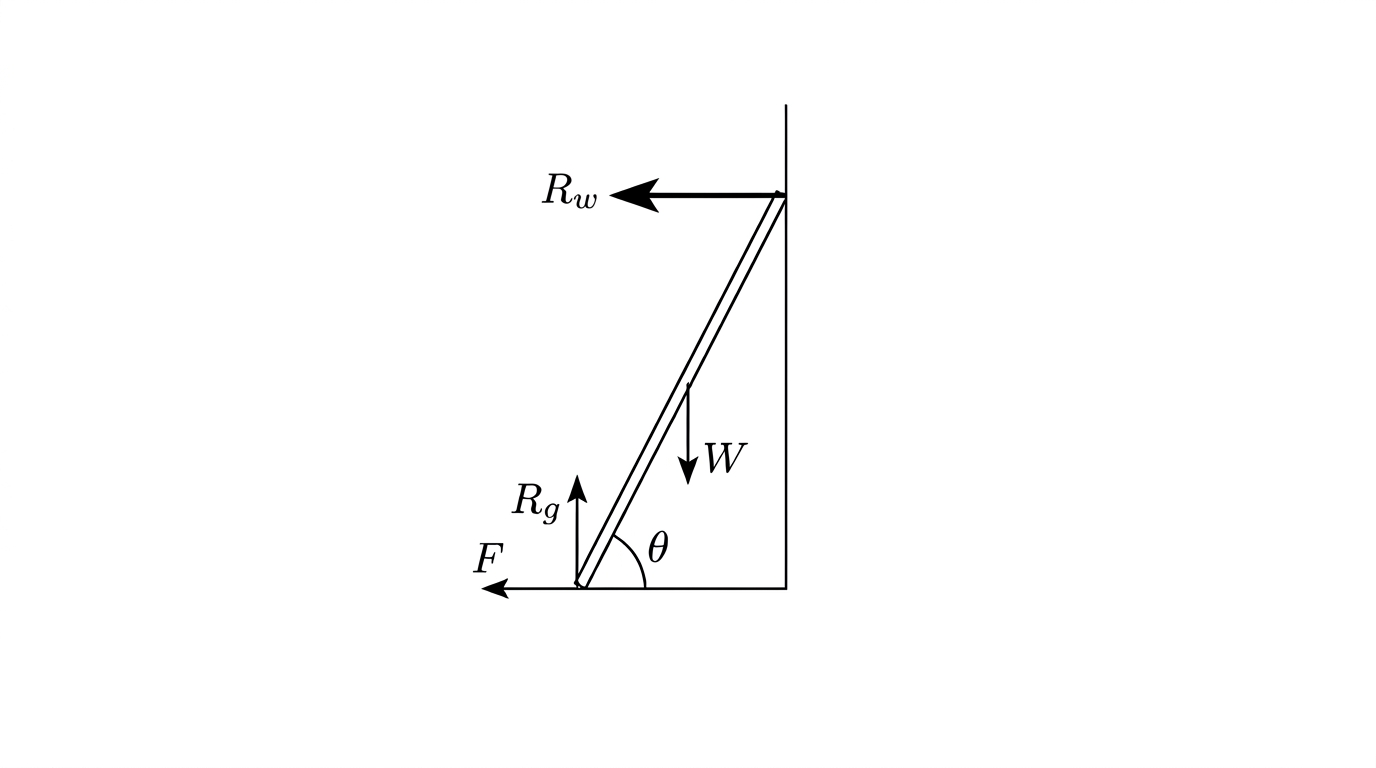
A ladder in limiting equilibrium: friction and the normal reaction act at the rough foot on the ground, only a normal reaction acts at the smooth top against the wall, and the weight acts at the midpoint.
Worked example 4
A ladder against a wallChallenge
A uniform ladder of weight $W$ rests with its foot on rough horizontal ground (coefficient of friction $\mu$) and its top against a smooth vertical wall, at angle $\theta$ to the ground. The ladder is in limiting equilibrium — on the point of slipping. Show that $\mu = \dfrac{1}{2\tan\theta}$.
MethodForce equilibrium in both directions, then moments about the foot
1
Forces: weight $W$ at the ladder's midpoint; normal reaction $R_g$ and friction $F=\mu R_g$ at the foot (ground); normal reaction $R_w$ at the top (wall — smooth, so no friction there).
Identify every force before writing any equation.
2
Vertical equilibrium: $R_g = W$ (the wall is smooth, so it contributes no vertical force).
Only the ground supports the ladder's weight.
3
Horizontal equilibrium: $F = R_w$ (friction at the foot balances the wall's push).
The only two horizontal forces must cancel.
4
Take moments about the foot of the ladder, of length $2a$ say: the weight acts at horizontal distance $a\cos\theta$ from the foot; the wall reaction $R_w$ acts at vertical distance $2a\sin\theta$ from the foot, horizontally.
Taking moments about the foot removes both $R_g$ and $F$ from the equation.
In limiting equilibrium, $F=\mu R_g = \mu W$. From step 3, $F=R_w$, so $\mu W = \dfrac{W}{2\tan\theta}$, giving $\mu = \dfrac{1}{2\tan\theta}$, as required.
Combine the friction condition with the moment result.
▪ shown
Why the foot is the right point for moments
Taking moments about the foot eliminates both unknowns there ($R_g$ and $F$) in one step, leaving an equation purely in $W$, $R_w$ and $\theta$. This is the ladder problem in its classic form — it appears throughout A-level mechanics and STEP-style problems precisely because it combines force resolution, moments and the limiting-friction condition in a single, tightly interlocking argument.
Common mistake
Taking moments and treating that as the whole solution. A moment equation alone cannot determine every unknown in a typical rigid-body problem — you almost always need force equilibrium as well, particularly to relate friction and normal reaction at a base, as in example 4. Set out both conditions explicitly, even if one of them turns out to need only a single line.
Check yourself
A uniform beam $AB$ of weight $40\ \text{N}$ and length $6\ \text{m}$ rests horizontally on two supports, at $A$ and $1\ \text{m}$ from $B$. A load of $20\ \text{N}$ is hung $2\ \text{m}$ from $A$. Find the reaction at each support.
The second support is $5\ \text{m}$ from $A$. Taking moments about $A$: $40(3)+20(2) = R_2(5) \Rightarrow 120+40=5R_2 \Rightarrow R_2=32\ \text{N}$.