When a curve refuses to integrate exactly, slice the area beneath it into trapezia instead, and add up the pieces.
9 min read4 worked examples
Approximating an area with strips
Not every function has a "nice" antiderivative — for some curves, exact integration is impossible or impractical with A-level techniques. The trapezium rule sidesteps this by approximating the area under $y=f(x)$ using a series of trapezia rather than finding an exact antiderivative.
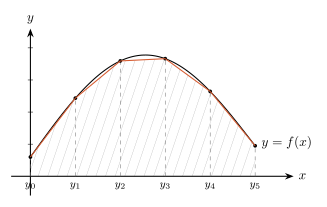
Split the interval $[a,b]$ into $n$ strips of equal width $h=\dfrac{b-a}{n}$, and record the y-values $y_0,y_1,\dots,y_n$ at each of the $n+1$ dividing points $x_0=a,x_1,\dots,x_n=b$. Joining consecutive points $(x_i,y_i)$ with a straight line turns each strip into a trapezium, whose area is easy to compute exactly.
The area under y = f(x) approximated by 5 trapezia of equal width h, using ordinates y₀ through y₅ at each dividing point.
The first and last ordinates ($y_0$ and $y_n$) appear once each, since they belong to only one trapezium; every ordinate in between is shared by two adjacent trapezia and so is counted twice.
Over-estimate or under-estimate?
Because each strip is topped with a straight line rather than the true curve, the trapezium rule's approximation is not exact — and a sketch reveals which way the error runs.
Reading the concavity
If the curve is convex (concave up, curving away from the x-axis) on the interval, each chord lies above the curve, so the trapezium rule gives an over-estimate. If the curve is concave (concave down, curving towards the x-axis), each chord lies below the curve, giving an under-estimate. Where a curve changes concavity within the interval, the two effects can partially cancel.
Worked example 1
Applying the rule with 4 strips
Use the trapezium rule with 4 strips to estimate $\displaystyle\int_0^4 \sqrt{x^2+1}\,dx$, giving your answer to 3 significant figures.
MethodTabulate the ordinates, then apply the formula
1
$h=\dfrac{4-0}{4}=1$, so the x-values are $0,1,2,3,4$.
Strip width from n = 4 strips over the interval [0, 4].
Explain, without further calculation, whether the trapezium rule applied to $\int_1^4 \ln x\,dx$ gives an over-estimate or an under-estimate of the true area.
MethodDetermine the concavity of y = ln x on the interval
1
$y=\ln x \Rightarrow \dfrac{dy}{dx}=\dfrac1x \Rightarrow \dfrac{d^2y}{dx^2}=-\dfrac{1}{x^2}$.
The second derivative determines concavity.
2
For $x\in[1,4]$, $\dfrac{d^2y}{dx^2}=-\dfrac1{x^2} < 0$ throughout.
Negative second derivative means the curve is concave (curving downward/towards the x-axis).
3
Since $y=\ln x$ is concave on $[1,4]$, each chord joining consecutive points lies below the curve.
A concave curve bulges above its chords.
4
The trapezia therefore underestimate the true area, so the trapezium rule gives an under-estimate.
Chords below the curve mean less area is captured than the true region.
▪ solved
Worked example 4
Comparing the estimate to the exact value · Challenge
Use the trapezium rule with 4 strips to estimate $\int_0^2 x^3\,dx$, then compare with the exact value and explain the sign of the error using the curve's concavity.
MethodCompute both the estimate and the exact integral, then interpret the difference
The estimate ($4.25$) exceeds the exact value ($4$) — an over-estimate of $0.25$.
Compare the two values.
5
$\dfrac{d^2y}{dx^2}=6x \ge 0$ on $[0,2]$, so $y=x^3$ is convex there — chords lie above the curve, consistent with the over-estimate found.
Concavity explains the direction of the error.
▪ solved
Look deeper — more strips, less error
As $n$ increases, each trapezium spans a narrower strip, so the straight-line chord deviates less from the true curve — the trapezium rule's estimate converges to the exact integral as $n\to\infty$. This is precisely why it's used only when exact integration is impractical, not as a replacement for it.
Common mistake
Doubling the wrong ordinates, or miscounting $n$ from a list of $x$-values. Remember: with $n+1$ ordinates there are $n$ strips, only $y_0$ and $y_n$ are counted once, and every other ordinate in the list is doubled — a quick recount before substituting avoids an easy arithmetic slip.
Check yourself
Use the trapezium rule with 5 strips to estimate $\displaystyle\int_0^5 \dfrac{1}{x+1}\,dx$, giving your answer to 3 significant figures. (Hint: h = 1 here, so the x-values are 0, 1, 2, 3, 4, 5.)