Every definite integral is a difference in disguise — subtract the lower boundary from the upper and the enclosed region falls straight out.
9 min read4 worked examples
From area under a curve to area between two boundaries
Integration reverses differentiation, and the definite integral $\int_a^b f(x)\,dx$ gives the (signed) area trapped between the curve $y=f(x)$, the x-axis, and the vertical lines $x=a$ and $x=b$. That single idea — a definite integral as an accumulated area — extends immediately to more interesting regions: the area between a curve and a straight line, or the area sandwiched between two curves.
The key realisation is that the x-axis was never special. It was simply the lower boundary of the region being measured. Replace it with any other curve or line, and the same accumulation idea applies — you just need to integrate the gap between the two boundaries rather than the height above y = 0.
The governing formula
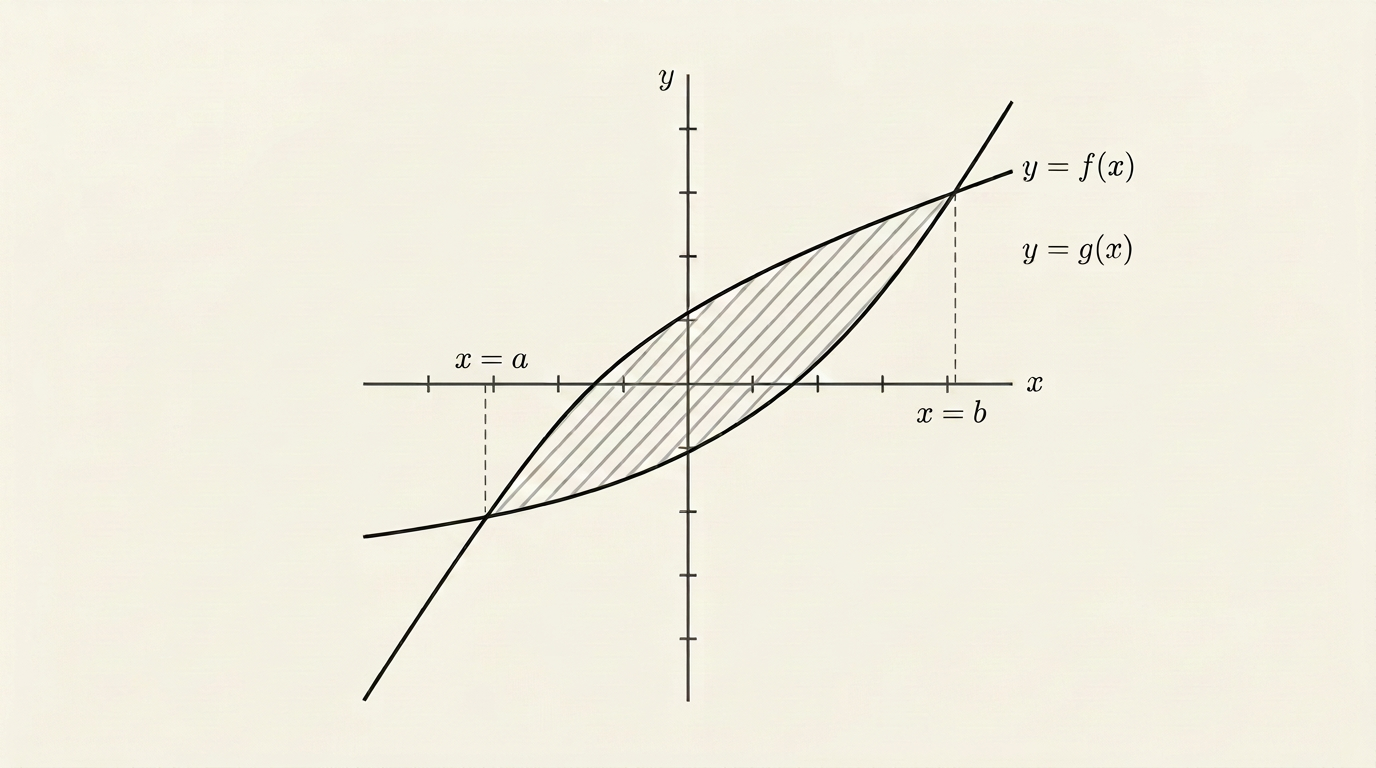
If $y=f(x)$ lies above $y=g(x)$ on the interval $a\le x\le b$, then the area of the region enclosed between the two curves is
$A = \int_a^b \big(f(x)-g(x)\big)\,dx$
Always subtract upper minus lower. Getting the order the wrong way round simply flips the sign of the answer — a useful check, since area itself must come out positive.
The shaded region between y = f(x) (upper) and y = g(x) (lower), from their left intersection x = a to their right intersection x = b. Its area is ∫ₐᵇ [f(x) − g(x)] dx.
Finding the limits: intersections come first
Unlike a simple area-under-a-curve problem, the limits $a$ and $b$ are rarely given outright — they're usually the x-coordinates where the two boundaries intersect, found by solving $f(x)=g(x)$. Locating these intersection points is therefore always the first step, before any integration begins.
Working order
1) Solve $f(x)=g(x)$ to find the intersection x-values — these become your limits. 2) Confirm which curve is on top between those limits (a quick sketch or a single test point does this). 3) Integrate the difference (upper − lower) between the limits.
Worked example 1
Area between a curve and a line
Find the area of the region enclosed between $y=6x-x^2$ and the line $y=2x$.
MethodFind intersections, identify the upper curve, integrate the difference
1
Solve $6x-x^2=2x \Rightarrow 4x-x^2=0 \Rightarrow x(4-x)=0 \Rightarrow x=0$ or $x=4$.
Intersections give the limits of integration.
2
Test $x=2$: curve gives $6(2)-4=8$; line gives $2(2)=4$. The curve is above the line on $(0,4)$.
Identifies which function is "upper" for the subtraction.
Evaluate at both limits and subtract; the integrand is even, so the region is symmetric about x = 0.
5
The enclosed area is $\dfrac{64}{3}$ square units.
Final answer.
▪ solved
Symmetry as a check
Because both curves are symmetric about the y-axis here, the enclosed region is too — a quick sanity check that the limits $x=-2$ and $x=2$ (rather than, say, an asymmetric pair) are sensible before committing to the integral.
Worked example 3
Region split by a sign change
The curve $y=x^3-4x$ and the line $y=0$ enclose two regions between $x=-2$ and $x=2$. Find the total enclosed area.
MethodSplit at every intersection, since "upper" swaps between regions
$\Big[\dfrac{x^4}{4}-2x^2\Big]_0^2 = (4-8)-0 = -4$, so this region contributes $|-4|=4$.
Second integral is negative because the curve is below the axis there — take its magnitude.
6
Total enclosed area $=4+4=8$ square units.
Add the magnitudes of each region — never add the signed integrals directly.
▪ solved
The key insight
A single integral $\int_{-2}^{2}(x^3-4x)\,dx$ would give $0$ here, since the two regions have opposite sign and cancel. Whenever curves cross between the limits, split the integral at every crossing point and combine magnitudes — never signed values — to get the true enclosed area.
Worked example 4
Region enclosed by three boundaries · Challenge
Find the area of the finite region bounded by $y=x^2$, the line $y=x+2$, and the y-axis, for $x\ge0$.
MethodIdentify which boundary is upper across the whole region, then integrate once
1
Solve $x^2=x+2 \Rightarrow x^2-x-2=0 \Rightarrow (x-2)(x+1)=0 \Rightarrow x=2$ or $x=-1$.
Intersection of curve and line.
2
Since the region is restricted to $x\ge0$, the relevant intersection is $x=2$; the y-axis gives the other limit, $x=0$.
The extra boundary "$x\ge0$" replaces the negative intersection at x = −1.
3
Test $x=1$: line gives $1+2=3$; curve gives $1^2=1$. The line is above the curve on $(0,2)$.
The enclosed area is $\dfrac{10}{3}$ square units.
Final answer.
▪ solved
Look deeper — why the y-axis mattered
Without the restriction $x\ge0$, the "natural" enclosed region between the curve and line would run from $x=-1$ to $x=2$. Adding a third boundary like the y-axis is a common way exam questions force you to identify the correct limits from a sketch rather than purely from solving $f(x)=g(x)$.
Common mistake
Integrating $f(x)-g(x)$ over the whole interval without checking whether the curves swap which one is "upper" partway through. If they cross between your limits, a single integral will let positive and negative contributions cancel, silently under-reporting the true area — always split at every intersection point inside the interval and sum the magnitudes.
Check yourself
Find the area of the region enclosed between $y=4-x^2$ and $y=x^2-4$. (Hint: find the intersections first, then identify which curve is on top between them.)
Method
1
$4-x^2=x^2-4 \Rightarrow 8=2x^2 \Rightarrow x=-2$ or $x=2$.
Solve for the intersections.
2
Test $x=0$: $4-x^2=4$, $x^2-4=-4$, so $y=4-x^2$ is on top on $(-2,2)$.