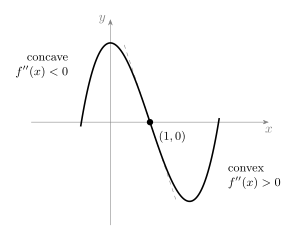
The second derivative doesn't just classify turning points — its sign describes the overall bend of a curve, and where that bend switches direction.
8 min read3 worked examples
The second derivative and the shape of a curve
Differentiating a function twice gives the second derivative, written $f''(x)$ or $\dfrac{d^2y}{dx^2}$ — the rate of change of the gradient itself. Its sign describes the curve's overall shape on an interval.
Convex and concave, defined
A curve is convex on an interval where $f''(x)\ge0$ — it curves upward like a cup, and every tangent line lies below the curve. A curve is concave on an interval where $f''(x)\le0$ — it curves downward like a dome, and every tangent line lies above the curve.
A simple way to remember which is which: a convex curve could "hold water" poured into it; a concave curve would spill it. $y=x^2$ is convex everywhere ($f''(x)=2>0$); $y=-x^2$ is concave everywhere ($f''(x)=-2<0$).
Points of inflection
A curve can be convex on part of its domain and concave on another part. The point where it switches from one to the other is called a point of inflection.
Testing for a point of inflection
A point of inflection requires both conditions: $f''(x)=0$ at that point, and $f''(x)$ genuinely changes sign either side of it. The second condition matters — $f''(x)=0$ on its own is not enough, as the final worked example below shows.
At (1, 0) the curve switches from concave (f″(x) < 0, curving downward) to convex (f″(x) > 0, curving upward) — the dashed line shows the tangent at the inflection point itself.
Worked example 1
Classifying convexity at a point
For the curve $y=x^3-3x^2+2$, determine whether the curve is convex or concave at (a) $x=0$, (b) $x=3$.
MethodFind f''(x), then evaluate its sign at each point
1
$\dfrac{dy}{dx}=3x^2-6x$, so $\dfrac{d^2y}{dx^2}=6x-6$.
Differentiate twice.
2
(a) At $x=0$: $\dfrac{d^2y}{dx^2}=6(0)-6=-6<0$.
Substitute $x=0$ into the second derivative.
3
Since $f''(0)<0$, the curve is concave at $x=0$.
A negative second derivative means concave.
4
(b) At $x=3$: $\dfrac{d^2y}{dx^2}=6(3)-6=12>0$, so the curve is convex at $x=3$.
A positive second derivative means convex.
▪ solved
Worked example 2
Finding a point of inflection
Find the point of inflection of $y=x^3-3x^2+2$.
MethodSolve f''(x)=0, then confirm a sign change
1
$\dfrac{d^2y}{dx^2}=6x-6$. Setting this to zero: $6x-6=0\Rightarrow x=1$.
A point of inflection can only occur where $f''(x)=0$.
2
Just below $x=1$ (e.g. $x=0.9$): $f''(0.9)=6(0.9)-6=-0.6<0$. Just above (e.g. $x=1.1$): $f''(1.1)=0.6>0$.
Test the sign of $f''(x)$ either side of $x=1$.
3
$f''(x)$ changes sign from negative to positive at $x=1$, confirming a genuine point of inflection.
Both conditions are satisfied: $f''(1)=0$ and a sign change either side.
4
At $x=1$: $y=1^3-3(1)^2+2=1-3+2=0$.
Substitute $x=1$ into the original equation to find the $y$-coordinate.
5
The point of inflection is $(1,0)$.
Combine the $x$- and $y$-coordinates.
▪ solved
Worked example 3
A trap: f''(x)=0 without a sign change · Challenge
Show that although $\dfrac{d^2y}{dx^2}=0$ at $x=0$ for the curve $y=x^4$, the point $(0,0)$ is not a point of inflection.
MethodCheck the sign of f''(x) either side of x=0
1
$\dfrac{dy}{dx}=4x^3$, so $\dfrac{d^2y}{dx^2}=12x^2$.
Differentiate twice.
2
At $x=0$: $\dfrac{d^2y}{dx^2}=12(0)^2=0$, satisfying the first condition.
This is necessary, but not sufficient, for a point of inflection.
3
At $x=-1$: $\dfrac{d^2y}{dx^2}=12(-1)^2=12>0$. At $x=1$: $\dfrac{d^2y}{dx^2}=12(1)^2=12>0$.
Test the sign either side of $x=0$.
4
Since $12x^2\ge0$ for every value of $x$, the second derivative never changes sign — it is positive on both sides of $x=0$ (and zero only momentarily at $x=0$ itself).
$x^2\ge0$ always, so $12x^2\ge0$ always.
5
$(0,0)$ is therefore not a point of inflection — the curve is convex on both sides, with no change in shape.
No sign change means the second required condition fails.
▪ shown
Look deeper
This is exactly analogous to a stationary point where $f'(x)=0$ but the point isn't a maximum or minimum (a stationary point of inflection, met in an earlier topic) — in both cases, a vanishing derivative is only the first clue, and checking what happens either side is what actually confirms the classification.
Common mistake
Concluding that $f''(x)=0$ automatically means a point of inflection, without checking that $f''(x)$ actually changes sign either side. Also common: mixing up the two shape words — "convex" always pairs with $f''(x)\ge0$ (cup-shaped), "concave" with $f''(x)\le0$ (dome-shaped).
Check yourself
Find the point of inflection of $y=x^3-6x^2+9x+1$, and confirm it genuinely is one.
Method
1
$\dfrac{dy}{dx}=3x^2-12x+9$, so $\dfrac{d^2y}{dx^2}=6x-12$.
Differentiate twice.
2
$6x-12=0\Rightarrow x=2$.
Solve $f''(x)=0$.
3
At $x=1.9$: $f''=-0.6<0$. At $x=2.1$: $f''=0.6>0$ — a genuine sign change.