When one event's outcome changes the odds of the next, a tree diagram tracks every branch of possibility — multiplying along, adding across.
10 min read4 worked examples
Reading a tree diagram
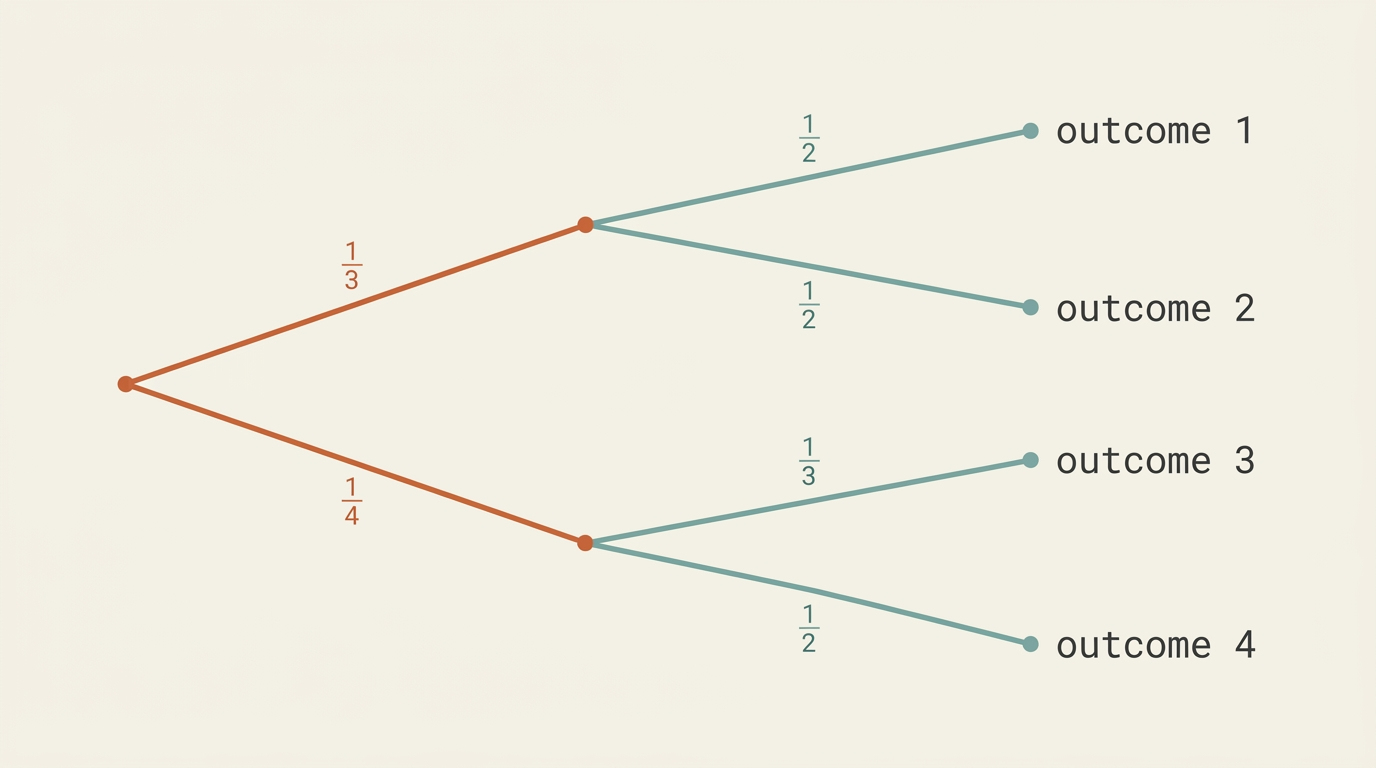
A tree diagram shows a sequence of events as branching paths: each branch is labelled with a probability, and each complete path from left to right represents one possible sequence of outcomes.
A two-stage tree diagram: multiply probabilities along a path, add probabilities across separate paths that lead to the same outcome.
Two rules make a tree diagram work:
Along a path (AND): multiply the probabilities on the branches you pass through.
Across paths (OR): if more than one path gives the outcome you want, add their probabilities together.
Trees without replacement
When sampling without replacement, the probabilities on later branches change depending on what happened earlier — this is exactly what a tree diagram is built to handle, since each branch's probability can be written down given everything that came before it on that path.
Why a tree diagram works even when events aren't independent
Unlike the simple multiplication rule ($P(A\cap B)=P(A)P(B)$, valid only for independent events), a tree diagram's branch probabilities are always conditional on the branches already taken — so "multiply along the path" remains valid whether or not the events are independent. This is precisely why trees are the standard tool once probabilities start changing between stages.
Strategy — check the branches at each point sum to 1
At every branching point, the probabilities of all branches leaving that point must sum to $1$, since they represent every possible outcome at that stage. This is a fast, reliable check for a correctly labelled tree diagram before doing any further calculation.
Worked example 1
Sampling without replacement
13 students audition for the school play: 9 audition for a speaking part and 4 for a non-speaking part. The director picks 2 of the 13 at random, one after another, to read the opening scene together. Find the probability both students picked auditioned for a speaking part.
MethodMultiply the two branch probabilities along the "both speaking-part" path
1
$P(\text{1st speaking}) = \dfrac{9}{13}$.
9 speaking-part auditionees out of 13 total, first pick.
2
Given the first was a speaking-part auditionee, 8 speaking and 4 non-speaking remain (12 total): $P(\text{2nd speaking}\mid\text{1st speaking}) = \dfrac{8}{12}$.
The second branch's denominator drops from $13$ to $12$ (one student has already been picked) — forgetting to update both the numerator and denominator on later branches is the single most common error with "without replacement" trees.
Worked example 2
Combining paths with OR
A sixth-form has a shortlist of 11 students for two university open-day places: 6 want to study engineering, 5 want to study natural sciences. Two students are chosen at random from the shortlist, without replacement, to fill the two places. Find the probability that exactly one of the two chosen wants to study natural sciences.
MethodIdentify both paths giving "exactly one sciences", then add
1
Two paths give exactly one sciences student: engineering-then-sciences, or sciences-then-engineering.
Order doesn't matter for the final count, so both paths qualify.
Sciences first (5/11), then engineering from the remaining 10 (6/10).
4
$P(\text{exactly one sciences}) = \dfrac{30}{110}+\dfrac{30}{110} = \dfrac{60}{110} = \dfrac{6}{11}$.
Add the two paths (OR).
▪ solved
The key insight
Spotting every path that leads to the required outcome is the real skill here — a tree diagram makes this visual, since you can trace each qualifying path by eye before doing any arithmetic. Missing a path is the most common way to get this style of question wrong.
Worked example 3
A three-stage tree
An archer hits the target with probability $0.8$ on each shot, independently of every other shot. She takes three shots. Find the probability she hits the target exactly twice.
MethodFind every path with exactly two hits, then add their probabilities
1
Three paths give exactly two hits: HHM, HMH, MHH (H = hit, M = miss).
Each places the single miss in a different position.
2
Each path has probability $(0.8)^2\times(0.2)^1 = 0.128$, since the hit probability doesn't change between shots.
Independent shots, so each path multiplies the same three numbers, just reordered.
3
$P(\text{exactly two hits}) = 3\times0.128 = 0.384$.
Three equally-probable paths, added together.
▪ solved
Look deeper — this is the binomial formula, built from first principles
This is exactly the calculation the binomial formula $\binom{n}{r}p^r(1-p)^{n-r}$ automates: $\binom{3}{2}=3$ counts the paths, and $(0.8)^2(0.2)^1$ is each path's probability. A tree diagram shows precisely where that formula comes from, for independent, identically-distributed trials.
Worked example 4
A tree diagram with a real-world setup · Challenge
A parcel firm uses two couriers: Courier X delivers 70% of parcels and has a 3% late-delivery rate; Courier Y delivers the remaining 30% and has an 8% late-delivery rate. Find the probability that a randomly chosen parcel is delivered late.
MethodBuild a two-stage tree: courier, then late or not
1
$P(\text{X and late}) = 0.7\times0.03 = 0.021$.
Multiply along the "X, then late" path.
2
$P(\text{Y and late}) = 0.3\times0.08 = 0.024$.
Multiply along the "Y, then late" path.
3
$P(\text{late}) = 0.021+0.024 = 0.045$.
Add the two paths that both end in "late".
▪ solved
Look deeper — this is P(late) built from two conditional pieces
This calculation is really $P(\text{late}) = P(X)P(\text{late}\mid X) + P(Y)P(\text{late}\mid Y)$ — a sum over every way the outcome could arise, weighted by how likely each route is. This pattern, splitting an event by which "cause" produced it, is the foundation for the next lesson's formal treatment of conditional probability.
Common mistake
Once one branch of a "without replacement" tree has been followed, every later branch on that same path must be updated to reflect it — but branches belonging to a different path start completely fresh. Carrying an update across into the wrong path is a frequent, costly error.
Check yourself
A yearbook committee of 12 people has 5 photographers and 7 writers. Two people are chosen at random, without replacement, to proofread the final draft. Find the probability both chosen are writers. (Hint: find P(1st writer), then P(2nd writer | 1st writer), then multiply.)