Quadratic Functions
The squared term bends the line into a parabola — and completing the square is the one technique that unlocks its roots, its vertex and its shape all at once.
A quadratic is any expression of the form $ax^2+bx+c$, where $a\neq 0$. That squared term is everything: it's what bends the graph into a smooth U-shape called a parabola, and it's why a quadratic can have two solutions, one, or none. Linear equations march in a straight line; the moment you square the variable, the graph turns, and turning is where all the interesting behaviour lives.
There are three questions we ask of every quadratic, and they're really the same question asked three ways: Where does it cross the $x$-axis? (its roots), where is its lowest or highest point? (its vertex), and what shape and position does its graph take? Master the algebra and all three answers fall out together.
You can solve quadratics by factorising, by formula, or by completing the square — but only completing the square tells you everything at once. Rewriting $ax^2+bx+c$ as $a(x+p)^2+q$ hands you the vertex $(-p,\,q)$ directly, proves whether the expression is always positive, and leads to the quadratic formula itself. The other methods answer one question; completing the square answers all of them. That's why it's worth the effort to make it automatic.
The three tools, and when to reach for each
Factorising — fastest when the roots are whole numbers. Write $ax^2+bx+c=(x-\alpha)(x-\beta)$; the roots are $\alpha$ and $\beta$.
Completing the square — rewrite as $(x+p)^2+q$. Use it for the vertex, for "always positive" proofs, or when factorising fails.
The quadratic formula — $x=\dfrac{-b\pm\sqrt{b^2-4ac}}{2a}$ — always works, and is the fallback when the roots aren't nice.
The quantity under the root, $b^2-4ac$, is the discriminant. It quietly decides how many real roots exist before you solve anything: positive means two, zero means one (a repeated root), negative means none.
Before diving into a solve, glance at $b^2-4ac$. If it's negative, the parabola never touches the $x$-axis and there are no real roots — stop before wasting time hunting for factors that don't exist. If it's a perfect square, the quadratic factorises nicely and you should factorise rather than reach for the formula.
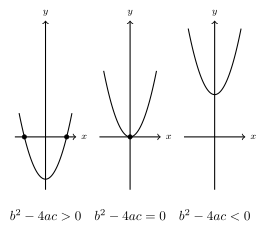
Worked example 1
The "product is zero" step is the logical heart of factorising — it's why factorising solves anything. $(2x-1)(x+3)=0$ forces one bracket to vanish; there's no other way for a product to equal zero. State both roots clearly; a lost solution is a lost mark.
Worked example 2
The completed-square form $(x-3)^2+2$ is the graph's fingerprint: the vertex sits at $(3,2)$, and because $q=2>0$ with an upward parabola, the curve never dips below the $x$-axis — proving the expression is always positive, with no roots. One line of algebra told us the position, the shape, and the number of roots simultaneously.
Worked example 3
"Exactly one repeated root" is a statement about the discriminant: it must equal zero. This is the discriminant working as a tool, not just a checker.
Both $k=6$ and $k=-6$ make the parabola just touch the $x$-axis at a single point (its vertex sits exactly on the axis). Geometrically, we've found the two positions of the curve where it grazes the axis rather than crossing it or missing it. The discriminant turned a picture ("touches once") into an equation ("$=0$") — that translation is the whole skill in these questions.
When completing the square with a leading coefficient, e.g. $2x^2+8x+1$, you must factor the $2$ out of the $x$-terms first: $2(x^2+4x)+1$, then complete the square inside. Forgetting to factor out $a$ before halving is the single most common error — you can't halve $8$ while the $2$ is still attached to the $x^2$.
Check yourself
Express $2x^2 + 12x + 23$ in the form $a(x+p)^2 + q$, and hence write down the minimum value.
(Hint: factor the 2 out of the $x$-terms before completing the square.)
The subtlety is step 3: the $-9$ sits inside the bracket the 2 multiplies, so it becomes $-18$ when the 2 is distributed. Miss that and the constant comes out wrong.