When a numerator's degree catches up with the denominator's, no amount of factorising helps — divide first, and everything that follows gets simpler.
10 min read4 worked examples
Dividing polynomials by hand
Algebraic long division divides one polynomial by another the same way long division divides numbers — matching the leading term, multiplying back, subtracting, and repeating with what's left. Dividing a polynomial $f(x)$ by a linear divisor $(x-a)$ produces a quotient $q(x)$, one degree lower than $f(x)$, and a constant remainder $r$:
$f(x) = (x-a)\,q(x) + r$
At each step: divide the leading term of what's left by the leading term of the divisor to get the next term of the quotient, multiply that term by the whole divisor, and subtract the result from what's left. Stop once the degree of what remains is lower than the divisor's degree — that's the remainder.
A shortcut for checking the remainder
By the remainder theorem (from Year 1), dividing $f(x)$ by $(x-a)$ always leaves remainder $f(a)$. This doesn't replace doing the division — the quotient still has to be found by the algorithm — but it's a fast, independent check that the remainder came out right.
Improper fractions need division first
An algebraic fraction is improper if its numerator's degree is greater than or equal to its denominator's — the case partial fractions can't handle directly. Dividing first rewrites it as a polynomial plus a proper fraction, which can then be split into partial fractions if the denominator factorises:
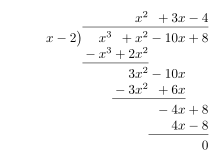
Divide $x^3+x^2-10x+8$ by $(x-2)$, and use the result to fully factorise the cubic.
The division laid out bus-stop style: $(x-2)$ outside the bracket, $x^3+x^2-10x+8$ inside, with the quotient $x^2+3x-4$ building up on top and each subtraction row shown underneath.
MethodMatch, multiply, subtract — one term at a time
1
$x^3\div x = x^2$. Multiply: $x^2(x-2)=x^3-2x^2$. Subtract: $(x^3+x^2)-(x^3-2x^2)=3x^2$, bringing down $-10x$ gives $3x^2-10x$.
First term of the quotient.
2
$3x^2\div x = 3x$. Multiply: $3x(x-2)=3x^2-6x$. Subtract: $(3x^2-10x)-(3x^2-6x)=-4x$, bringing down $+8$ gives $-4x+8$.
Second term of the quotient.
3
$-4x\div x = -4$. Multiply: $-4(x-2)=-4x+8$. Subtract: $(-4x+8)-(-4x+8)=0$.
Remainder is zero — an exact factor.
4
Quotient $x^2+3x-4=(x+4)(x-1)$, remainder $0$.
Factorise the quadratic quotient.
5
So $x^3+x^2-10x+8 = (x-2)(x+4)(x-1)$.
Combine the divisor with the factorised quotient.
▪ solved
Examiner's eye
A remainder of zero means the divisor is a genuine factor — exactly what the factor theorem would have predicted by checking $f(2)=0$ first. Long division goes further than the factor theorem by finding the full quotient, not just confirming a factor exists.
Worked example 2
Division with a non-zero remainder
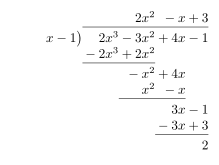
Divide $2x^3-3x^2+4x-1$ by $(x-1)$, giving the quotient and remainder.
Same bus-stop layout, but this time the last row doesn't cancel: quotient $2x^2-x+3$ with remainder $2$ left over.
MethodSame algorithm — this time it doesn't reach zero
1
$2x^3\div x=2x^2$. Multiply: $2x^2(x-1)=2x^3-2x^2$. Subtract: $-x^2$, bring down $4x$: $-x^2+4x$.
First term of the quotient.
2
$-x^2\div x=-x$. Multiply: $-x(x-1)=-x^2+x$. Subtract: $3x$, bring down $-1$: $3x-1$.
Combine the polynomial part with the split fraction.
▪ solved
Look deeper — the full picture
This worked example closes the loop the whole topic has been building towards: an improper fraction (this lesson) whose proper remainder happens to have a repeated or distinct factorised denominator (the last two lessons) can always be fully decomposed. Check the degrees first, divide if needed, then split whatever proper fraction remains.
Common mistake
Trying to split an improper fraction straight into partial fractions without dividing first. Setting $\dfrac{2x^2+3x-1}{(x+2)(x-1)} = \dfrac{A}{x+2}+\dfrac{B}{x-1}$ directly cannot work: the right-hand side is always a proper fraction (degree of the top less than the bottom once combined), so it can never equal an improper one. Always compare the degrees of numerator and denominator before choosing a method.
Check yourself
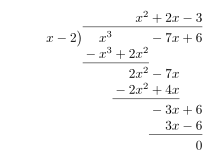
Divide $x^3-7x+6$ by $(x-2)$, and use the result to fully factorise the cubic. (Hint: there's no $x^2$ term, so treat its coefficient as 0.)
$x^3-7x+6$ has no $x^2$ term, so a $0x^2$ placeholder keeps every column lined up: quotient $x^2+2x-3$, remainder $0$.