Adding & Subtracting Volumes
Rotate the space between two curves and you get a washer, not a disc — subtract the inner solid of revolution from the outer one to find what's left.
The washer method
When the region between two curves $y_1=f(x)$ (outer) and $y_2=g(x)$ (inner), with $f(x)\geq g(x)\geq0$ on $[a,b]$, is rotated $360°$ about the $x$-axis, the resulting solid (a washer or annular solid) has volume $$V=\pi\int_a^b\big(y_1^2-y_2^2\big)\,dx$$ This is found by subtracting the inner solid of revolution from the outer one.
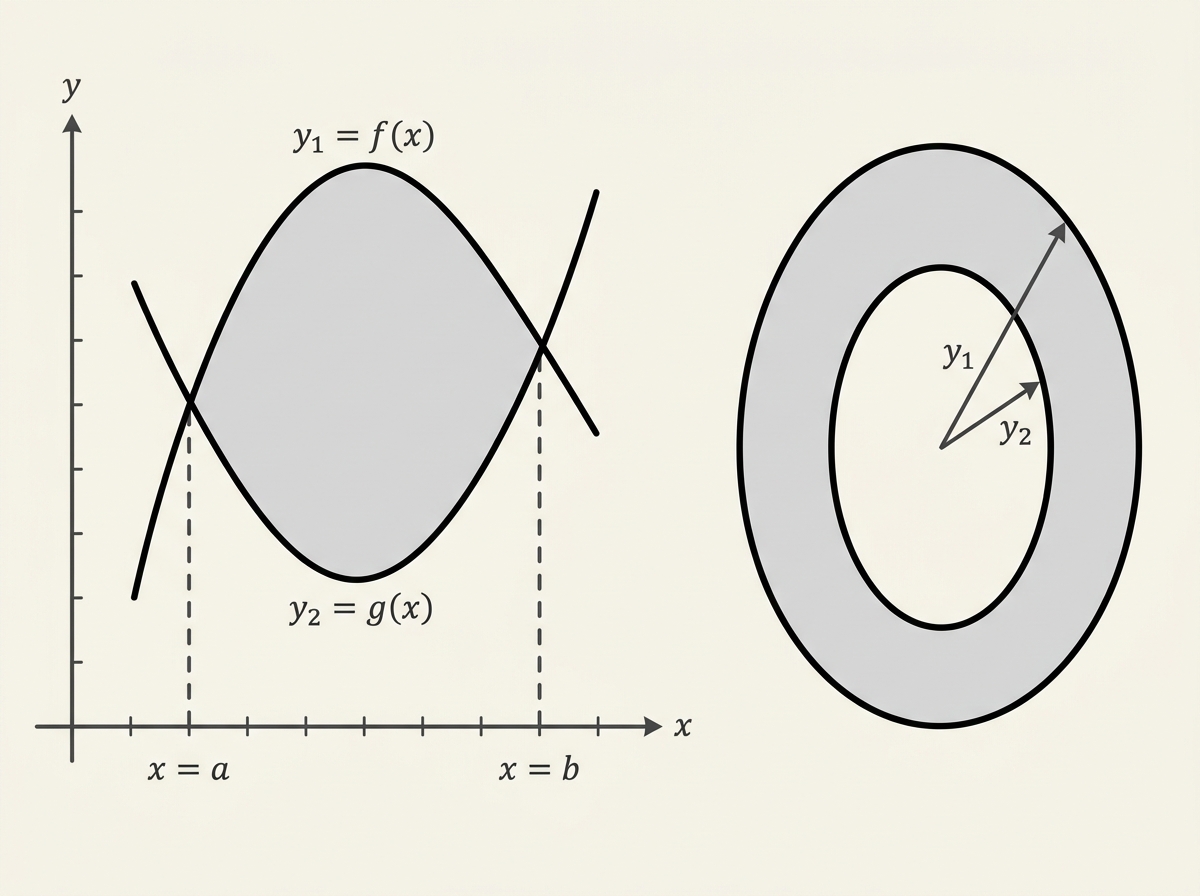
$V\neq\pi\displaystyle\int(y_1-y_2)^2\,dx$ — you must square each radius separately and then subtract, since volume scales with the difference of the two disc areas, not the disc formed by the difference of the radii.
Intersection: $4-x^2=x^2 \Rightarrow 4=2x^2 \Rightarrow x^2=2 \Rightarrow x=\pm\sqrt2$.
Outer curve is $y_1=4-x^2$ (larger for $-\sqrt2<x<\sqrt2$), inner is $y_2=x^2$.
$V=\pi\displaystyle\int_{-\sqrt2}^{\sqrt2}\big[(4-x^2)^2-(x^2)^2\big]\,dx=\pi\int_{-\sqrt2}^{\sqrt2}(16-8x^2+x^4-x^4)\,dx=\pi\int_{-\sqrt2}^{\sqrt2}(16-8x^2)\,dx$.
By symmetry: $=2\pi\displaystyle\int_0^{\sqrt2}(16-8x^2)\,dx=2\pi\left[16x-\dfrac{8x^3}{3}\right]_0^{\sqrt2}$.
$=2\pi\left(16\sqrt2-\dfrac{8(2\sqrt2)}{3}\right)=2\pi\left(16\sqrt2-\dfrac{16\sqrt2}{3}\right)=2\pi\cdot\dfrac{32\sqrt2}{3}=\dfrac{64\sqrt2\,\pi}{3}$.
Volumes with a hole (washer about the y-axis / vase problems)
Rearranging $y=\tfrac12\sqrt x$: $x=4y^2$, so outer radius squared is $x^2=16y^4$.
Volume of the full solid: $V_1=\pi\displaystyle\int_0^4 16y^4\,dy=\pi\left[\dfrac{16y^5}{5}\right]_0^4=\pi\cdot\dfrac{16(1024)}{5}=\dfrac{16384\pi}{5}$.
Volume of the cylindrical hole (radius 1, height 4): $V_2=\pi(1)^2(4)=4\pi$.
Capacity $=V_1-V_2=\dfrac{16384\pi}{5}-4\pi=\dfrac{16384\pi-20\pi}{5}=\dfrac{16364\pi}{5}$.
Intersection: $x+1=x^2-1 \Rightarrow x^2-x-2=0 \Rightarrow (x-2)(x+1)=0 \Rightarrow x=-1,2$.
For $-1<x<2$, checking $x=0$: line gives $1$, curve gives $-1$, so the line is the outer curve (in terms of $|y|$ contributing more to $y^2$ needs checking carefully — since $y$ can be negative, we compare $y_1^2$ vs $y_2^2$ directly, not just $y_1$ vs $y_2$). At $x=0$: $(1)^2=1$, $(-1)^2=1$ — equal, so care is needed; using $y_1=x+1$ (line) as outer since $|x+1|\geq|x^2-1|$ on this interval by direct comparison at several points, e.g. $x=0.5$: line gives $1.5$, $(1.5)^2=2.25$; curve gives $-0.75$, $(-0.75)^2=0.5625$ — line dominates.
$V=\pi\displaystyle\int_{-1}^{2}\big[(x+1)^2-(x^2-1)^2\big]\,dx=\pi\int_{-1}^2\big[(x^2+2x+1)-(x^4-2x^2+1)\big]\,dx$
$=\pi\displaystyle\int_{-1}^2(-x^4+3x^2+2x)\,dx=\pi\left[-\dfrac{x^5}{5}+x^3+x^2\right]_{-1}^2$
At $x=2$: $-\dfrac{32}{5}+8+4=-\dfrac{32}{5}+12=\dfrac{-32+60}{5}=\dfrac{28}{5}$.
At $x=-1$: $\dfrac15-1+1=\dfrac15$.
$V=\pi\left(\dfrac{28}{5}-\dfrac15\right)=\pi\cdot\dfrac{27}{5}=\dfrac{27\pi}{5}$.
When curves can take negative $y$-values, always compare $y_1^2$ and $y_2^2$ directly at a test point inside the interval to identify which is the "outer" (larger $y^2$) curve — you cannot assume the curve with the larger $y$-value also has the larger $y^2$-value once negative values are involved.
Exam-style questions
Question 1 6 marks
The region enclosed between $y=6-x$ and $y=x^2$ (for $x\geq0$) is rotated $360°$ about the $x$-axis. Find the exact volume generated.
Intersection: $6-x=x^2 \Rightarrow x^2+x-6=0 \Rightarrow (x+3)(x-2)=0 \Rightarrow x=2$ (taking $x\geq0$) (M1, A1)
$V=\pi\displaystyle\int_0^2\big[(6-x)^2-(x^2)^2\big]\,dx=\pi\int_0^2(36-12x+x^2-x^4)\,dx$ (M1, A1)
$=\pi\left[36x-6x^2+\dfrac{x^3}{3}-\dfrac{x^5}{5}\right]_0^2=\pi\left(72-24+\dfrac83-\dfrac{32}{5}\right)$ (M1)
$=\pi\left(48+\dfrac83-\dfrac{32}{5}\right)=\pi\left(\dfrac{720}{15}+\dfrac{40}{15}-\dfrac{96}{15}\right)=\dfrac{664\pi}{15}$ (A1)
Question 2 5 marks
A bowl is modelled by rotating the region under $y=\dfrac{x^2}{3}$, between $x=0$ and $x=3$, about the $y$-axis. Find the exact volume of the bowl (in cm³ if measurements are in cm).
When $x=3$, $y=3$; rearranging $y=x^2/3 \Rightarrow x^2=3y$ (M1, A1)
$V=\pi\displaystyle\int_0^3 3y\,dy=\pi\left[\dfrac{3y^2}{2}\right]_0^3=\pi\left(\dfrac{27}{2}\right)=\dfrac{27\pi}{2}\text{ cm}^3$ (M1, A1, A1)
Question 3 6 marks
The region enclosed between $y=x$ and $y=x^3$ (for $0\leq x\leq1$) is rotated $360°$ about the $x$-axis. Find the exact volume generated.
On $(0,1)$, $x\geq x^3$, so outer curve is $y=x$. (B1)
$V=\pi\displaystyle\int_0^1\big[x^2-x^6\big]\,dx=\pi\left[\dfrac{x^3}{3}-\dfrac{x^7}{7}\right]_0^1$ (M1, A1)
$=\pi\left(\dfrac13-\dfrac17\right)=\pi\left(\dfrac{7-3}{21}\right)=\dfrac{4\pi}{21}$ (M1, A1, A1)