Volumes of Revolution Around the x-Axis
Same formula as Year 1 — but now every integration technique in the book is fair game for evaluating it.
Revisiting the volume of revolution formula
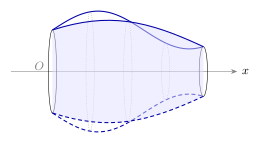
Recall that rotating the region under $y=f(x)$ between $x=a$ and $x=b$ fully around the $x$-axis creates a solid of volume
$$V=\pi\int_a^by^2\,dx$$
What's new in Year 2 is the difficulty of the curves involved — you'll now need every integration technique from this book (trigonometric identities, inverse trig results, partial fractions, integration by substitution) to actually evaluate $\displaystyle\int y^2\,dx$.
$V=\pi\displaystyle\int_0^{\pi/6}\cos^23x\,dx$. Using $\cos^2\theta=\dfrac12(1+\cos2\theta)$ with $\theta=3x$: $\cos^23x=\dfrac12(1+\cos6x)$.
$V=\pi\displaystyle\int_0^{\pi/6}\frac12(1+\cos6x)\,dx=\frac\pi2\left[x+\frac16\sin6x\right]_0^{\pi/6}$
$=\dfrac\pi2\left(\left(\dfrac\pi6+\dfrac16\sin\pi\right)-(0+0)\right)=\dfrac\pi2\left(\dfrac\pi6+0\right)=\dfrac{\pi^2}{12}$.
Before integrating, always find $y^2$ explicitly and fully simplify it — it's easy to make a sign or index error squaring an expression involving fractions, roots or trig functions. Writing $y^2=\ldots$ as its own line of working, before substituting into $V=\pi\displaystyle\int y^2\,dx$, avoids this.
A worked example needing an inverse trig result
$y^2=\dfrac4{4-x^2}$, so $V=\pi\displaystyle\int_0^1\frac4{4-x^2}\,dx=4\pi\int_0^1\frac1{4-x^2}\,dx$.
This denominator doesn't match the $\arcsin$-type result directly (it's $a^2-x^2$ in the denominator with no square root) — instead, use partial fractions: $\dfrac1{4-x^2}=\dfrac1{(2-x)(2+x)}=\dfrac{1/4}{2-x}+\dfrac{1/4}{2+x}$.
$V=4\pi\displaystyle\int_0^1\left(\frac{1/4}{2-x}+\frac{1/4}{2+x}\right)dx=\pi\Big[-\ln|2-x|+\ln|2+x|\Big]_0^1=\pi\Big[\ln\left(\dfrac{2+x}{2-x}\right)\Big]_0^1$
$=\pi\left(\ln3-\ln1\right)=\pi\ln3$.
Exam-style questions
Question 1 7 marks
The region $R$ is bounded by $y=\tan x$, the $x$-axis and the line $x=\dfrac\pi4$. Find the exact volume generated when $R$ is rotated $2\pi$ radians about the $x$-axis. (Hint: use $\tan^2x=\sec^2x-1$.)
$V=\pi\displaystyle\int_0^{\pi/4}\tan^2x\,dx=\pi\int_0^{\pi/4}(\sec^2x-1)\,dx$. (M1, A1)
$=\pi\Big[\tan x-x\Big]_0^{\pi/4}=\pi\left(\left(1-\dfrac\pi4\right)-(0-0)\right)$. (M1, A1)
$=\pi\left(1-\dfrac\pi4\right)=\pi-\dfrac{\pi^2}4$. (A1, A1)
Question 2 8 marks
The region $R$ is bounded by $y=\dfrac1{\sqrt{9+x^2}}$, the $x$-axis and the lines $x=0$ and $x=3$. Find the exact volume generated when $R$ is rotated $2\pi$ radians about the $x$-axis, leaving your answer in terms of $\pi$.
$y^2=\dfrac1{9+x^2}$, so $V=\pi\displaystyle\int_0^3\dfrac1{9+x^2}\,dx$; this matches the standard $\arctan$ form with $a=3$. (M1, A1)
$=\pi\left[\dfrac13\arctan\left(\dfrac x3\right)\right]_0^3=\dfrac\pi3\Big(\arctan1-\arctan0\Big)$. (M1, A1)
$=\dfrac\pi3\times\dfrac\pi4=\dfrac{\pi^2}{12}$. (A1, A1)