Intersections & Perpendiculars
Do two lines meet, and where — and what is the shortest possible distance from a point to a line that misses it entirely?
Testing whether two lines intersect
Set the two line equations equal, componentwise, giving three equations in the two parameters $s,t$. Solve two of the equations simultaneously, then check the solution in the third. If it's consistent, the lines meet at that point; if not, the lines are skew (they miss each other without being parallel).
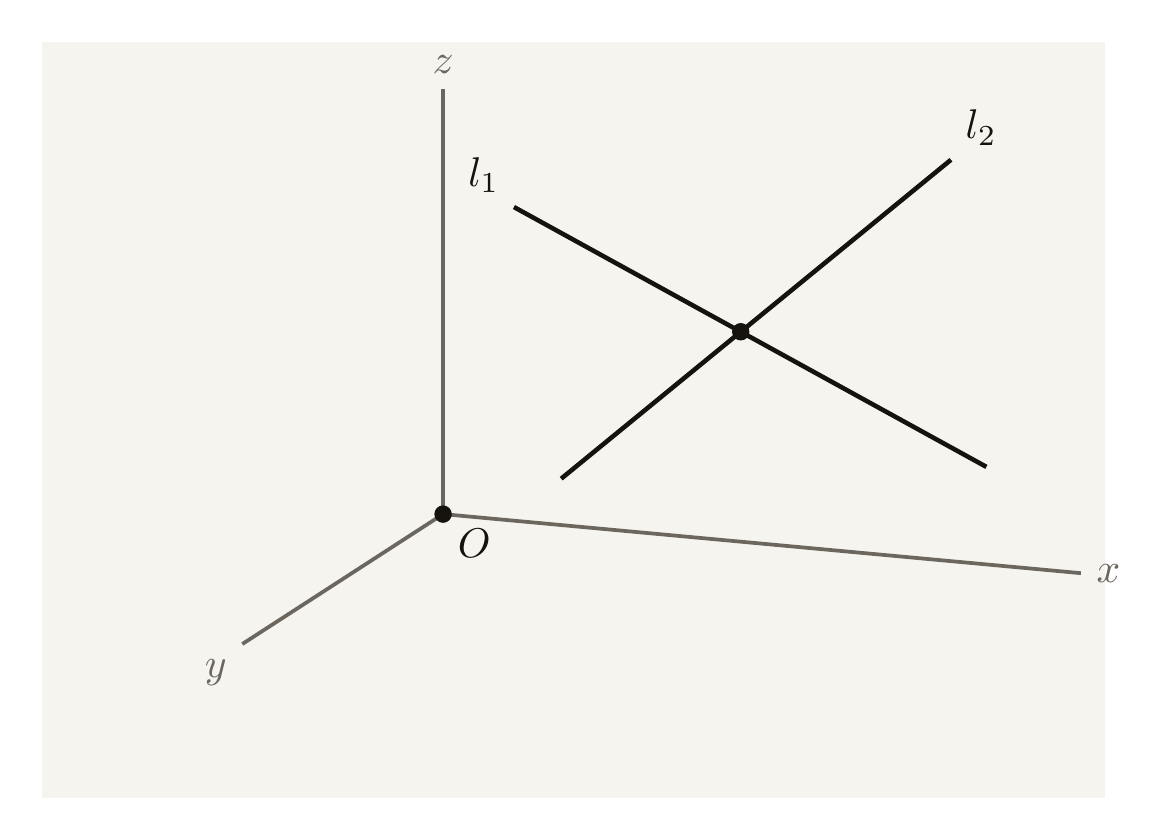
Equate components: $x$: $1+s=2t$. $y$: $2-s=3+t$. $z$: $2s=1-t$.
From the $y$-equation: $s=-1-t$. Substitute into the $x$-equation: $1+(-1-t)=2t \Rightarrow -t=2t \Rightarrow t=0$, so $s=-1$.
Check in the $z$-equation: LHS $=2(-1)=-2$; RHS $=1-0=1$. These don't match, so the lines are skew — they do not intersect.
Perpendicular distance from a point to a line
To find the shortest distance from point $P$ to line $\mathbf{r}=\mathbf{a}+t\mathbf{d}$: let $F=\mathbf{a}+t\mathbf{d}$ be a general point on the line. The vector $\vec{PF}$ is perpendicular to the line exactly when $\vec{PF}\cdot\mathbf{d}=0$. Solve this equation for $t$ to find $F$, the foot of the perpendicular, then the distance is $|\vec{PF}|$.
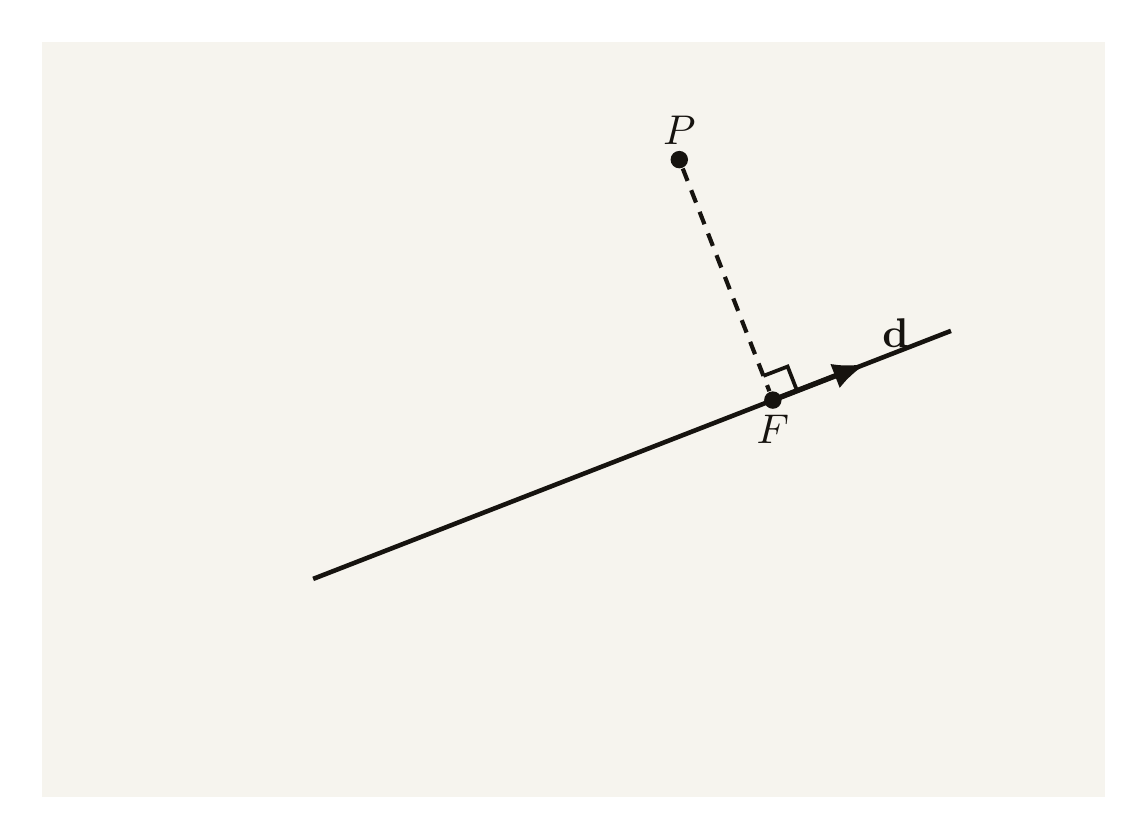
General point on line: $F=(2+t,1+t,-t)$. Then $\vec{PF}=F-P=(1+t,1+t,-t-2)$.
$\vec{PF}\cdot(1,1,-1)=0$: $(1+t)+(1+t)-(-t-2)=0 \Rightarrow 1+t+1+t+t+2=0 \Rightarrow 3t+4=0 \Rightarrow t=-\tfrac43$.
$F=(2-\tfrac43,1-\tfrac43,\tfrac43)=(\tfrac23,-\tfrac13,\tfrac43)$. $\vec{PF}=(\tfrac23-1,-\tfrac13,\tfrac43-2)=(-\tfrac13,-\tfrac13,-\tfrac23)$.
Equate components: $x$: $s=4-t$. $y$: $s=t$. $z$: $s=t$.
From $y$: $s=t$. Substituting into the $x$-equation: $t=4-t \Rightarrow 2t=4 \Rightarrow t=2$, so $s=2$.
Check in the $z$-equation: LHS $=s=2$; RHS $=t=2$. These match, confirming consistency across all three equations, so the lines intersect.
Substituting $s=2$ into $\mathbf{r}_1$: the point of intersection is $(2,2,2)$.
Using the same parameter letter for both lines is a common error — always use a different letter ($s$ and $t$) for each line, since they are independent variables that generally take different values at the point of intersection.
Exam-style questions
Question 1 7 marks
Show that the lines $\mathbf{r}_1=(1,0,2)+s(1,1,-1)$ and $\mathbf{r}_2=(3,2,0)+t(-1,1,1)$ intersect, and find the coordinates of the point of intersection.
$x$: $1+s=3-t \Rightarrow s+t=2$. $y$: $s=2+t \Rightarrow s-t=2$. (M1, A1)
Adding the two equations: $2s=4 \Rightarrow s=2$, so $t=0$. (M1, A1)
Check $z$: LHS $=2-s=2-2=0$; RHS $=0+t=0$. These match, confirming the lines intersect. (M1)
Substituting $s=2$ into $\mathbf{r}_1$: point of intersection is $(1+2,0+2,2-2)=(3,2,0)$. (A1)
Question 2 6 marks
Find the shortest distance from the point $Q(0,0,0)$ to the line $\mathbf{r}=(1,2,1)+t(1,-1,1)$.
General point: $F=(1+t,2-t,1+t)$. $\vec{QF}=F-Q=(1+t,2-t,1+t)$. (M1)
$\vec{QF}\cdot(1,-1,1)=0$: $(1+t)-(2-t)+(1+t)=0 \Rightarrow 3t=0 \Rightarrow t=0$ (M1, A1)
$F=(1,2,1)$, so $\vec{QF}=(1,2,1)$, and $|\vec{QF}|=\sqrt{1+4+1}=\sqrt6$ (M1, A1, A1)