Equations of Lines & Planes in 3D
A line needs a point and a direction; a plane needs a point and a normal — vector equations describe both with almost the same idea.
The vector equation of a line
A line through the point with position vector $\mathbf{a}$, in the direction of vector $\mathbf{d}$, has equation $$\mathbf{r}=\mathbf{a}+t\mathbf{d}, \qquad t\in\mathbb{R}$$ where $\mathbf{r}=(x,y,z)$ is the position vector of a general point on the line.
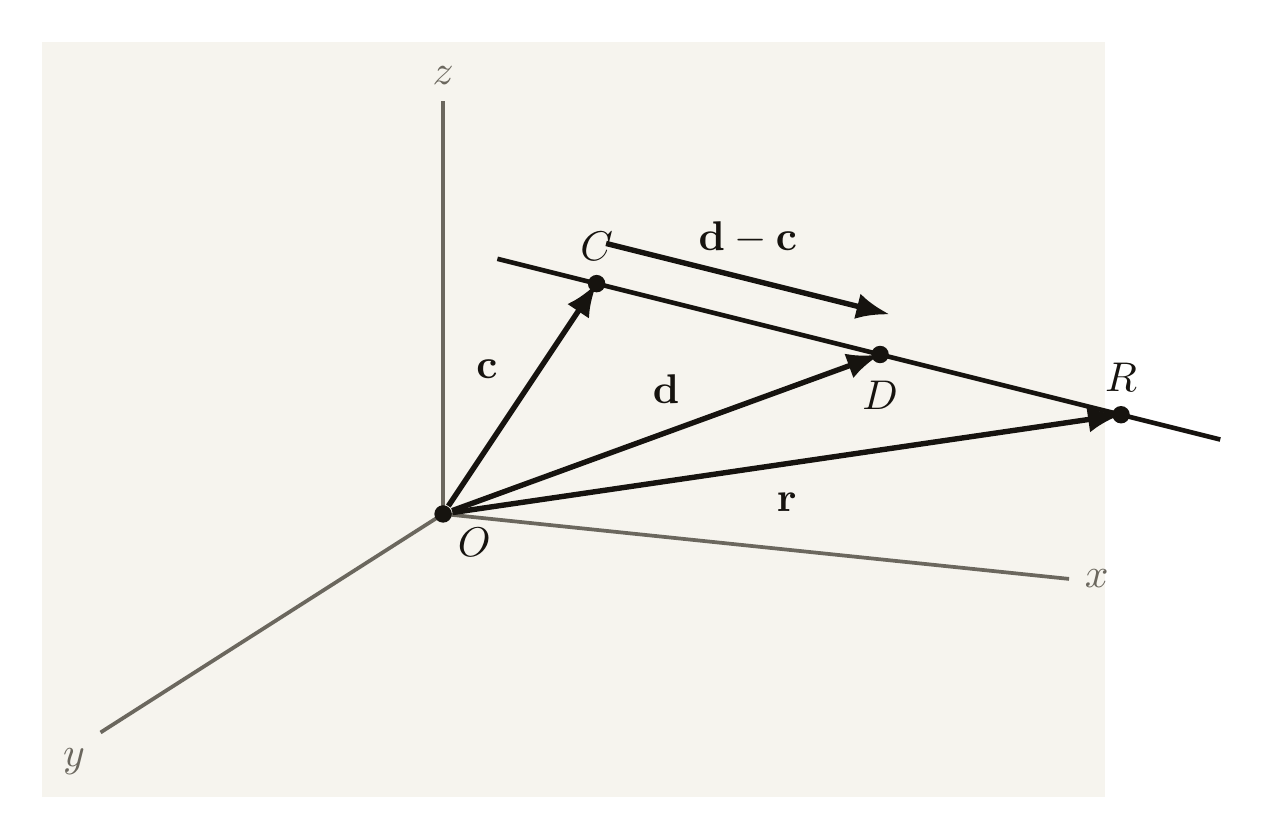
Direction vector: $\vec{AB}=B-A=(2,-3,5)$.
The vector and Cartesian equations of a plane
A plane through point $\mathbf{a}=(x_0,y_0,z_0)$ with normal vector $\mathbf{n}=(n_1,n_2,n_3)$ satisfies $\mathbf{n}\cdot(\mathbf{r}-\mathbf{a})=0$, giving the Cartesian form $$n_1x+n_2y+n_3z=d, \qquad d=\mathbf{n}\cdot\mathbf{a}$$
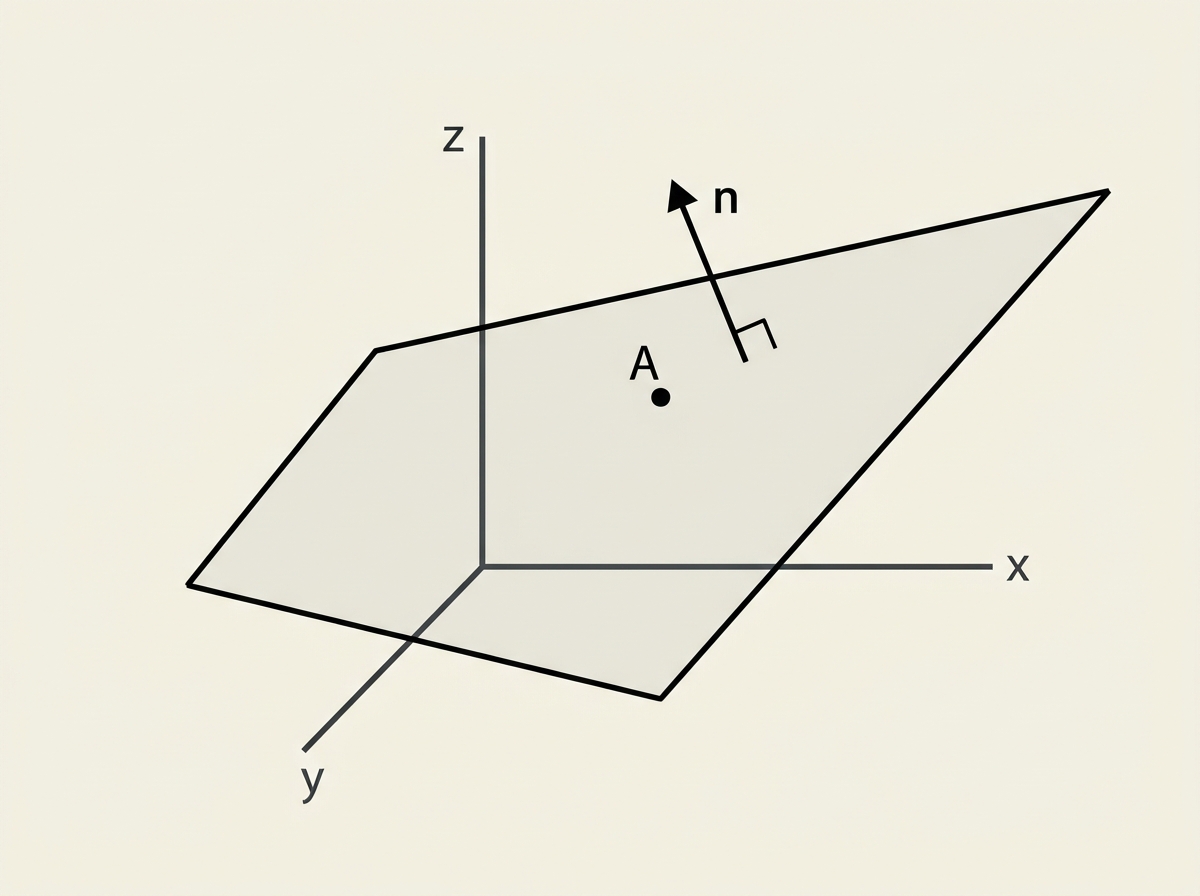
$d=\mathbf{n}\cdot\mathbf{a}=1(2)+(-2)(1)+4(-3)=2-2-12=-12$.
Two direction vectors in the plane: $\vec{AB}=(-1,1,0)$, $\vec{AC}=(-1,0,1)$.
Normal $\mathbf{n}=\vec{AB}\times\vec{AC}=\begin{vmatrix}\mathbf{i}&\mathbf{j}&\mathbf{k}\\-1&1&0\\-1&0&1\end{vmatrix}=(1(1)-0(0))\mathbf{i}-((-1)(1)-0(-1))\mathbf{j}+((-1)(0)-1(-1))\mathbf{k}=(1,1,1)$.
$d=\mathbf{n}\cdot A=1(1)+1(0)+1(0)=1$.
The direction vector of a line must be found by subtracting position vectors ($B-A$), not by using either point's coordinates directly as the direction.
Exam-style questions
Question 1 5 marks
Find the vector equation of the line through $P(4,-1,2)$ parallel to $\mathbf{d}=(1,2,-2)$, and determine whether the point $(6,3,-2)$ lies on this line.
$\mathbf{r}=\begin{pmatrix}4\\-1\\2\end{pmatrix}+t\begin{pmatrix}1\\2\\-2\end{pmatrix}$ (M1, A1)
$x$: $4+t=6\Rightarrow t=2$. Check $y$: $-1+2(2)=3$ ✓. Check $z$: $2-2(2)=-2$ ✓. (M1, A1)
All three coordinates are consistent with $t=2$, so the point does lie on the line. (A1)
Question 2 5 marks
Find the Cartesian equation of the plane through $(0,2,-1)$ with normal vector $(3,-1,2)$, and state whether the point $(1,1,1)$ lies on this plane.
$d=3(0)+(-1)(2)+2(-1)=-4$, so the plane is $3x-y+2z=-4$ (M1, A1)
Substituting $(1,1,1)$: $3(1)-1+2(1)=4\neq-4$ (M1, A1)
The point does not lie on the plane. (A1)