Further Maths/Lessons/Vectors/Equation of a Plane in 3D
Core Pure · Vectors · Year 1

Equation of a Plane in Three Dimensions

A single normal vector, perpendicular to every direction within it, pins down an entire flat plane through three-dimensional space.

19 min read 5 worked examples

The normal form of a plane

Definition 34.1 — Cartesian equation of a plane

A plane through point $\mathbf{a}=(x_0,y_0,z_0)$ with normal vector $\mathbf{n}=(n_1,n_2,n_3)$ satisfies $\mathbf{n}\cdot(\mathbf{r}-\mathbf{a})=0$, giving the Cartesian form $$n_1x+n_2y+n_3z=d, \qquad d=\mathbf{n}\cdot\mathbf{a}$$
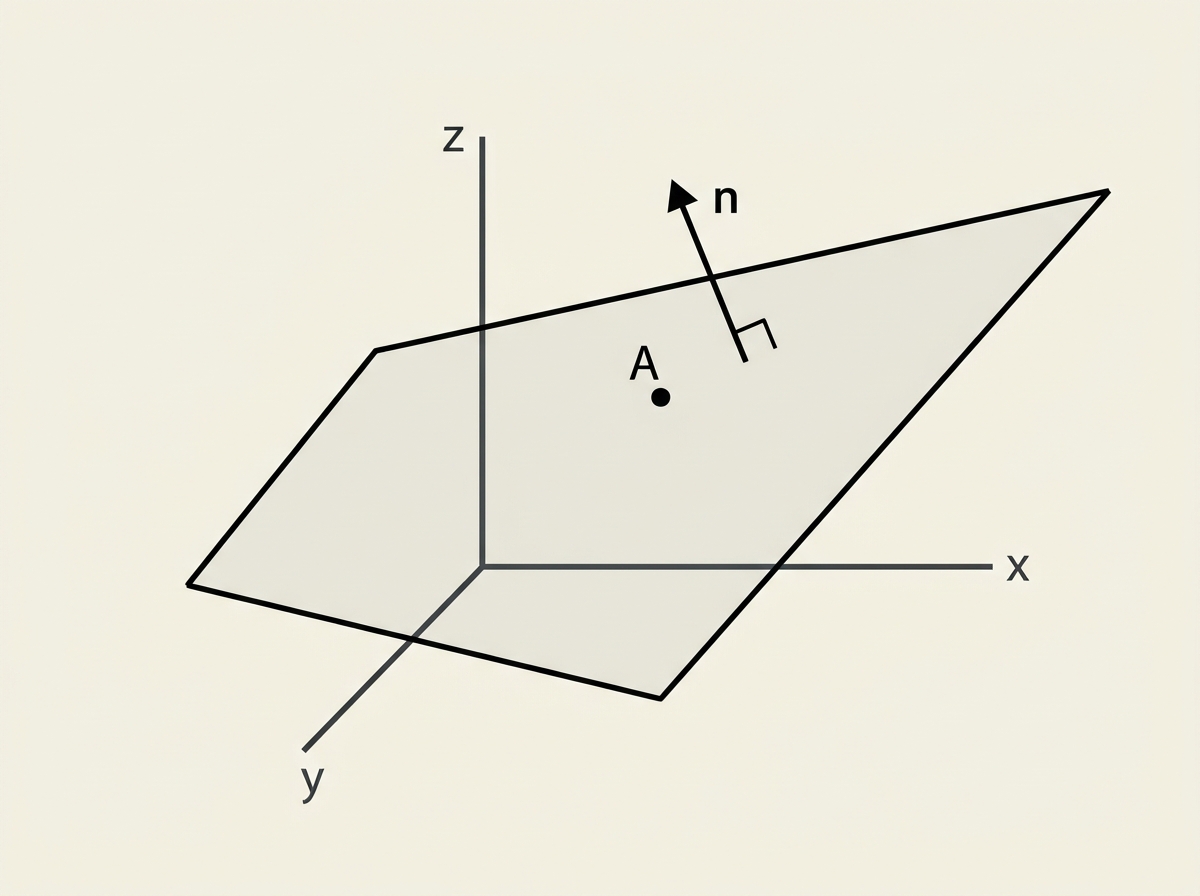
A 3D coordinate system showing a flat plane, with a normal vector n drawn perpendicular to the plane from a point A on the plane, and a dashed line showing the perpendicular relationship
Fig. 1 — the normal vector n is perpendicular to every direction lying within the plane, which is exactly what defines the plane's equation.
Example 1 · Finding the equation of a plane from a point and normal
Find the Cartesian equation of the plane through $(2,1,-3)$ with normal vector $(1,-2,4)$.

$d=\mathbf{n}\cdot\mathbf{a}=1(2)+(-2)(1)+4(-3)=2-2-12=-12$.

$$x-2y+4z=-12$$

The vector (parametric) form of a plane

Definition 34.2 — vector form of a plane

A plane through point $\mathbf{a}$, containing two non-parallel direction vectors $\mathbf{u}$ and $\mathbf{v}$ lying in the plane, has vector equation $$\mathbf{r}=\mathbf{a}+\lambda\mathbf{u}+\mu\mathbf{v},$$ $$\lambda,\mu\in\mathbb{R}$$

ProofWhere the vector form of a plane comes from
1
Let $R$ be any point in the plane through $A$ (position vector $\mathbf{a}$) containing two non-parallel directions $\mathbf{u}$ and $\mathbf{v}$, with $R$ having position vector $\mathbf{r}$.
A general point captures the whole plane at once.
2
By the triangle law, $\mathbf{r}=\mathbf{a}+\vec{AR}$.
Travelling from the origin to $A$, then from $A$ to $R$, reaches $R$ either way.
3
Since $\vec{AR}$ lies in the plane and $\mathbf{u},\mathbf{v}$ are two non-parallel directions within it, $\vec{AR}$ can always be written as a combination $\lambda\mathbf{u}+\mu\mathbf{v}$ for some scalars $\lambda,\mu$.
Any vector confined to a flat plane can be reached by moving some amount along each of two non-parallel directions in that plane — much like moving along two non-parallel axes in 2D.
4
Combining steps 2 and 3: $\mathbf{r}=\mathbf{a}+\lambda\mathbf{u}+\mu\mathbf{v}$.
This holds for every point $R$ in the plane for some choice of $\lambda,\mu$, and every choice of $\lambda,\mu$ gives a point in the plane.
∎

The scalar product form of a plane

Theorem 34.3 — scalar product form

A plane through point $\mathbf{a}$ with normal vector $\mathbf{n}$ can be written as $$\mathbf{r}\cdot\mathbf{n}=k, \qquad k=\mathbf{a}\cdot\mathbf{n}$$ This is a compact half-way point between the vector form and the fully expanded Cartesian form: writing $\mathbf{r}=(x,y,z)$ and expanding the dot product on the left recovers $n_1x+n_2y+n_3z=k$, exactly Definition 34.1 with $d=k$.

ProofDeriving $\mathbf{r}\cdot\mathbf{n}=k$
1
Let $R$, position vector $\mathbf{r}$, be any point in the plane, so $\vec{AR}=\mathbf{r}-\mathbf{a}$.
Vector from the known point $A$ to the general point $R$.
2
Since $\vec{AR}$ lies in the plane and $\mathbf{n}$ is perpendicular to the plane, $\vec{AR}\cdot\mathbf{n}=0$, i.e. $(\mathbf{r}-\mathbf{a})\cdot\mathbf{n}=0$.
Every direction lying within the plane is perpendicular to the normal.
3
Expanding: $\mathbf{r}\cdot\mathbf{n}-\mathbf{a}\cdot\mathbf{n}=0$, so $\mathbf{r}\cdot\mathbf{n}=\mathbf{a}\cdot\mathbf{n}$.
Distributing the dot product over subtraction, then rearranging.
4
Since $\mathbf{a}$ and $\mathbf{n}$ are fixed, $\mathbf{a}\cdot\mathbf{n}$ is a constant $k$, giving $\mathbf{r}\cdot\mathbf{n}=k$.
Any specific point known to lie in the plane can be used to compute $k$.
∎
Example 2 · Scalar product and Cartesian form from a point and normal
Find an equation of the plane through $(1,-2,3)$ with normal vector $(2,1,-1)$, in both scalar product form and Cartesian form.

$k=\mathbf{a}\cdot\mathbf{n}=2(1)+1(-2)+(-1)(3)=2-2-3=-3$.

$$\mathbf{r}\cdot\begin{pmatrix}2\\1\\-1\end{pmatrix}=-3$$ $$\text{equivalently}$$ $$2x+y-z=-3$$

Finding a plane through three points using the cross product

Method 34.4 — plane through three points

Given three points $A,B,C$ in the plane, form two direction vectors $\vec{AB}$ and $\vec{AC}$ lying in the plane. The normal is $\mathbf{n}=\vec{AB}\times\vec{AC}$ (perpendicular to both, hence to the whole plane). Then use $d=\mathbf{n}\cdot A$ as in Definition 34.1.

Example 3 · Finding a plane through three points
Find the Cartesian equation of the plane through $A(1,0,0)$, $B(0,1,0)$, $C(0,0,1)$.

Two direction vectors in the plane: $\vec{AB}=(-1,1,0)$, $\vec{AC}=(-1,0,1)$.

Normal $\mathbf{n}=\vec{AB}\times\vec{AC}=\begin{vmatrix}\mathbf{i}&\mathbf{j}&\mathbf{k}\\-1&1&0\\-1&0&1\end{vmatrix}=(1(1)-0(0))\mathbf{i}-((-1)(1)-0(-1))\mathbf{j}+((-1)(0)-1(-1))\mathbf{k}=(1,1,1)$.

$d=\mathbf{n}\cdot A=1(1)+1(0)+1(0)=1$.

$$x+y+z=1$$
Example 4 · Converting vector form to Cartesian form
Find the Cartesian equation of the plane $\mathbf{r}=(1,2,0)+\lambda(1,0,-1)+\mu(0,1,2)$.

Normal $\mathbf{n}=(1,0,-1)\times(0,1,2)=\begin{vmatrix}\mathbf{i}&\mathbf{j}&\mathbf{k}\\1&0&-1\\0&1&2\end{vmatrix}=(0(2)-(-1)(1))\mathbf{i}-(1(2)-(-1)(0))\mathbf{j}+(1(1)-0(0))\mathbf{k}=(1,-2,1)$.

$d=\mathbf{n}\cdot(1,2,0)=1(1)-2(2)+1(0)=1-4=-3$.

$$x-2y+z=-3$$
Example 5 · Checking a point against a plane
Determine whether the point $(4,-1,2)$ lies on the plane $2x+3y-z=3$.

Substituting: $2(4)+3(-1)-2=8-3-2=3$ ✓

The point does lie on the plane.

Common mistake

The two direction vectors used to find a normal via the cross product must both lie in the plane — using a vector from a point outside the plane, or using parallel vectors (which give a zero cross product), leads to an incorrect or undefined normal.

Exam-style questions

Question 1 5 marks

Find the Cartesian equation of the plane through $(0,2,-1)$ with normal vector $(3,-1,2)$, and state whether the point $(1,1,1)$ lies on this plane.

$d=3(0)+(-1)(2)+2(-1)=-4$, so the plane is $3x-y+2z=-4$ (M1, A1)

Substituting $(1,1,1)$: $3(1)-1+2(1)=4\neq-4$ (M1, A1)

The point does not lie on the plane. (A1)

Question 2 8 marks

Find the Cartesian equation of the plane through $A(2,0,1)$, $B(3,1,0)$, $C(1,2,2)$.

$\vec{AB}=(1,1,-1)$, $\vec{AC}=(-1,2,1)$ (M1, A1)

$\mathbf{n}=\vec{AB}\times\vec{AC}=\begin{vmatrix}\mathbf{i}&\mathbf{j}&\mathbf{k}\\1&1&-1\\-1&2&1\end{vmatrix}=(1+2,1+1,2+1)=(3,2,3)$ (M1, A1, A1)

$d=\mathbf{n}\cdot A=3(2)+2(0)+3(1)=9$ (M1, A1)

$3x+2y+3z=9$ (A1)

Question 3 6 marks

Find the Cartesian equation of the plane $\mathbf{r}=(2,-1,3)+\lambda(1,1,0)+\mu(0,1,1)$.

$\mathbf{n}=(1,1,0)\times(0,1,1)=(1(1)-0(1),0(0)-1(1),1(1)-1(0))=(1,-1,1)$ (M1, A1, A1)

$d=1(2)-1(-1)+1(3)=2+1+3=6$ (M1, A1)

$x-y+z=6$ (A1)