Sums of Natural Numbers, Squares & Cubes
Three standard summation formulae, derived from scratch by a telescoping trick, and put to work evaluating series that would be painful to add term by term.
The sum of the first n natural numbers
$$\sum_{r=1}^{n} r = 1+2+3+\cdots+n = \frac{n(n+1)}{2}$$
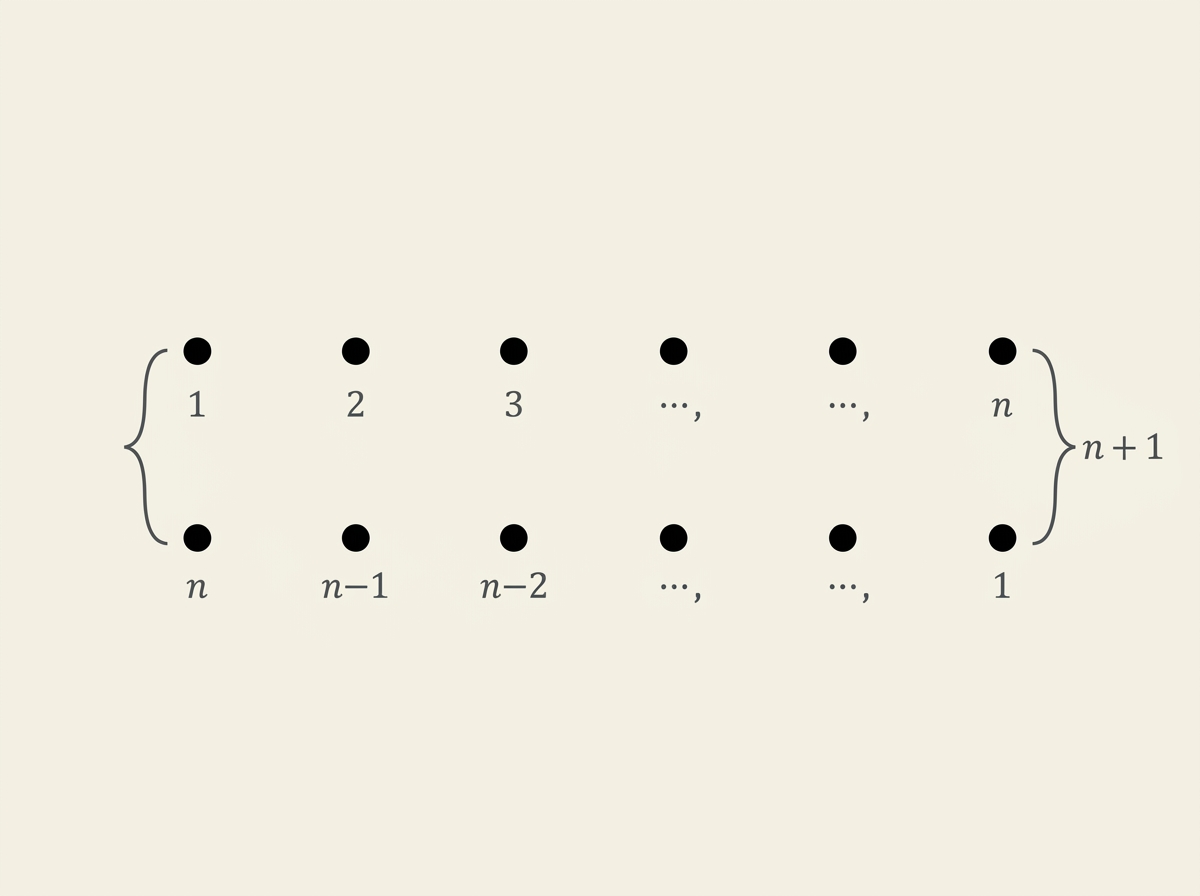
Writing the sum forwards and backwards and adding the two versions term by term (Gauss's classic pairing trick) gives $n$ pairs that each sum to $n+1$, for a combined total of $n(n+1)$. Since this counts the sum twice, dividing by $2$ gives the formula above.
The sum of the first n squares
$$\sum_{r=1}^{n} r^2 = 1^2+2^2+\cdots+n^2 = \frac{n(n+1)(2n+1)}{6}$$
This formula is proved using a telescoping identity — the same idea used later, in Year 2, for the method of differences. Start from the algebraic identity $(r+1)^3-r^3=3r^2+3r+1$, and sum both sides from $r=1$ to $n$.
The sum of the first n cubes
$$\sum_{r=1}^{n} r^3 = 1^3+2^3+\cdots+n^3 = \left[\frac{n(n+1)}{2}\right]^2 = \left(\sum_{r=1}^n r\right)^2$$
Remarkably, the sum of the first $n$ cubes is exactly the square of the sum of the first $n$ natural numbers. This is proved by the identical telescoping method, starting instead from $(r+1)^4-r^4=4r^3+6r^2+4r+1$ and using both Theorem 1.1 and Theorem 1.2 along the way — this full derivation is set as Exam-style Question 2 below, so you can practise the technique yourself.
All three formulae assume the sum starts at $r=1$. For a sum from $r=k$ to $n$, split it as $\displaystyle\sum_{r=k}^{n} = \sum_{r=1}^{n} - \sum_{r=1}^{k-1}$, apply the formula to each full sum, and subtract.
$\displaystyle\sum_{r=1}^{20} r(r+1) = \sum r^2+\sum r = \frac{20\cdot21\cdot41}{6}+\frac{20\cdot21}{2} = 2870+210 = 3080$
$\displaystyle\sum_{r=6}^{15} r^2 = \sum_{r=1}^{15}r^2-\sum_{r=1}^{5}r^2 = \frac{15\cdot16\cdot31}{6}-\frac{5\cdot6\cdot11}{6} = 1240-55 = 1185$
Expand: $(2r-1)^2=4r^2-4r+1$, so the sum is $4\sum r^2-4\sum r+n$.
Factor out $n$ and combine over a denominator of 3:
Since $4n^2-1=(2n-1)(2n+1)$, this simplifies to $\dfrac{n(2n-1)(2n+1)}{3}$, as required.
$\sum r^2 \neq \left(\sum r\right)^2$ in general — squaring the Σr formula is a frequent slip. Only the cube sum happens to equal the square of the Σr formula (Theorem 1.3); Σr² has its own distinct formula.
Exam-style questions
Question 1 5 marks
Evaluate $\displaystyle\sum_{r=1}^{12}(r^3-2r^2)$.
$\sum r^3 = \left[\dfrac{12\cdot13}{2}\right]^2 = 78^2 = 6084$ (M1, A1)
$\sum r^2 = \dfrac{12\cdot13\cdot25}{6} = 650$ (M1, A1)
$\sum(r^3-2r^2) = 6084-2(650) = 4784$ (A1)
Question 2 7 marks
Prove, using the telescoping identity $(r+1)^4-r^4=4r^3+6r^2+4r+1$, that $\displaystyle\sum_{r=1}^{n} r^3 = \left[\dfrac{n(n+1)}{2}\right]^2$.
Summing both sides from $r=1$ to $n$: LHS telescopes to $(n+1)^4-1$; RHS gives $4\sum r^3+6\sum r^2+4\sum r+n$ (M1, M1).
$(n+1)^4-1=n^4+4n^3+6n^2+4n$; substitute $\sum r^2=\dfrac{n(n+1)(2n+1)}{6}$ and $\sum r=\dfrac{n(n+1)}{2}$: $6\sum r^2=2n^3+3n^2+n$, $4\sum r=2n^2+2n$ (M1, A1)
$4\sum r^3 = (n^4+4n^3+6n^2+4n)-(2n^3+3n^2+n)-(2n^2+2n)-n = n^4+2n^3+n^2 = n^2(n+1)^2$ (M1)
$\sum r^3 = \dfrac{n^2(n+1)^2}{4} = \left[\dfrac{n(n+1)}{2}\right]^2$, as required (A1)