Improper Integrals
An unbounded region can still enclose a finite area — as long as the curve decays fast enough for the limiting process to settle on a finite value.
What makes an integral "improper"
The integral $\displaystyle\int_a^bf(x)\,dx$ is improper if either:
- one or both limits is infinite, or
- $f(x)$ is undefined at $x=a$, at $x=b$, or at some point strictly between $a$ and $b$.
Even though the region described is unbounded (either infinitely long, or approaching a vertical asymptote), the enclosed area can still be finite — the curve simply needs to decay fast enough. When the limiting process below produces a finite value, the integral is convergent; otherwise it's divergent.
Replace the indefinite limit with a variable (commonly $t$), evaluate the resulting proper integral as a function of $t$ using the fundamental theorem of calculus as usual, then take the limit as $t$ tends to the value the indefinite limit was approaching.
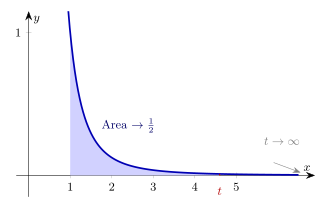
Replace $\infty$ with $t$: $\displaystyle\int_1^t x^{-3}\,dx=\left[-\frac12x^{-2}\right]_1^t=-\frac1{2t^2}-\left(-\frac12\right)=\frac12-\frac1{2t^2}$.
As $t\to\infty$, $\dfrac1{2t^2}\to0$, so the integral tends to $\dfrac12-0=\dfrac12$.
The limit exists and is finite, so the integral converges, with value $\dfrac12$.
$f(x)=\dfrac1{\sqrt x}$ is undefined at $x=0$, so replace the lower limit with $t\to0^+$: $\displaystyle\int_t^4x^{-1/2}\,dx=\Big[2x^{1/2}\Big]_t^4=4-2\sqrt t$.
As $t\to0^+$, $2\sqrt t\to0$, so the integral tends to $4-0=4$. It converges, with value $4$.
Not every improper integral converges. For $\displaystyle\int_1^\infty\dfrac1x\,dx$, the working gives $\Big[\ln x\Big]_1^t=\ln t-\ln1=\ln t$, and $\ln t\to\infty$ as $t\to\infty$ — the limit doesn't exist as a finite number, so the integral diverges. Always check the limit actually exists before declaring convergence.
Splitting integrals with an internal singularity
If $f(x)$ is undefined at a point $c$ strictly between $a$ and $b$, you must split the integral at $c$ and consider each piece as a separate improper integral: $\displaystyle\int_a^bf(x)\,dx=\int_a^cf(x)\,dx+\int_c^bf(x)\,dx$. Both pieces must converge individually for the whole integral to converge — if either piece diverges, so does the whole integral.
Exam-style questions
Question 1 6 marks
Show that $\displaystyle\int_0^{\infty}e^{-4x}\,dx$ converges and find its exact value.
$\displaystyle\int_0^te^{-4x}\,dx=\left[-\dfrac14e^{-4x}\right]_0^t=-\dfrac14e^{-4t}+\dfrac14$. (M1, A1)
As $t\to\infty$, $e^{-4t}\to0$, so the integral $\to\dfrac14-0=\dfrac14$. (M1, A1)
The limit exists and is finite, so the integral converges to $\dfrac14$. (A1, A1)
Question 2 6 marks
Show that $\displaystyle\int_2^{\infty}\frac1{(x-1)^2}\,dx$ converges and find its exact value.
Replace $\infty$ with $t$: $\displaystyle\int_2^t(x-1)^{-2}\,dx=\Big[-(x-1)^{-1}\Big]_2^t=-\dfrac1{t-1}+1$. (M1, A1)
As $t\to\infty$, $\dfrac1{t-1}\to0$, so the integral $\to0+1=1$. (M1, A1)
The limit exists and is finite, so the integral converges to $1$. (A1, A1)
Question 3 7 marks
Determine whether $\displaystyle\int_{-\infty}^{\infty}x^2\sin(2x)\,dx$ converges. Justify your answer fully.
Both limits are infinite, so split at $x=0$: $\displaystyle\int_{-\infty}^{\infty}x^2\sin2x\,dx=\int_{-\infty}^0x^2\sin2x\,dx+\int_0^{\infty}x^2\sin2x\,dx$, and both pieces must converge individually. (M1)
Integrating by parts twice: $\displaystyle\int x^2\sin2x\,dx=-\frac{x^2\cos2x}2+\int x\cos2x\,dx=-\frac{x^2\cos2x}2+\frac{x\sin2x}2+\frac{\cos2x}4\,(+C)$. (M1, A1)
So $\displaystyle\int_0^tx^2\sin2x\,dx=\left[-\frac{x^2\cos2x}2+\frac{x\sin2x}2+\frac{\cos2x}4\right]_0^t=-\frac{t^2\cos2t}2+\frac{t\sin2t}2+\frac{\cos2t}4-\frac14$. (M1)
As $t\to\infty$, $\cos2t$ oscillates between $-1$ and $1$ without settling on a value, while $t^2\to\infty$ — so $-\dfrac{t^2\cos2t}2$ oscillates with ever-growing amplitude and has no limit. (A1)
The limit doesn't exist, so $\displaystyle\int_0^{\infty}x^2\sin2x\,dx$ diverges — and since one piece already fails to converge, the whole integral $\displaystyle\int_{-\infty}^{\infty}x^2\sin2x\,dx$ diverges too. (A1)
Note: although $x^2\sin2x$ is an odd function, this does not mean the integral equals $0$ — that would require taking a symmetric (principal-value) limit, which isn't valid here since each piece must converge independently, and neither does. (B1)