Differentiating Inverse Trigonometric Functions
Implicit differentiation unlocks derivatives for arcsin, arccos and arctan.
Differentiating the inverse trig functions
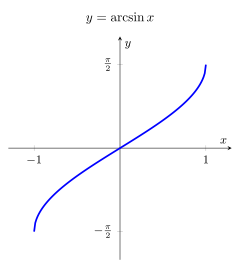
$$\frac{d}{dx}(\arcsin x)=\frac1{\sqrt{1-x^2}}$$
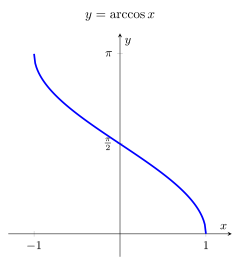
$$\frac{d}{dx}(\arccos x)=-\frac1{\sqrt{1-x^2}}$$
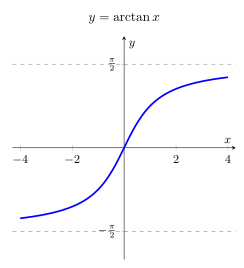
$$\frac{d}{dx}(\arctan x)=\frac1{1+x^2}$$
Notice that $\arcsin x$ and $\arccos x$ have derivatives that are negatives of each other — consistent with $\arcsin x+\arccos x=\dfrac\pi2$ being constant, so their derivatives must sum to zero.
Let $u=3x$, so $y=\arctan u$. Then $\dfrac{dy}{du}=\dfrac1{1+u^2}$ and $\dfrac{du}{dx}=3$.
By the chain rule: $\dfrac{dy}{dx}=\dfrac{dy}{du}\times\dfrac{du}{dx}=\dfrac3{1+9x^2}$.
By the product rule: $\dfrac{dy}{dx}=2x\arcsin x+x^2\times\dfrac1{\sqrt{1-x^2}}=2x\arcsin x+\dfrac{x^2}{\sqrt{1-x^2}}$.
Exam-style questions
Question 1 5 marks
Given $y=\arccos(2x)$, find $\dfrac{dy}{dx}$, and state the values of $x$ for which the derivative is defined.
Let $u=2x$: $\dfrac{dy}{du}=-\dfrac1{\sqrt{1-u^2}}$, $\dfrac{du}{dx}=2$. (M1, A1)
$\dfrac{dy}{dx}=-\dfrac2{\sqrt{1-4x^2}}$. (M1, A1)
Defined for $|2x|\lt1$, i.e. $-\dfrac12\lt x\lt\dfrac12$. (A1)
Question 2 5 marks
Given $y=\arcsin(4x)$, find $\dfrac{dy}{dx}$, and state the values of $x$ for which the derivative is defined.
Let $u=4x$: $\dfrac{dy}{du}=\dfrac1{\sqrt{1-u^2}}$, $\dfrac{du}{dx}=4$. (M1, A1)
$\dfrac{dy}{dx}=\dfrac4{\sqrt{1-16x^2}}$. (M1, A1)
Defined for $|4x|\lt1$, i.e. $-\dfrac14\lt x\lt\dfrac14$. (A1)