Geometric Interpretation of Systems of Equations
Every equation $ax+by+cz=d$ is a plane. Solving three of them at once is really asking: where — if anywhere — do three planes meet?
Three planes, three outcomes
Each equation $a_1x+a_2y+a_3z=b$ describes a flat, infinite plane in three-dimensional space. A system of three such equations therefore describes three planes, and "solving the system" means finding every point $(x,y,z)$ that lies on all three planes simultaneously. The previous lesson showed that checking $\det(A)$ tells you whether that solution is unique — this lesson works out what's actually happening geometrically in every case, including the two you can't distinguish from the determinant alone.
A system of three linear equations in three unknowns has exactly one of the following: a unique solution (one point), no solution (the system is inconsistent), or infinitely many solutions (the system is consistent but underdetermined). $\det(A)\neq0$ guarantees the first case. $\det(A)=0$ means one of the other two — and only by examining the equations themselves can you tell which. Geometrically, these three outcomes break down into exactly five named configurations of the three planes: a point, a sheaf, a fully coincident plane (the three consistent pictures), and a triangular prism or a set of parallel planes (the two inconsistent pictures).
Case 1: a unique solution — the planes meet at a point
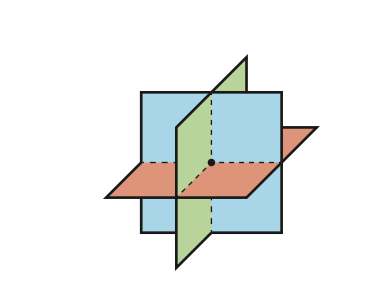
When $\det(A)\neq0$, the three planes are tilted relative to each other in just the right way that they intersect at exactly one shared point, found by $\mathbf{x}=A^{-1}\mathbf{b}$. This is the case covered in full in the previous lesson.
Case 2: a sheaf — the planes share a common line
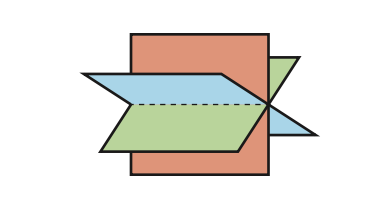
If $\det(A)=0$ but the equations remain consistent (no contradiction arises), the three planes typically form a sheaf — three distinct planes that all pass through one common line. Every point on that line satisfies all three equations, so the solution set is a whole line: a one-parameter family, usually written with a parameter such as $t$.
Case 3: all three planes coincide
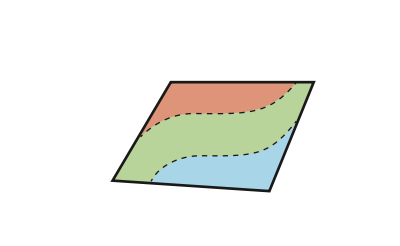
If $\det(A)=0$, the remaining way to get infinitely many solutions is if all three equations describe the same plane (each is a scalar multiple of the others). Every point on that one plane is then a solution — the last of the three consistent configurations.
If one row of the coefficient matrix (or a combination of two rows) is a scalar multiple of another row, the corresponding planes are either identical or parallel. To decide between a sheaf and a full coincident plane, eliminate one variable between two different pairs of equations: if the two resulting two-variable equations are themselves consistent (proportional or identical), the whole system is consistent, and you can then substitute back to describe the line or plane of solutions explicitly.
Case 4: two or more planes parallel and non-identical
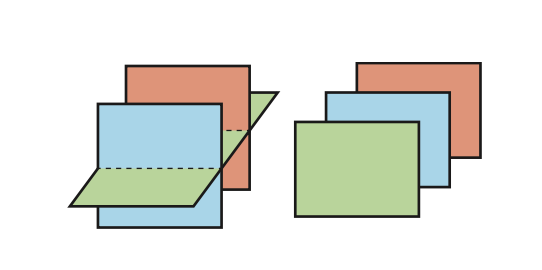
If $\det(A)=0$ and eliminating a variable produces a contradiction (something like $0=k$ for $k\neq0$), the system is inconsistent — no point lies on all three planes. One way this happens: two or more of the planes are parallel and distinct, so they never meet each other at all, regardless of the third plane. This can look like all three planes mutually parallel, or just two of them parallel while the third cuts across both.
Case 5: the triangular prism
Here too $\det(A)=0$. This is the second way to be inconsistent: no two planes are parallel, yet each pair still intersects in its own line, and those three lines of intersection are parallel to one another without ever coinciding. The planes form a triangular prism, enclosing a tube-shaped gap with no shared point anywhere along it — the fifth and last named configuration.
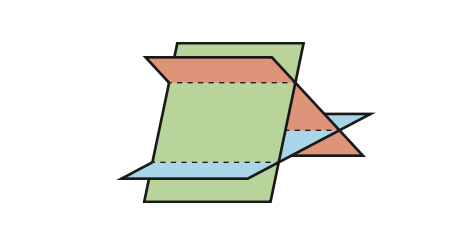
Don't assume $\det(A)=0$ always means "no solution" — that's only one of the two singular outcomes. Equally, don't assume a singular system is automatically consistent. The determinant only tells you that the planes fail to meet at a single point; you always have to go back to the equations to find out whether they meet along a line/plane (consistent) or not at all (inconsistent).
Working it out algebraically
Given a system with $\det(A)=0$: (1) eliminate one variable between two different pairs of the three equations, giving two new equations in the remaining two variables; (2) compare these two new equations — if one is a non-zero multiple of the other (or they're identical), they're consistent, so the original system has infinitely many solutions; if they contradict each other (same left-hand side, different right-hand side, or a false equation like $0=5$ appears), the original system is inconsistent, with no solutions.
$A=\begin{pmatrix}1&1&1\\2&-1&1\\1&2&-1\end{pmatrix}$. Expanding along the first row: $\det(A)=1((-1)(-1)-1(2))-1(2(-1)-1(1))+1(2(2)-(-1)(1))=1(-1)-1(-3)+1(5)=-1+3+5=7$.
Since $\det(A)\neq0$, the system has a unique solution — the three planes meet at exactly one point. Eliminate $z$ from (1) and (2): $(1)-(2)$ gives $-x+2y=3$ (4). Eliminate $z$ from (1) and (3): $(1)+(3)$ gives $2x+3y=8$ (5).
From (4), $x=2y-3$. Substituting into (5): $2(2y-3)+3y=8 \Rightarrow 7y=14 \Rightarrow y=2$, so $x=1$. From (1): $1+2+z=6 \Rightarrow z=3$.
The three planes meet at the single point $(1,2,3)$.
$A=\begin{pmatrix}1&1&3\\1&-1&-1\\3&1&5\end{pmatrix}$. Expanding along the first row: $\det(A)=1((-1)(5)-(-1)(1))-1(1(5)-(-1)(3))+3(1(1)-(-1)(3))=1(-4)-1(8)+3(4)=-4-8+12=0$.
Eliminate $z$ from (1) and (2): $(1)+3\times(2)$ gives $x+y+3z+3x-3y-3z=7-3 \Rightarrow 4x-2y=4 \Rightarrow 2x-y=2$ (4). Eliminate $z$ from (1) and (3): $5\times(1)-3\times(3)$ gives $5x+5y+15z-9x-3y-15z=35-39 \Rightarrow -4x+2y=-4 \Rightarrow 2x-y=2$ (5) — identical to (4). So the system is consistent, confirming the three planes form a sheaf, meeting along a common line.
To find that line, introduce the parameter $\lambda$ by setting $x=\lambda$. From (4): $y=2\lambda-2$. Substituting into (1): $\lambda+(2\lambda-2)+3z=7 \Rightarrow 3z=9-3\lambda \Rightarrow z=3-\lambda$.
So $x=\lambda$, $y=-2+2\lambda$, $z=3-\lambda$, which gives the vector equation of the line: $\mathbf{r}=\begin{pmatrix}0\\-2\\3\end{pmatrix}+\lambda\begin{pmatrix}1\\2\\-1\end{pmatrix}$.
Compare equation (2) with $2\times$(1): $2(x+2y-z)=2x+4y-2z$, and $2\times4=8$ — this matches (2) exactly. Compare equation (3) with $-3\times$(1): $-3(x+2y-z)=-3x-6y+3z$, and $-3\times4=-12$ — this matches (3) exactly.
Since (2) and (3) are both scalar multiples of (1), the rows of $A=\begin{pmatrix}1&2&-1\\2&4&-2\\-3&-6&3\end{pmatrix}$ are all proportional, so $\det(A)=0$.
All three equations describe the exact same plane, $x+2y-z=4$ — every point on it satisfies all three equations, so there are infinitely many solutions filling the whole plane.
Doubling equation (1): $2x+4y-2z=8$. But equation (2) states $2x+4y-2z=9$. Since $8\neq9$, this is a direct contradiction — equations (1) and (2) describe two parallel, distinct planes (proportional left-hand sides, non-proportional constants), so they never meet.
Because two of the three planes are already parallel and non-identical, no point can lie on all three, regardless of equation (3). Since the rows of $A$ corresponding to (1) and (2) are proportional, $\det(A)=0$, and the system is inconsistent: it has no solutions.
This has the same coefficient matrix $A=\begin{pmatrix}1&1&3\\1&-1&-1\\3&1&5\end{pmatrix}$ as Example 2, so $\det(A)=0$ again. But no row of $A$ is a scalar multiple of another, so no two of the three planes are parallel to each other.
Eliminate $z$ from (1) and (2) exactly as before: $2x-y=2$ (4). Eliminate $z$ from (1) and (3): $5\times(1)-3\times(3)$ gives $5x+5y+15z-9x-3y-15z=35-42 \Rightarrow -4x+2y=-7 \Rightarrow 2x-y=3.5$ (5).
Equations (4) and (5) have the same left-hand side but different right-hand sides ($2\neq3.5$), a direct contradiction — the system is inconsistent. Since no two planes are parallel, each pair still meets in its own line, and with $\det(A)=0$ those three lines must be parallel and distinct: the planes enclose a triangular prism.
Exam-style questions
Question 1 4 marks
Show that the system below is inconsistent.
Doubling equation (1): $2x+2y-2z=2$ (M1)
Equation (2) states $2x+2y-2z=5$. Since $2\neq5$, this is a contradiction (A1)
Equations (1) and (2) represent parallel, distinct planes, so no point can satisfy both — the system is inconsistent regardless of equation (3) (B1, B1)
Question 2 6 marks
The system below has $\det(A)=0$. Determine whether it is consistent, and if so, describe the geometric configuration of the three planes.
Eliminate $z$ from (1) and (2): $(1)-2\times(2)$ gives $x+y+2z-4x+2y-2z=8-10 \Rightarrow -3x+3y=-2$ (4) (M1, A1)
Eliminate $z$ from (1) and (3): $(1)+2\times(3)$ gives $x+y+2z+2x-4y-2z=8-6 \Rightarrow 3x-3y=2$ (5) (M1, A1)
Equation (5) is exactly $-1\times$ equation (4) rearranged ($3x-3y=2 \Leftrightarrow -3x+3y=-2$), so (4) and (5) are consistent (the same equation) (A1)
The system is consistent with infinitely many solutions — the three planes form a sheaf, meeting along a common line (A1)
Question 3 5 marks
Explain, without doing any further calculation, why a system of three linear equations in three unknowns can never have exactly two solutions.
Each equation represents a plane, which is flat (infinite and undivided) rather than curved (B1)
Two distinct planes either don't meet at all (parallel) or meet along an entire line, never at just one or two isolated points (B1)
A third plane can then meet that line at a single point, contain the whole line, or miss it — giving one solution, infinitely many, or none (B1)
There is no configuration of three flat planes that intersect in exactly two isolated points, since intersections of planes are always empty, a single point, a line, or a plane — never a pair of points (B1, B1)