Determinants
A single number computed from a matrix's entries reveals whether it can be undone, and by how much it stretches or shrinks area and volume.
The determinant of a 2×2 matrix
For $A=\begin{pmatrix}a&b\\c&d\end{pmatrix}$, the determinant is $\det(A)=|A|=ad-bc$. If $\det(A)\neq0$, $A$ is non-singular; if $\det(A)=0$, $A$ is singular.
$\det(A)=3(4)-1(2)=12-2=10$. Since $\det(A)\neq0$, $A$ is non-singular.
The determinant of a 3×3 matrix
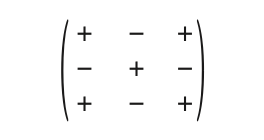
$$\det(A)=a_{11}\begin{vmatrix}a_{22}&a_{23}\\a_{32}&a_{33}\end{vmatrix}-a_{12}\begin{vmatrix}a_{21}&a_{23}\\a_{31}&a_{33}\end{vmatrix}+a_{13}\begin{vmatrix}a_{21}&a_{22}\\a_{31}&a_{32}\end{vmatrix}$$ Each $2\times2$ determinant is the minor formed by deleting the row and column of the entry it multiplies; signs alternate $+,-,+$ across the row.
$\det(A)=1\begin{vmatrix}1&4\\6&0\end{vmatrix}-2\begin{vmatrix}0&4\\5&0\end{vmatrix}+3\begin{vmatrix}0&1\\5&6\end{vmatrix}$
$=1(0-24)-2(0-20)+3(0-5)=-24+40-15=1$.
$\det(M)=2(4)-1(3)=8-3=5$.
Area scale factor $=|\det(M)|=5$. New area $=5\times5=25$.
Singular matrices
When $\det(A)=0$, the transformation represented by $A$ collapses the plane (or space, for $3\times3$) onto a line, a point, or a lower-dimensional subspace, losing information. This is why singular matrices have no inverse (covered in the next lesson) — two different starting points can map to the same image.
$\det(A)=k(k+1)-3(4)=k^2+k-12$.
Singular when $k^2+k-12=0 \Rightarrow (k+4)(k-3)=0 \Rightarrow k=-4$ or $k=3$.
When expanding a $3\times3$ determinant, forgetting to alternate the signs $+,-,+$ (i.e. treating every term as positive) is one of the most frequent errors — always write out the sign pattern explicitly before substituting numbers.
Exam-style questions
Question 1 4 marks
Find $\det(A)$ for $A=\begin{pmatrix}1&2&-1\\3&0&2\\4&-1&3\end{pmatrix}$.
$\det(A)=1\big(0(3)-2(-1)\big)-2\big(3(3)-2(4)\big)+(-1)\big(3(-1)-0(4)\big)$ (M1)
$=1(0+2)-2(9-8)+(-1)(-3-0)=2-2+3=3$ (M1, A1)
$\det(A)=3$ (A1)
Question 2 5 marks
Given that $M=\begin{pmatrix}2&k\\5&3\end{pmatrix}$ is singular, find $k$, and describe geometrically what happens to the unit square under this transformation.
$\det(M)=2(3)-k(5)=6-5k=0 \Rightarrow k=\dfrac65$ (M1, A1, A1)
The unit square is collapsed onto a line through the origin (zero area image), since the columns of $M$ become parallel. (B1, B1)
Question 3 5 marks
A triangle of area $8$ is transformed by $M=\begin{pmatrix}3&-2&1\\0&1&4\\2&0&-1\end{pmatrix}$ combined with a further 2D scaling — instead, find $\det(M)$ for this $3\times3$ matrix directly (used to scale volumes in 3D).
$\det(M)=3\begin{vmatrix}1&4\\0&-1\end{vmatrix}-(-2)\begin{vmatrix}0&4\\2&-1\end{vmatrix}+1\begin{vmatrix}0&1\\2&0\end{vmatrix}$ (M1)
$=3(-1-0)+2(0-8)+1(0-2)=-3-16-2=-21$ (M1, A1, A1, A1)